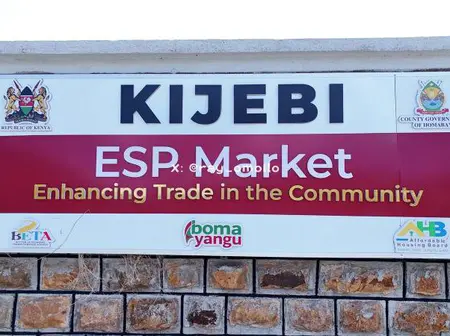
NewThe government has unveiled the Kijebi Modern Market in Suba South, Homa Bay County, featuring modern trading facilities, cold storage rooms and an ICT hub.The government has unveiled the Kijebi Modern Market in Suba South, Homa Bay County, featuring modern trading facilities, cold storage rooms and an ICT hub.
Category: Economy&Finance
-
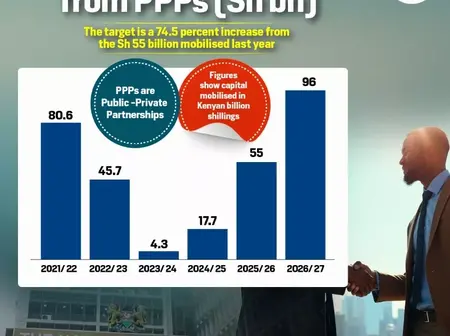
Private capital mobilised from PPPs (Sh bn)
Private capital mobilisation through Public-Private Partnerships stands at Sh55 billion for the 2025/26 financial year, setting the stage for a targeted increase. Authorities have established a target of a 74.5 percent surge to Sh96 billion for the upcoming 2026/27 period.
Treasury records outline a volatile trajectory of funds attracted through these cooperative arrangements over recent fiscal cycles.
A retrospective look at the figures indicates significant fluctuation in capital inflows over the years. During the 2021/22 fiscal cycle, mobilisation reached Sh80.6 billion before dropping to Sh45.7 billion in 2022/23. The downward trend deepened sharply in 2023/24, plunging to a low of Sh4.3 billion. Recovery began to take shape in the 2024/25 period as collections rose modestly to Sh17.7 billion, followed by a stronger rebound to Sh55 billion in the current 2025/26 cycle.
The projected jump to Sh96 billion for 2026/27 represents an ambitious push to accelerate infrastructure and public service delivery through private sector engagement. These allocations reflect ongoing efforts by the National Treasury to leverage alternative financing models to bridge developmental funding gaps. As stakeholders look toward the upcoming financial year, meeting the projected threshold will require consistent execution of partnership frameworks to sustain investor confidence and secure the targeted capital injection.
-

Nigerian Exchange Group Acquires 10% Stake in Nairobi Securities Exchange
The Nigerian Exchange Group Plc (NGX Group) has acquired a 10 per cent stake in the Nairobi Securities Exchange (NSE) in a strategic investment aimed at strengthening financial ties between West and East Africa.In a statement on Monday, November 16, NGX Group said the acquisition would expand its presence in East Africa while providing greater exposure to one of the region’s established capital markets.
-

KFS Responds to Illegal Logging Allegations in Kericho
ResponseThe Kenya Forest Service (KFS) has responded to allegations of illegal forest activities in several forest stations in Kericho County.The Kenya Forest Service (KFS) has responded to allegations of illegal forest activities in several forest stations in Kericho County.In a statement on Monday, November 16, the Service said it had noted allegations circulating on social media regarding purported illegal activities in several forest stations across the county.
-
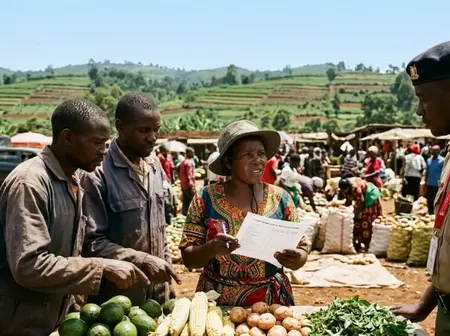
Kenya must rethink agricultural taxation to remain competitive
We cannot become an agricultural export powerhouse by making production expensive. It is time to rethink taxation, investment incentives and the cost of doing business.
Kenya has an opportunity to strengthen its agricultural sector, create jobs, attract foreign investment and grow exports. However, achieving these ambitions requires a business environment that makes farming, processing and exporting more competitive.
We want farmers to produce more, exporters to access international markets and investors to put money into agribusiness. Yet, along the value chain, taxes, levies, permits, handling charges and administrative costs can increase the cost of doing business and make our products less competitive.
It is therefore worth reconsidering our approach. Agriculture should be treated as a strategic economic sector that deserves meaningful tax incentives and an enabling business environment.
Consider neighbouring Tanzania. Its agricultural development offers lessons that Kenya could examine. According to Tanzania's 2024 Economic Survey, food crop production reached approximately 22.8 million tonnes, an 11.8 per cent increase from 2023. Its food self-sufficiency ratio stood at 128 per cent.
Tanzania has also positioned itself to attract agricultural investment through targeted incentives. Qualifying agricultural investors can benefit from capital expenditure allowances, preferential treatment for eligible agricultural inputs and investment facilitation, including access to suitable land through designated arrangements.
This approach recognises that agriculture is not simply about growing food. It is also about attracting capital, creating employment, developing rural economies and earning foreign exchange.
Kenya has made provisions for tax relief in agriculture, but there is room to examine how effectively these measures translate into lower operating costs for businesses.
Take VAT, for example. Agricultural exporters may benefit from zero-rating on exports and recover eligible input VAT. However, businesses must first purchase inputs, pay VAT, maintain compliance records, submit claims and wait for refunds.
This process can tie up funds that businesses would otherwise use to purchase produce from farmers, buy packaging materials, pay workers or finance subsequent shipments.
For an agricultural business operating on tight margins, cash flow is critical. It can determine whether a business expands production or struggles to finance its next order.
There is a case for reviewing whether qualifying agricultural inputs could be made tax-free at the point of purchase, rather than requiring businesses to pay VAT and seek refunds later.
There is a fundamental difference between declaring agriculture tax-exempt and making production genuinely tax-free. Refunds are not the same as exemptions. They involve paperwork, compliance costs, delays and working capital requirements. Reducing these burdens would help businesses direct more resources towards production and expansion.
The same principle could apply to agricultural levies and export-related charges. Kenya should review government-imposed fees associated with production, inspection, certification, packaging, storage and export clearance. Charges that do not provide a necessary and measurable service could be reconsidered, while those covering essential services should be rationalised to ensure that their costs remain reasonable.
The cost of exporting is another area that deserves attention if Kenya is to maintain its competitive position.
Consider the following indicative comparisons between the Kenyan and Tanzanian airport export corridors:
Airport terminal handling in Kenya is approximately $0.12–$0.18 per kilogram, compared with Tanzania's $0.03–$0.075.
Cold storage overstay in Kenya is approximately $0.10–$0.20 per kilogram per day, compared with Tanzania's $0.05 and above.
Government inspection and permits in Kenya are approximately $0.004–$0.005 per kilogram, compared with Tanzania's indicative flat consignment charges of $15–$50.
These figures are indicative and require verification against current airport tariffs, commodity categories and service providers. Nevertheless, they point to cost differences that warrant further investigation.
A few cents per kilogram may appear insignificant. However, when multiplied across hundreds of tonnes of vegetables, fruits or flowers, the difference becomes substantial.
International buyers consider price, quality and reliability when selecting suppliers. Kenya must therefore ensure that its regulatory and operational costs do not undermine the competitiveness of its agricultural exports.
There is another important consideration. Kenya and Tanzania share broadly similar tropical climates, agricultural conditions and access to many of the same regional and international markets. They grow similar crops and enjoy comparable agricultural opportunities.
Kenyan products are not inherently inferior to Tanzania's. Nor does Tanzania enjoy an exclusive tropical advantage that Kenya cannot replicate.
The difference increasingly lies in how the two countries manage investment, taxation, production costs and export logistics. When two countries produce comparable-quality products but one makes it cheaper to grow, package, store and export, the commercial advantage becomes evident.
Kenya has agricultural expertise, established export markets, experienced farmers, private-sector capacity and infrastructure to compete. Maintaining these advantages will require continued attention to taxation, investment facilitation and the overall cost of doing business.
There is also a wider economic opportunity that Kenya should consider. Agriculture is not merely about feeding the country. It is an important source of foreign exchange.
When exporters receive dollars, euros or pounds from international buyers, the money supports foreign currency inflows. It also creates demand for local labour, stimulates transport, packaging, processing and financial services, and generates income for thousands of farmers.
Kenya should therefore consider establishing an Agricultural Production and Export Investment Incentive Programme.
Investors willing to establish commercial farms, aggregation centres, packhouses, cold-storage facilities, processing plants and export infrastructure could receive preferential access to suitable government land through transparent, long-term lease arrangements.
The country could also consider a programme targeting foreign agricultural investors, under which qualifying export proceeds are channelled through the Kenyan banking system. This would improve foreign currency inflows, strengthen foreign exchange liquidity and support the country's reserves, while respecting legitimate profit repatriation rights and foreign exchange regulations.
Several practical interventions could help advance this agenda.
First, qualifying agricultural inputs should be considered for tax exemption at source. These could include seeds, fertilisers, irrigation equipment, crop protection products, packaging materials and cold-chain equipment. This would reduce the burden of upfront VAT financing.
Second, national and county governments should review agricultural levies imposed on production, movement, aggregation and exports. The review should identify duplication and charges that do not provide measurable services, with a view to eliminating or rationalising them.
Third, Kenya could introduce meaningful export incentives, including rebates, investment allowances and time-bound tax incentives for businesses that demonstrate increased export volumes, local sourcing, employment creation and foreign exchange earnings.
Fourth, the government and relevant service providers should explore ways of reducing airport and cargo costs. Competitive handling, inspection, storage and cold-chain tariffs would help agricultural exporters. Jomo Kenyatta International Airport should be positioned as an export advantage rather than an additional cost centre.
Fifth, suitable government land could be made available to commercial agribusiness investors through long-term leases. Such arrangements should target investors willing to commit capital, create jobs, develop irrigation and supply local and international markets.
Sixth, where VAT exemptions are not possible, the government should consider predictable refund timelines and automated processes. This would reduce the time businesses spend financing government operations while awaiting refunds.
Finally, incentives should support both local consumption and exports. Businesses investing in local food production, processing, storage and distribution also contribute to food security, employment and reduced dependence on imports.
These incentives should be tied to measurable performance. They should also include safeguards against land speculation, tax abuse and investors who acquire concessions without delivering production.
The argument is not that the government should abandon taxation. Rather, the economic returns from enabling agricultural businesses to produce and export more could be substantially greater than the revenue collected from taxing their inputs and operations.
Kenya has the potential to strengthen its position as a leading agricultural producer and exporter. Realising this potential will require policies that make investment, production and access to international markets more attractive.
The government and its relevant agencies have an important role to play. The Ministry of Agriculture, the National Treasury, the Kenya Revenue Authority, the Kenya Investment Authority, county governments and export facilitation agencies should examine these issues collectively.
Agricultural competitiveness cannot be achieved by the Ministry of Agriculture alone. It requires coordinated economic policy and collaboration between government and the private sector.
As Kenya seeks to attract more investment and expand its export markets, the cost of doing business must remain a central consideration. A competitive agricultural sector will require more than favourable climate conditions and productive farmers. It will also depend on a policy environment that allows businesses to grow, invest and compete effectively.
We cannot tax our way into becoming an agricultural export powerhouse. We must first make it worthwhile to produce.
Mulumi Mwangi is an entrepreneur, marketing consultant and business strategist.
-

Nigerian Firm Acquires 10% Stake in Nairobi Securities Exchange
AcquisitionNigerian Exchange Group Plc (NGX Group) has acquired a 10 per cent equity stake in the Nairobi Securities Exchange (NSE) in a strategic investment aimed at expanding its presence in Africa.Nigerian Exchange Group Plc (NGX Group) has acquired a 10 per cent equity stake in the Nairobi Securities Exchange (NSE) in a strategic investment aimed at expanding its presence in Africa.
-
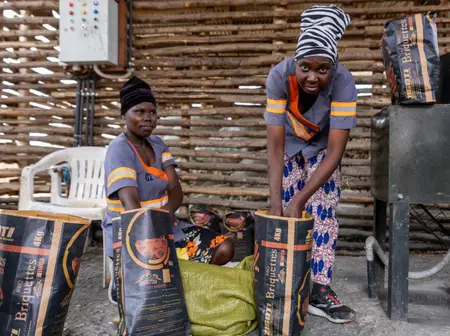
How women at Zigoti Coffee Works are turning coffee farming, agricultural waste and savings into sustainable livelihoods
When Cissy Nafula moved from Busia to Zigoti in Mityana District, her priority was to find a reliable source of income to support her two children. She initially hoped to start her own business but found an unexpected opportunity in coffee production at Zigoti Coffee Works Limited.The 26-year-old joined the women-led coffee enterprise earlier this year and says the job has given her a dependable income and a chance to plan for her family’s future.
-

Inside Posta Kenya’s New Ksh126M Business Targeting Hospitals and Medical Supplies
Delivering vaccines, insulin and blood to healthcare facilities could soon become a major source of income for the Postal Corporation of Kenya (Posta), which is moving into specialised medical transportation with an investment of Ksh 96.8 million.The state-owned corporation is expanding its logistics operations to include the distribution of medical products that require controlled temperatures during transportation.
-

Ruto Calls for Global Financial Reforms to Boost Africa’s Agricultural Production
President William Ruto has called for reforms to the international financial system to enable African countries to access affordable, long-term financing and unlock their agricultural potential.Ruto said Africa could become a major global food producer but continued to face challenges such as inadequate irrigation, expensive credit, poor storage facilities, limited processing capacity and fragmented markets.
-

Posta eyes Sh126m revenue from new healthcare logistics business
The Postal Corporation of Kenya is targeting Sh126 million in revenue from a new healthcare logistics business as it seeks to diversify its income streams beyond traditional mail and parcel delivery.
The state-owned corporation has invested Sh96.8 million in 11 specialised vehicles, including six refrigerated trucks designed to transport vaccines, insulin, blood and other temperature-sensitive medical supplies.
The fleet, launched on November 2 under the Post4Health Cold Chain Logistics initiative, is expected to serve healthcare facilities in Nairobi, Nakuru, Nandi, Kericho, Bomet, Baringo and Elgeyo Marakwet counties, as well as Eldoret.
The investment includes Sh22 million from the Universal Postal Union (UPU) and Sh42.93 million from Kenya's Universal Service Fund, with Posta seeking to tap into demand for specialised medical supply distribution.
The new business marks an expansion of the corporation's logistics operations at a time when digital communication continues to erode demand for traditional letter delivery and private courier companies increase competition in the parcel market.
Information, Communications and the Digital Economy Cabinet Secretary William Kabogo said the initiative would help address gaps in healthcare logistics, particularly in the distribution of medical products requiring controlled temperatures.
“The logistics expansion forms part of a wider turnaround strategy aimed at modernising postal operations, developing new revenue streams and optimising the corporation's assets,” said Posta Postmaster General and Chief Executive Officer John Tonui.
The corporation is banking on its nationwide network of more than 500 outlets to strengthen its position in last-mile delivery and distribution services.
It is also expanding digital services through MPost, which allows customers to use their mobile phone numbers as virtual postal addresses, and PostaPay, a digital wallet targeting farmers, small businesses and other underserved customers.
“Government was committed to repositioning Posta as a key player in the digital economy, the Post4Health proved public institutions could innovate and deliver,” said principal secretary for Broadcasting and Telecommunications Stephen Isaboke.
Posta's latest financial and operational figures point to a growing contribution from parcel services. Domestic and international parcel volumes rose to 1.48 million in the 2024/2025 financial year from 137,764 in the previous reporting period, while domestic letters increased 19.5 percent to 174,057.
The healthcare logistics unit will, however, need to secure sustained demand from county governments and healthcare institutions to achieve its projected revenue target and establish itself as a commercially viable business.
The expansion reflects Posta's efforts to reposition itself from a traditional mail delivery operator into a broader logistics and digital services provider.