
NCBA Group Plc Shares resumed trading at the Nairobi Securities Exchange(NSE) Tuesday 3rd November 2026 after being suspended on Wednesday 21st October, as some investors who held NCBA shares began receiving payments for part of the shares they sold to Nedbank Group.Cash payments and issuance of Nedbank shares to accepting shareholders commence alongside the transaction.
Category: Economy&Finance
-

NCBA transfers 66pc stake to Nedbank Group
NCBA Group on Tuesday transferred 1.087 billion shares to Nedbank Group, making the South African multinational its controlling shareholder with a 66 percent stake.
The NCBA shares were moved through a block trade on the Nairobi Securities Exchange (NSE), a move that lifted the day’s equity turnover to Sh107.7 billion.
-

CMA seeks to reduce Reits entry price to Sh100,000
The Capital Markets Authority is proposing to reduce the minimum subscription to a real estate investments trust (Reit) from Sh5 million per investor to Sh100,000 in a bid to spur interest in the investments vehicle.
The Authority had set the minimum investment at Sh5 million in 2013 when Reits were introduced to the market in an effort to ensure only sophisticated investors who understood the risks associated with the vehicles took part.
-

Treasury projects Ksh5.4 trillion national budget for 2027/2028 financial year
National Treasury Cabinet Secretary John Mbadi has projected a Ksh5.4 trillion budget for the 2027/2028 financial year, representing an increase from the current Ksh4.8 trillion budget.
Speaking during the NCBA Bank 2026 Kenya’s Outlook in Nairobi on Tuesday, November 3, 2026, Mbadi said the proposed budget would be supported by revenue projections of slightly below Ksh4 trillion.
“For the financial year 2027/2028, we are planning a budget of about Ksh5.4 trillion, with revenue projected at just under Ksh4 trillion,” Mbadi said.
The Treasury CS projected a fiscal deficit of 5.9 per cent of the Gross Domestic Product (GDP), noting that his team was working towards reducing the figure further while making provisions for pending bills and priority government programmes.
“The fiscal deficit is projected at 5.9 per cent of GDP, but I am still working with my team even further down below 5.9 per cent as we provide for pending bills and priority programmes before declining steadily to 4.6 per cent by the financial year 2029/2030,” he stated.
Mbadi said the government had identified five key areas it would focus on to safeguard the country’s economic gains and strengthen public finances.
The first priority involves broadening the tax base without increasing existing tax rates.
According to Mbadi, the Treasury intends to rely on data, technology, improved compliance and administrative reforms to enhance revenue collection.
“One, broadening the tax base but not raising tax rates. Through data, technology and better compliance, administrative reforms, some of which will start taking effect from January next year,” he explained.
The second priority involves improving public expenditure by ensuring the government spends within its means.
Mbadi said the Treasury would embrace zero-based budgeting as part of efforts to improve resource allocation and ensure government spending is directed towards priority programmes.
The National Treasury has set November 16, 2026, as the deadline for submitting Kenya’s 2027 Budget Policy Statement to Parliament, bringing forward the budget process ahead of the August 2027 General Election.
Treasury Cabinet Secretary John Mbadi said in a notice on Tuesday, November 3, 2026, that the revised calendar was intended to accommodate the upcoming elections and allow the government to prepare the 2027/28 financial year budget earlier.
“In view of the revised budget calendar to accommodate the General Elections scheduled for August 2027, the 2027 BPS will be submitted to Parliament by 16th November 2026,” Mbadi said in a public notice.
-

Secret trust beneficiaries risk losing access to dividends
Secret beneficiaries of trusts risk losing access to dividends and proceeds from the sale of assets if they fail to disclose their identity under proposed rules seeking to curb money laundering.
The draft Trust Administration Regulations 2026, allow trustees to suspend a person's right to receive distributions from a trust or restrict the payment or transfer of benefits attributable to their interest where they fail to comply with beneficial ownership disclosure requirements.
-

David Ndii: Kericho has overtaken Kiambu in coffee production
Economist David Ndii has praised the strides being made in Kenya’s coffee sector, highlighting Kericho County’s rise to become the country’s leading coffee producer after overtaking Kiambu.
Ndii, while speaking during the launch of the NCBA 2026 economic outlook on Tuesday, October 3, 2026, acknowledged the changing dynamics in the coffee industry, pointing to the latest production figures showing Kericho taking the top position among coffee-producing counties.
“Kericho has overtaken Kiambu as the highest producer of coffee,” David Ndii stated.
According to the figures shared on the County Government of Kericho’s website, Kericho produced approximately 6.01 million kilograms of clean coffee, valued at about Ksh5.29 billion.
Murang’a followed with approximately 4.96 million kilograms, while Nyeri ranked third with about 4.63 million kilograms.
Kiambu, which has traditionally been among Kenya’s leading coffee-producing counties, ranked fifth with approximately 4.18 million kilograms, behind Kirinyaga, which occupied fourth position.
The figures place Kericho ahead of several established coffee-growing counties, marking a significant shift in the country’s coffee production landscape.
Ndii further expressed optimism about the sector’s future, projecting that coffee could eventually surpass tea in export earnings if the current momentum is sustained.
Tea has maintained a leading position among Kenya’s major agricultural exports for decades, contributing significantly to foreign exchange earnings and supporting millions of livelihoods across the country.
However, renewed attention to coffee production, improved returns to farmers and increased investment in the value chain could strengthen the crop’s contribution to the economy.
Kericho’s emergence at the top of the production rankings also highlights the county’s growing significance in Kenya’s agricultural economy.
The development comes amid renewed efforts to revitalise the coffee industry, improve farmers’ earnings and strengthen Kenya’s position in the international coffee market.
Further details contained in the county government’s coffee production data show that Kericho produced 6,000,516 kilograms of clean coffee, valued at approximately Ksh5.29 billion, equivalent to USD41 million.
Murang’a followed with 4,959,789 kilogrammes valued at Ksh4.33 billion, while Nyeri recorded 4,627,312 kilogrammes worth approximately Ksh4.18 billion. Kirinyaga came fourth with 4,606,788 kilogrammes valued at Ksh4.31 billion, while Kiambu completed the top five with 4,175,636 kilogrammes worth Ksh3.46 billion.
The comparison figures in the county’s document also highlight changes in production among the leading coffee-growing counties. Kericho’s clean coffee output increased from 3,027,701 kilograms in the comparison column to 6,000,516 kilograms, while Nyeri’s production figures moved from 5,461,591 to 4,627,312 kilograms. Kirinyaga also recorded a decline from 6,787,583 to 4,606,788 kilograms.
Other counties featuring prominently in the rankings include Nandi, which produced 2,222,087 kilograms, and Bungoma, which recorded 1,838,273 kilograms, placing them sixth and seventh, respectively. The figures underline the growing contribution of counties outside the traditional Central Kenya coffee belt to Kenya’s coffee production.
-

Retirement big test: How to keep pension from running dry
For thousands of Kenyans, retirement is becoming a financial race against time, with pension savings expected to cover decades of living costs after the monthly salary disappears.
The danger is not only retiring with too little money, but exhausting what has been saved before death, as food, rent, healthcare and family demands continue long after employment.
-

Kenya Partners With Idris Elba to Boost Creative Economy and Youth Talent
Foreign Affairs Principal Secretary Korir Sing’Oei on Tuesday, November 3, shared details of a government partnership with British actor Sir Idris Elba.In a statement, he said the partnership was formalised through the signing of a Statement of Intent on the sidelines of the 2026 Commonwealth Heads of Government Meeting (CHOGM) in Antigua and Barbuda.
-
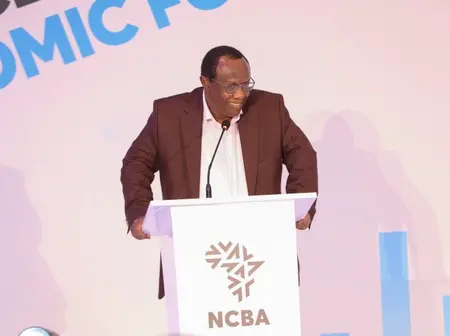
David Ndii says affordable housing projects are fuelling increased milk consumption in Kenya
Chief Economic Adviser David Ndii has dismissed concerns about a milk shortage in Kenya, arguing that increased consumption is contributing to stockouts in supermarkets despite rising production.
Ndii said the country was producing more milk than it did when the current administration took office, but changing consumption patterns were putting pressure on supplies available on supermarket shelves.
Speaking during the 2026 NCBA Economic Forum in Nairobi on Tuesday, November 3, 2026, Ndii pointed to the growing number of workers at affordable housing construction sites as an example of how demand for milk was increasing.
He explained that contractors at the sites provide workers with milk alongside other supplies, creating a growing market that consumers and analysts might not immediately associate with the country’s overall milk consumption.
“Then the question becomes who’s consuming this milk? Certainly probably not the people in this room who haven’t increased their consumption a lot. But it means that there are people who aren’t consuming a lot of milk, who are now consuming a lot of milk,” Ndii said.
“And I can tell you where you can find them. If you go to any of our construction sites where we are doing affordable housing, where there are a couple of hundred thousand people working every day or in the construction site, you will find crates of milk sitting there.”
Ndii added that providing milk to construction workers had become part of the supplies offered to employees at some of the sites.
“Because that’s one of the things that construction workers provide to the workers on site as well as other things,” he said.
To support his argument, Ndii cited data from the Kenya National Bureau of Statistics (KNBS), saying annual milk production had increased by 20 per cent since the current administration took office.
He put the country’s production at approximately 5.6 billion litres, arguing that the additional output alone was greater than the annual milk production of 90 per cent of African countries.
“The increase is actually more milk than 90 per cent of the countries in Africa produce, just the increase. It’s more milk than most of the countries in Africa actually produce, more dairy milk,” he stated.
The economist also highlighted growth in milk processing, saying the volume of milk received by processors had increased by 34 per cent.
According to Ndii, processors were receiving approximately 500 million litres annually in 2022 before the figure reached one billion litres last year.
He noted that intake during the first eight months of 2026 had remained close to the corresponding period in 2025, despite concerns about the effects of drought on supply.
Ndii argued that the combination of increased production and processor intake pointed to stronger demand as an explanation for the stockouts.
“So if there is no reduction in supply and there’s actually a very sharp increase in both production and the intake by processors, what can explain the stockouts on the shelf? What explains the stockouts on the shelves? The only thing left to explain that stockout on the shelves is demand,” he said.
Beyond supermarket supplies, Ndii highlighted the financial importance of the dairy sector, estimating that Kenya’s annual milk production was worth nearly Ksh400 billion at current farm-gate prices.
He also pointed to the rising value of quality dairy cattle, saying good dairy heifers were selling for approximately Ksh300,000 to Ksh350,000.
The economist said the high prices reflected growing demand for productive dairy animals, adding that Kenya was importing cattle from countries including South Africa and the Netherlands while also exporting dairy animals to other African markets.
He further argued that some of the economic activity taking place in the dairy sector was not adequately reflected in official economic statistics.
Ndii said rapid structural changes in the economy could leave statistical sampling methods outdated, making it difficult for official figures to capture emerging activities.
He said he had discussed the issue with KNBS, arguing that the bureau could be relying on information from established parts of the economy while missing developments taking place in newer or rapidly expanding sectors.
-

KTDA Appoints James Githinji Mwangi as New KTA Holdings Board Chairman
The Kenya Tea Development Agency (KTDA) has appointed James Githinji Mwangi as the new Chairman of the Board of KTA Holdings.In a statement on Tuesday, November 3, KTDA confirmed that Mwangi had been selected to take over the leadership, replacing the outgoing chairman Enos Njeru.