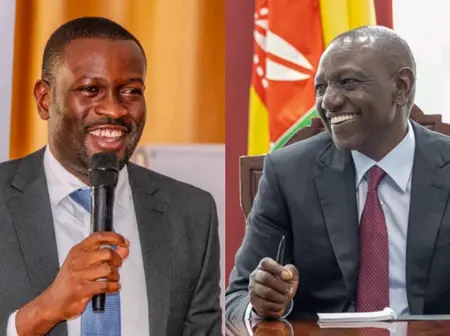
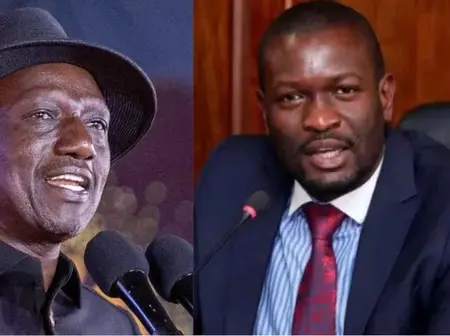
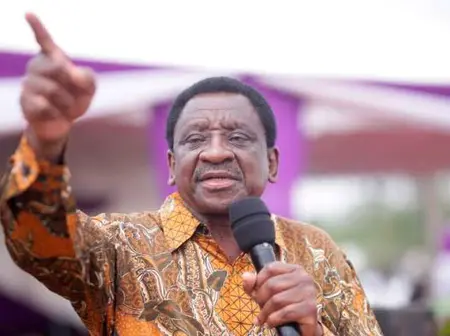
The survey, released on Thursday, November 12, 2026, by Trends and Insights for Africa (TIFA), places President William Ruto and Nairobi Senator Edwin Sifuna at 31 per cent each. The figures indicate that neither politician has managed to establish an advantage over the other despite their different political positions.
The results come at a time when political activities are gaining momentum ahead of the August 2027 General Election. Ruto is seeking to retain his position, while Sifuna's growing national profile has introduced another dimension to the competition, particularly within opposition politics.
Sifuna has attracted considerable attention through his association with the Linda Mwananchi movement, which has been advocating for a grassroots-driven political approach. His latest performance marks a notable improvement compared to earlier TIFA surveys, where he received 10 per cent support in May before rising to 15 per cent in June.
Ruto, on the other hand, had maintained support of approximately 24 per cent in the May and June surveys. The latest results therefore suggest changing voter preferences, with the President facing a stronger challenge from a politician whose national popularity has continued to grow.
However, the reported figures do not provide a clear indication of who would eventually occupy State House. Kenya's presidential election requirements demand that the winner secure more than half of the valid votes cast and at least 25 per cent of the votes in 24 counties.
With neither politician close to meeting that threshold in the reported survey, political partnerships, regional influence and undecided voters could significantly shape the outcome of the 2027 contest. The poll also highlights how unpredictable the presidential race could become as election day approaches.
In a judgment delivered on Wednesday, November 11, 2026, Justice Roselyne Aburili ruled that the restrictions imposed on refugees seeking work permits amounted to indirect discrimination and violated their right to equal treatment and human dignity.
The court directed the government to review its policies and procedures governing refugee work permit applications within 360 days. It also ordered the Director of Immigration Services to determine all pending applications within 180 days and provide written explanations whenever an application is rejected.
The decision followed a petition filed by Kituo Cha Sheria and other petitioners, who challenged the administrative barriers preventing refugees from accessing employment opportunities in Kenya's formal labour market.
The petitioners argued that although Kenyan law recognises the right of refugees to work, the procedures used by immigration authorities had made it difficult for them to enjoy that right in practice.
Justice Aburili found that immigration authorities had applied an unpublished policy that effectively excluded refugees from consideration for work permits. She ruled that the practice violated constitutional provisions guaranteeing equality before the law and protection against discrimination.
The judge also found that the lack of clear procedures for handling applications, unreasonable delays and failure to provide written reasons for decisions amounted to violations of the right to fair administrative action under Article 47 of the Constitution.
In explaining the importance of the ruling, the judge observed that refugees should not be viewed simply as people seeking assistance, but as individuals who have been forced to leave their homes, livelihoods and communities because of circumstances beyond their control.
She emphasised that Kenya has a constitutional, legal and moral responsibility to protect refugees, citing the Constitution, the Refugees Act of 2021 and international conventions to which the country is a signatory.
The ruling comes against the background of longstanding concerns over the challenges refugees face when seeking formal employment. Although the Refugees Act provides recognised refugees with the right to engage in gainful employment, run businesses or practise professions for which they hold recognised qualifications, administrative requirements have often complicated access to these opportunities.
One of the major obstacles has been the Class M work permit application process, which requires refugees to navigate procedures involving immigration authorities and the Department of Refugee Services.
The court's decision is therefore expected to improve transparency and accountability in the processing of applications. Immigration authorities will be required to publish clear guidelines and ensure that applicants receive timely decisions.
The judge also retained supervisory jurisdiction over the matter to monitor the implementation of the orders and ensure that the government complies with the directives.
Beyond employment, the ruling could have wider economic implications by supporting refugees who want to use their skills, earn a living and contribute to the communities hosting them.
However, the ruling does not automatically grant every refugee a work permit. Instead, it requires the government to establish fair, transparent and accessible procedures through which eligible applicants can have their applications considered without discrimination.
Stephanie Jepchumba Ruto is the daughter of President William Ruto, but unlike her famous sister, she has chosen to stay out of the spotlight.
Most Kenyans know Charlene, who is regularly seen at youth events, in front of cameras and delivering speeches. Stephanie has taken a very different path, and by all accounts she has refused attention at every turn.
She finished her Law course at Strathmore University in 2019. With her family name, she could have gone into politics, big business or simply become famous for nothing.
According to the account circulating online, she did not want that life. She went quiet and began working with children, the kind of work that happens behind the scenes and is rarely posted about.
You will not find her chasing microphones. Those who follow her story say that if she is seen somewhere, there is a good chance she had to be there. When she does show up, it is not for politics.
In February she visited St. Mary's Children's Home in Mbiuni, Machakos. She did not arrive with a big speech or a crowd around her. She simply came to support the children and left.
That may be why so many Kenyans noticed her at Charlene's wedding in Mwanza, Tanzania. She did nothing special there. It is just that she is rarely seen in public, so her presence stood out among the many guests who attended the ceremony.
Her story offers a quiet contrast in a country where politics and publicity often go hand in hand.
For a member of the First Family, choosing a low profile and focusing on children is unusual, and it has earned admiration from many who say that service does not need an audience.
A survey released on Thursday, November 12, by Trends and Insights for Africa (TIFA) indicates that both Ruto and Sifuna command 31 per cent support among respondents nationwide. The results mean the Head of State has failed to establish a lead over the Nairobi senator, who has increasingly become a prominent figure in opposition politics.
The latest findings also point to a significant change in voter preferences compared to previous surveys conducted earlier in 2026. In May and June, TIFA placed Ruto at 24 per cent, maintaining his position ahead of other potential presidential contenders.
Meanwhile, Sifuna's popularity has been growing steadily. The senator recorded 10 per cent support in May before rising to 15 per cent in June, eventually matching the President at 31 per cent in the latest survey.
Sifuna has gained national political attention through his association with the Linda Mwananchi faction, which has been pushing a grassroots political agenda. His growing support could influence opposition strategies, particularly as different political leaders consider possible alliances ahead of the 2027 elections.
However, neither candidate has reached the constitutional requirements for winning the presidency based on the reported poll figures. Kenya's electoral laws require a presidential candidate to secure more than 50 per cent of valid votes cast and at least 25 per cent of the votes in 24 or more counties.
With the elections approaching, political alliances, regional support and undecided voters could prove decisive in determining who eventually succeeds in capturing State House in 2027.
Former Deputy President Rigathi Gachagua has emerged as the political figure most blamed for divisions within Kenya’s opposition, according to a new survey by Trends and Insights for Africa (TIFA).
The poll, released on Thursday, November 12, 2026, shows that 43 per cent of opposition supporters believe Gachagua is responsible for the disagreements and divisions affecting the political bloc.
The findings place Gachagua ahead of other political figures whose actions and political positions have been linked to the divisions within the opposition.
President William Ruto and his United Democratic Alliance (UDA) government came second, with 15 per cent of respondents blaming them for the disagreements.
The results highlight growing concerns about unity among opposition leaders as they prepare for the 2027 General Election. Despite their shared interest in challenging the Kenya Kwanza administration, disagreements among key political figures continue to raise questions about their ability to work together.
The survey also places Gachagua at the centre of the debate surrounding the opposition's internal disagreements, suggesting that a significant number of supporters believe his political role has contributed to the challenges facing the bloc.
The findings come at a time when opposition leaders are expected to strengthen their cooperation and develop a common political strategy ahead of the next general election.
With several politicians seeking influence within the opposition, maintaining unity remains an important challenge. Political differences, competing interests and disagreements over leadership could affect efforts to establish a strong political alliance capable of challenging the ruling coalition.
The TIFA findings therefore raise important questions about the future of opposition cooperation and the ability of its leaders to resolve their differences.
As the 2027 elections approach, opposition leaders face growing pressure to address internal divisions and build a united front.
The authority is encouraging taxpayers facing disputed tax assessments and other disagreements to consider Alternative Dispute Resolution (ADR), a process that allows both sides to negotiate and seek an acceptable solution through dialogue.
In a communication shared on Thursday, November 12, KRA explained that the mechanism provides an opportunity for taxpayers to present their grievances and discuss disputed matters with the authority before committing to potentially expensive and time-consuming litigation.
The taxman described ADR as a faster, more affordable and confidential approach that encourages cooperation between the authority and taxpayers.
“Not every tax dispute needs a courtroom. Through Alternative Dispute Resolution (ADR), KRA and taxpayers can resolve eligible tax disputes through dialogue in a faster, more cost-effective and confidential process,” the authority stated.
KRA added that the process encourages collaboration and allows both parties to work towards mutually acceptable solutions without prolonged legal battles.
Taxpayers interested in using ADR are required to complete an application form and attach documents supporting their case.
According to KRA, applications can be submitted to the Tax Dispute Resolution Office at Ushuru Pension Towers, Block B, 7th Floor, in Upper Hill, Nairobi.
Alternatively, applicants can send scanned copies of the completed forms together with the relevant supporting documents through ADR@KRA.GO.KE.
The application must contain the taxpayer's personal or business details, information about the disputed tax matter, its current status and evidence relating to the disagreement.
Once an application is considered, the discussions involve three main parties: the taxpayer, the Commissioner or an appointed representative, and an independent facilitator who guides the negotiations.
The facilitator does not make a decision or force either side to accept particular terms. Instead, the role is to help both parties identify areas of agreement and work towards a settlement.
What happens after an application is submitted?
KRA expects participants to provide relevant information honestly, attend scheduled meetings and observe agreed timelines throughout the process.
Confidentiality is also an important part of the arrangement, allowing the taxpayer and the authority to discuss the disputed issues in a structured environment.
If an agreement is reached, the terms are recorded in a formal ADR agreement outlining what both parties have accepted.
However, participation is voluntary. Neither KRA nor the taxpayer can be compelled to enter the process or accept a settlement.
The authority also cautioned that any agreement reached must comply with the Constitution and existing tax laws.
Although ADR covers various tax disagreements, not every dispute can be resolved through the mechanism.
KRA's guidelines exclude cases where a proposed settlement would violate the Constitution, tax legislation or other applicable laws.
The process may also be unsuitable where a matter requires an authoritative interpretation of the law or where a court ruling would serve the wider public interest.
Disputes already covered by an undisputed court judgment or ruling are also excluded. Additionally, the process cannot proceed if either party is unwilling to participate.
Under Section 55 of the Tax Procedures Act, ADR proceedings are generally expected to be completed within 120 days. Where a court refers a matter for ADR, the applicable period depends on the directions issued by the court.
KRA's latest communication builds on a dispute resolution framework that the authority adopted for tax and customs matters in 2015.
The mechanism is supported by Article 159(2)(c) of the Constitution, which recognises alternative methods of resolving disputes, including mediation, reconciliation and arbitration.
It is also provided for under Section 55 of the Tax Procedures Act, 2015, and Section 28 of the Tax Appeals Tribunal Act, 2013.
ADR complements the existing tax dispute process, where a taxpayer can first object to a decision made by the Commissioner before taking the matter to the Tax Appeals Tribunal or the courts.
KRA has previously explained that the arrangement helps reduce litigation expenses, ease the backlog of unresolved disputes and maintain working relationships between taxpayers and the authority.
The authority has also indicated that the ADR process itself is free of charge, although taxpayers who hire lawyers or other professional advisers may incur additional expenses.
For Kenyans who disagree with tax assessments or other decisions made by the taxman, the option provides another route to pursue a settlement without immediately resorting to court action, provided the dispute qualifies and both parties are willing to participate.
The findings also show a rise in support for the Linda Mwananchi faction, which has reportedly reached 17 per cent, moving ahead of the Orange Democratic Movement (ODM), which stands at 10 per cent.
The survey indicates a shift in the political landscape, particularly within the opposition, where Linda Mwananchi has gained ground as ODM’s support has declined.
According to the findings, ODM’s support dropped from 20 per cent recorded in TIFA’s June 2026 survey to 10 per cent in the latest findings.
The poll also places the Democracy for the Citizens Party (DCP) at nine per cent, down from 16 per cent in May, while Jubilee has dropped to four per cent.
Despite the changes, a significant number of Kenyans remain without a preferred political party. About 28 per cent of respondents said they did not identify with any political formation.
The survey was conducted between October 26 and November 5, 2026, as political formations continue positioning themselves ahead of the 2027 General Election.
The findings highlight changing political affiliations, with established parties facing competition from emerging political movements.
Speaking on Thursday, Natembeya said if President Ruto himself has accepted that it is time for the old guard to go home, then elderly leaders should not deceive Kenyans.
Natembeya specifically mentioned elderly leaders from Bungoma, Vihiga and Butere, saying they should stop clinging to power.
"It is time for us, the young people, to take over the leadership of Kenya," Natembeya said.
His statement has sparked massive reactions in the Western region, where several old leaders are still fighting to remain relevant ahead of 2027.
Supporters of Natembeya celebrated his message, saying he is the voice of the youth and the future of Western politics.
"Natembeya is right. The old guard has failed us. It is time for young leaders," one supporter said.
Others said Natembeya's message proves that Western region needs fresh leadership that understands the problems of young people.
However, critics mocked Natembeya, saying he is not young himself and should also go home.
"Natembeya is also old. He should retire first before telling others to retire," one viewer said.
Others accused Natembeya of using Ruto's remarks to attack his political rivals in Western.
One thing is clear Natembeya has thrown a big challenge to Western bigwigs, and the battle for Western leadership is now on.
Media personality Willis Raburu has reacted with confidence after the latest TIFA opinion poll revealed a dead heat in the 2027 presidential race.
His statement has set social media on fire, with Sifuna supporters celebrating the poll as proof that the senator has shaken the political ground.
"Sifuna started from nowhere. Now he is tying with a sitting president. That is not a joke," one supporter said.
Others said the tie shows Kenyans are tired and are ready for a new face in State House.
Sifuna's rise has been one of the biggest surprises of the 2027 race, moving from being dismissed as newspaper hype to now matching Ruto in a national poll.
However, Ruto's supporters dismissed the poll, saying polls do not vote and Ruto will still win easily.
"TIFA polls have been wrong before. On the ground, it is Tutam," one Ruto supporter said.
Others said Ruto's development tours and the Broad-Based government will give him the edge in August 2027.
One thing is clear the 2027 race is no longer a one-man show. With Ruto and Sifuna tied, Kenya is heading for one of the tightest elections in history, and every vote will count.
Siaya Governor James Orengo has confirmed he will seek a second term in the 2027 general election on a Liberal Democratic Party ticket and not ODM.
The veteran politician known as the Walking Constitution made the declaration on November 12 2026. He was meeting Ugenya women delegates at his Masiro home. He urged supporters across Siaya to register with LDP in large numbers and walk with him as they finish the work they started. Orengo expressed confidence of victory at the polls.
The announcement settles months of speculation that the senior counsel and long-time ODM figure might pursue the presidency. Earlier in the year he had positioned LDP as a political vehicle amid realignments linked to the Linda Mwananchi movement and opposition efforts against President William Ruto.
He has been expanding LDP’s reach beyond Nyanza. The party has recruited aspirants from counties including Homa Bay and Turkana and Kwale and Garissa.
His decision has triggered a swift response from ODM grassroots structures in Siaya. At a parallel strategy meeting at Sega Lodge North Ugenya MCA Benard Adala and West Ugenya MCA Oduor Odongo and other leaders downplayed Orengo’s exit.
They insisted that ODM remains the dominant force. They vowed to protect all elective seats from the county assembly to the governorship under the party’s umbrella.
ODM Ugenya Branch Secretary Maurice Omole said officials are organising grassroots structures. He added that they are intensifying voter registration and membership drives ahead of nominations.
Political realignments in Siaya are intensifying as 2027 approaches. Orengo’s shift to LDP marks a significant break from the party that has long dominated the county. It sets the stage for a contest between the governor’s new vehicle and ODM’s entrenched local machinery.