Category: Economy&Finance

  • David Ndii Revisits Old Supermarket Prices as Kenyans Question Rising Cost of Living

    David Ndii Revisits Old Supermarket Prices as Kenyans Question Rising Cost of Living

    The exchange took place on Monday, November 23, 2026, after a Kenyan took to X and challenged Ndii to explain historical price comparisons in language ordinary citizens could easily understand.

    The user also questioned the government's development record, particularly the number of kilometres of roads completed.

    Ndii responded by posting a vintage advertisement from Ebrahim’s and Sunbeam supermarkets, featuring discounted prices of various household commodities.

    The advertisement displayed prices of everyday products, including butter, rice, sugar, soap and other cooking essentials, offering a glimpse into supermarket shopping in an earlier period.

    Although the advertisement did not indicate its publication year, its appearance triggered renewed interest in how the prices of basic commodities have evolved and what the changes mean for ordinary households.

    The discussion comes amid persistent public concerns over the affordability of food, transportation and other necessities.

    Data from the Kenya National Bureau of Statistics (KNBS) shows that inflation has continued to affect households differently depending on their income levels.

    In September 2026, Nairobi's low-income households experienced inflation of 7.94 per cent, higher than the 6.20 per cent recorded among middle-income households and 6.61 per cent among upper-income households.

    National annual inflation stood at 6.76 per cent during the same period.

    Food and non-alcoholic beverages recorded a 9.5 per cent annual price increase, while transport costs rose by 15.6 per cent.

    The figures have intensified discussions about purchasing power, with low-income families facing greater pressure because a significant portion of their earnings goes towards basic necessities.

    Ndii's decision to share the decades-old supermarket advertisement has therefore brought back a familiar question: Can ordinary Kenyans still afford the same standard of living as the cost of essential goods continues to rise?

    https://peopledaily.digital/news/ndii-pulls-out-old-supermarket-price-list-after-kenyan-asks-what-happened-to-prices-of-essential-goods
  • Relief for Sugarcane Farmers as Ruto Releases KSh1.2 Billion Bonus Across 5 Millers

    Relief for Sugarcane Farmers as Ruto Releases KSh1.2 Billion Bonus Across 5 Millers

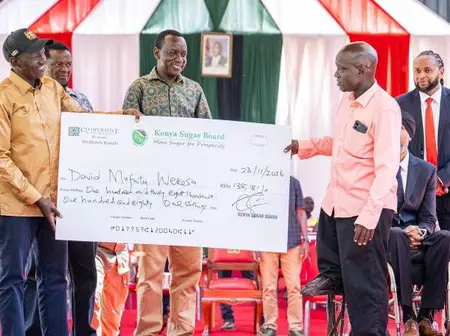
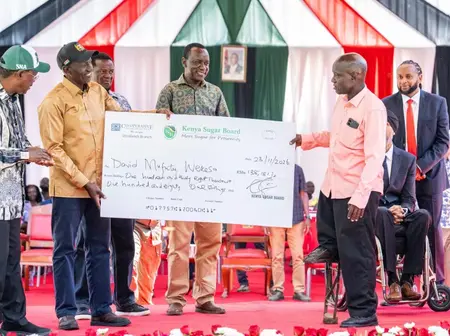
    During the event, growers supplying cane to Nzoia Sugar pocketed KSh195 million directly. According to a statement shared by President Ruto on his official Facebook page, this payout ensures sugarcane growers enjoy annual rewards just like tea and coffee farmers.

    The bonus rollout will expand to other major public millers starting next week. Farmers delivering to Mumias Sugar Factory in Kakamega County are next in line for their payments. Growers linked to Chemelil and Muhoroni factories in Kisumu County, alongside Sony Sugar in Migori County, will also receive their funds.

    Beyond the annual bonus, government reforms have fundamentally changed how local millers operate. Leasing public factories to private investors has ended the painful multi-year delays that previously crippled farmers. Today, growers receive their dues every week right after delivering cane, while factory workers earn regular monthly salaries.

    Private investment is already reshaping production capacity on the ground. The Rai Group, which currently manages Nzoia Sugar Factory, has injected KSh1.9 billion into modernising the plant and developing its nuclear estate. That capital also covers the irrigation of 3,600 acres of cane, alongside KSh688 million remitted to the state in taxes.

    Earlier state interventions laid the groundwork for this recovery. The government previously wrote off KSh117 billion in historical debts owed by struggling public millers. Authorities also subsidised farm inputs, allowing growers to buy a 50kg bag of fertiliser at KSh2,000.

    These combined efforts have pushed national sugar output sharply upward. Kenya expects total production to reach 900,000 metric tonnes this year alone. Officials project output will hit 1.2 million metric tonnes soon, positioning the country to achieve full self-sufficiency and stop relying on expensive sugar imports.

    With weekly cane payments and annual bonuses now rolling out across the sugar belt, do you think leasing public factories to private investors has saved Kenya's sugar industry? Share your thoughts below.

  • Ruto promises Nzoia sugarcane farmers double bonus payout in 2027

    Ruto promises Nzoia sugarcane farmers double bonus payout in 2027

    President William Ruto has promised sugarcane farmers supplying Nzoia Sugar Company double bonus payments in 2027, following the Sh195 million payout announced for growers this year.

    Speaking at Nzoia Sugar Factory in Bungoma County, the President said farmers would receive an improved bonus next year after the government put in place proper arrangements to strengthen the sugar industry.

    Ruto said the Sh195 million being paid to farmers this year was only the beginning, promising that the payout would double in the next financial cycle.

    “I want to tell Nzoia sugarcane farmers, this year, we are paying Sh195 million in bonus. Next year, since we will have made proper arrangements, the bonus will be double what you have received this year,” he said.

    The President defended his development commitments, saying his administration had moved beyond making promises to implementing practical plans aimed at transforming the agricultural sector.

    He said his government was guided by a clear strategy and was not making decisions through guesswork, adding that its commitments were backed by deliberate planning.

    “I am the one standing here, the one who has announced it. Some people back then, when I would say something, they would say it is impossible. But these days they have begun to realise that I mean what I say and I say what I mean,” Ruto said.

    “We have a plan, we are not doing guesswork. We think about it end to end on how we take things forward.”

    The President urged Nzoia sugarcane farmers to increase production, saying the sector presented significant opportunities as the government stepped up efforts to revive the sugar industry.

    “I want to ask cane farmers in Nzoia to work extra hard. There are a lot of opportunities in the sector,” he said.

    The Sh195 million bonus payout will benefit farmers supplying Nzoia Sugar Company, with growers receiving Sh597.10 per tonne of cane delivered.

    The payment was announced during a ceremony in Kanduyi, Bungoma County, attended by Ruto and Agriculture Principal Secretary Paul Kipronoh Ronoh.

    The Nzoia payout forms part of a broader Sh1.2 billion sugar bonus package announced for farmers supplying public sugar factories, following an earlier Sh50 million payment at Mumias Sugar Factory.

    The government says the bonus payments are part of efforts to ensure sugarcane farmers directly benefit from the recovery of the local sugar industry.

  • I&M Capital urges investors to diversify wealth beyond Uganda

    I&M Capital urges investors to diversify wealth beyond Uganda

    thumbnail

    Ugandans have been urged to look beyond domestic investment opportunities and explore international financial markets to diversify their portfolios, manage investment risks and secure their financial future.The call was made on Friday, 20th November, by Philip Musinguzi, the Country Manager of I&M Capital, during a wealth management session with members of the Rotary Club of Kigo Seven Lakes Golf (District 9214) at Lake Victoria Serena Golf Resort and Spa.

  • Tarra Agility Africa Launches Digital Platform to Track Kenyan Tax Changes

    Tarra Agility Africa Launches Digital Platform to Track Kenyan Tax Changes

    Tarra Agility Africa | LinkedIn

    The company says the terminal flags unsupported tax positions, tracks statutory deadlines and assigns identified risks to specific employees within an organisation. Where expert input is needed, Tarra Agility's tax specialists can review the findings and issue a certified report within 48 hours.

    The platform's website says its findings are grounded in decided cases, statutes and KRA notices, and certified by a named Tarra Agility practitioner.

    Tarra Agility says the platform uses secure login systems and end-to-end encryption, with each client's information kept separate. After the initial rollout in Kenya, the company plans to launch it in other African markets, including Uganda and South Africa.

    Business Daily reported that Tarra Agility used the platform in a study of tax disputes decided between 2011 and 2026. It found KRA won 52 per cent of the 5,250 disputes. Taxpayers won 36 per cent, and the remaining 12 per cent ended in split or partial decisions.

    Beatrice Njeri, a partner in tax compliance and accounting at the firm, said many companies conduct tax health checks as an annual exercise but fail to turn the findings into practical action.

    The reports reviewed did not give pricing, the number of clients or the exact launch date. The claims about the platform's capabilities come from the company, and the reports reviewed did not include independent testing. https://x.com/moneyacademyKE/status/2124822247504253381?a=3brc-72RVqSLc2iHqFQ&s=20

  • Safaricom unveils Ksh60 weekly plan offering families Ksh100,000 after a member’s death

    Safaricom unveils Ksh60 weekly plan offering families Ksh100,000 after a member’s death

    Safaricom unveils Ksh60 weekly plan offering families Ksh100,000 after a member’s death

    Safaricom has outlined how Kenyans can save Ksh60 weekly and access insurance benefits of up to Ksh100,000 for funeral expenses if they or a covered family member dies, through its Tuunza Mapato insurance product.

    The service, available through Safaricom’s M-PESA platform, is designed to provide financial protection to individuals and families against unexpected expenses arising from hospitalisation or death.

    Under the Msingi package, an individual pays Ksh60 every week to access funeral cover worth Ksh100,000, payable to the nominated next of kin in the event of the insured person’s death.

    Customers who opt for the higher Bora package pay Ksh100 weekly and qualify for funeral cover worth Ksh200,000.

    The product also provides hospital cash benefits to help customers cushion themselves against income losses and other expenses when admitted to hospital.

    Safaricom offers two packages under Tuunza Mapato, allowing customers to select coverage depending on their financial capacity.

    Under the Msingi package, an individual pays Ksh60 weekly and receives Ksh1,000 for every night spent in hospital, up to a maximum of Ksh30,000 annually.

    The Bora package costs Ksh100 weekly and provides Ksh2,000 for every night spent in hospital, with an annual limit of Ksh60,000.

    For families of up to five members, including the principal member and four dependants, the Msingi package costs Ksh240 weekly, while Bora costs Ksh400 weekly.

    The funeral benefit is designed to provide financial assistance to families following the death of a covered member.

    Under Msingi, the insurer pays Ksh100,000 per covered person, while Bora provides Ksh200,000 per covered person.

    The hospital cash benefit is paid for eligible admissions at Ministry of Health-registered Level 3 to Level 5 hospitals.

    However, the product does not directly settle hospital bills. Instead, it provides cash compensation for eligible hospital admissions, helping households manage expenses and potential income disruptions.

    Customers can access Tuunza Mapato through Safaricom’s available registration channels.

    They can dial *334# and navigate to the insurance services menu or use the Safaricom OneApp to select the insurance option and register for their preferred package.

    The weekly premiums are automatically deducted through M-PESA after customers authorise the payment arrangement.

    New customers also qualify for a two-week free coverage period, subject to the product’s terms and conditions.

    Safaricom CEO Peter Ndegwa

    Tuunza Mapato is provided through Safaricom Insurance Agency Limited and underwritten by Turaco Microinsurance Limited.

    Safaricom facilitates access to the service through its technology platforms, while the insurer is responsible for processing and paying eligible claims.

    Customers are required to provide supporting documentation when submitting claims, including identification documents and relevant hospital or death records, depending on the nature of the claim.

    The product also has waiting periods, exclusions and other conditions that customers should review before enrolling.

    More details are available on Safaricom’s official https://www.safaricom.co.ke/media-center-landing/frequently-asked-questions/tuunza-mapato Tuunza Mapato Frequently Asked Questions page.

  • UFAA Gives Kenyans 30 Days to Challenge Claims on Deceased Persons’ Unclaimed Wealth

    UFAA Gives Kenyans 30 Days to Challenge Claims on Deceased Persons’ Unclaimed Wealth

    (Photo courtesy)

    The Unclaimed Financial Assets Authority (UFAA) has given Kenyans 30 days to challenge applications by individuals and public institutions seeking to administer or receive money and other financial assets belonging to deceased persons.

    In a Gazette Notice published on Friday, November 20, 2026, the authority released a list of applicants seeking recognition as administrators, agents and recipients of unclaimed wealth belonging to deceased individuals.

    The list includes individual applicants as well as public offices such as cities, towns, county commissioners' offices and public trusts acting on behalf of families unable to pursue succession processes independently.

    UFAA has invited members of the public with objections to any of the listed applications to submit them at its offices within 30 days of publication.

    The objection window is intended to protect rightful beneficiaries and prevent money from being released to individuals or institutions whose claims may be disputed.

    The authority indicated that if no objections are received within the stipulated period, payments will be made to the listed applicants.

    The development comes amid growing concerns over the amount of money and other financial assets lying unclaimed across Kenya.

    According to a 2025 national survey prepared for the Draft National Policy on Unclaimed Financial Assets, 2026, Kenya's unclaimed financial assets are estimated at KSh 394 billion, representing a 63 per cent increase from KSh 241 billion recorded in 2018.

    The assets include dormant bank accounts, pension benefits, insurance payouts, unpaid dividends and mobile money balances.

    The financial services sector accounts for approximately 62 per cent of the total unclaimed wealth.

    By December 2025, UFAA had received approximately KSh 41 billion in unclaimed assets but had returned only KSh 2.8 billion to 37,390 rightful owners.

    The Treasury has noted that the recovery rate remains significantly below the global benchmark of between 30 and 40 per cent.

    The survey also identified more than 18,000 potential institutions holding unclaimed financial assets, although fewer than 2,000 had submitted reports to the authority by December 2025.

    UFAA's database currently contains more than 10 million potential beneficiaries.

    Under the Unclaimed Financial Assets Act, 2011, financial institutions such as banks and SACCOs are required to declare certain accounts unclaimed after two years of inactivity without contact from their owners.

    Institutions must first make efforts to reach the account holders before transferring the assets to UFAA.

    However, the law does not impose a deadline on rightful owners or beneficiaries seeking to recover their money.

    Kenyans wishing to establish whether they or their deceased relatives have unclaimed financial assets can check through the USSD code *361# or the authority's official website, ufaa.go.ke.

    Meanwhile, the National Treasury has proposed changes to the management of unclaimed wealth through the Draft National Policy on Unclaimed Financial Assets, 2026, published on November 12.

    The proposed reforms include simplifying claims procedures, particularly for small amounts, strengthening reporting requirements for financial institutions and expanding UFAA's mandate to cover dormant cryptocurrency wallets, stablecoins and other digital assets.

    The proposal comes after Kenyans transacted approximately KSh 740 billion in cryptocurrency during the year leading to June 2026.

    The Treasury has invited members of the public to participate in 11 public forums scheduled between November 23 and December 4 across different parts of the country.

    The forums will cover Mombasa, Kisii, Garissa, Kisumu, Kitui, Kitale, Meru, Eldoret, Nyeri and Nakuru before concluding in Nairobi at the Kenya School of Government on December 4.

    Members of the public have until Friday, December 4, 2026, to submit their views on the proposed policy.

    The proposed changes are expected to shape how Kenya identifies, safeguards and returns unclaimed financial assets to their rightful owners.

    https://www.kenyans.co.ke/news/129601-ufaa-publishes-names-claimants-seeking-deceased-kenyans-wealth-gives-30-days-object

  • UFAA Publishes Names of Claimants Seeking Deceased Kenyans’ Wealth, Gives 30 Days to Object

    UFAA Publishes Names of Claimants Seeking Deceased Kenyans’ Wealth, Gives 30 Days to Object

    The list includes individuals and claims made through public offices, including county commissioners, towns, cities, and public trusts. These offices may represent families who have been unable to complete succession processes on their own.

    Under the Unclaimed Financial Assets Act of 2011, financial institutions must surrender money and other assets that have remained unclaimed for the required period. UFAA then holds the assets and works to return them to their rightful owners.

    A 2026 draft national policy estimates that Kenya has about KSh 394 billion in unclaimed assets, up from KSh 241 billion in 2018. The assets include dormant bank accounts, pension benefits, insurance payments, unpaid dividends, and mobile money balances.

    By December 2025, UFAA had received about KSh 41 billion in unclaimed assets but had returned only KSh 2.8 billion to 37,390 owners. The authority is urging Kenyans to check for unclaimed assets belonging to them or their relatives by dialling *361# or visiting its official website, ufaa.go.ke. The agency says there is no deadline for making claims.

    Link source:https://www.facebook.com/share/p/1ZK5nUJqVL/

  • Gov’t Rolls Out Ksh1.2 Billion Sugarcane Farmers’ Bonus

    Gov’t Rolls Out Ksh1.2 Billion Sugarcane Farmers’ Bonus

    thumbnail

    BonusesPresident William Ruto's administration has begun distributing Ksh1.2 billion in bonuses to farmers supplying sugarcane to public sugar factories across the country.President William Ruto's administration has begun distributing Ksh1.2 billion in bonuses to farmers supplying sugarcane to public sugar factories across the country.In a statement on Monday, November 23, Ruto said the payment marked a milestone in the government's efforts to ensure sugarcane farmers benefited from their produce in a manner similar to growers of other agricultural crops.

  • Government Begins Paying KSh1.2 Billion Sugarcane Farmers’ Bonuses as Kenya Targets Higher Sugar Pro

    Government Begins Paying KSh1.2 Billion Sugarcane Farmers’ Bonuses as Kenya Targets Higher Sugar Pro

    The government has started paying sugarcane farmers a total of KSh1.2 billion in bonuses across public sugar factories in different parts of the country. The payments are expected to support farmers and reward them for supplying sugarcane to the factories.

    The first payment was made at Nzoia Sugar Factory in Kanduyi Constituency, Bungoma County. Farmers who supply sugarcane to the factory received KSh195 million as part of this year's bonus payments.

    The government said farmers at Mumias Sugar Factory in Kakamega County will receive their bonuses next week. Other farmers supplying sugarcane to Chemilil and Muhoroni factories in Kisumu County, as well as Sony Sugar in Migori County, will also benefit from the payments.

    The government says it has introduced several changes to improve the sugar industry and make farming more profitable. One of the major changes is leasing public sugar factories to private companies to improve their operations.

    Under the new arrangement, farmers are paid every week after delivering sugarcane to the factories. This has helped reduce delays that previously forced farmers to wait for years before receiving their money. Factory employees are also receiving their salaries regularly every month.

    At Nzoia Sugar Factory, the Rai Group has invested KSh1.9 billion in improving the factory, its housing facilities and irrigation systems. The investment also includes irrigation of 3,600 acres of land to support sugarcane production. The company has also paid KSh688 million in taxes to the government.

    To support farmers and improve factory operations, the government has also written off KSh117 billion in debts owed by sugar factories. Farmers can also access fertiliser at a lower price of KSh2,000 for a 50-kilogram bag.

    These measures are expected to increase sugar production and reduce Kenya's dependence on imported sugar.

    The government expects the country to produce 900,000 metric tonnes of sugar this year. It is also targeting production of 1.2 million metric tonnes in the future to help Kenya meet its local sugar demand.

    The bonus payments are expected to provide financial support to farmers and encourage more people to continue growing sugarcane. The government says the changes are aimed at improving the lives of farmers and strengthening the sugar industry.

    source:https://www.facebook.com/share/p/1FKNtbx95A/