Because niobium and rare earth elements are classified among Kenya’s strategic minerals, state equity participation under the Mining Act sits alongside mineral royalties, taxes, and domestic value-addition requirements as core pillars for capturing national returns from the resource.
The stake mechanism comes into focus after the Ministry of Mining, Blue Economy and Maritime Affairs named the US-backed Frontier Minerals Consortium—bringing together Frontier Minerals LLC, American Resources Corporation, ReElement Technologies, and Bunker Hill Mining Corp—as the preferred bidder following a competitive international tender launched in March 2026.
Rare earth elements and niobium are critical inputs for electric vehicle motors, wind turbines, electronics, aerospace alloys, and high-strength steel, placing the Kwale deposit—one of the world’s notable undeveloped rare earth and niobium prospects—at the centre of global supply-chain competition.
Crucially, officials have emphasized that naming a preferred bidder does not yet authorize mining.
Before commercial extraction can begin, the consortium must still navigate prospecting rights, environmental and social impact assessments, community consultations—including sensitive questions around the gazetted Mrima Hill Sacred Grove and local Digo heritage—and feasibility studies prior to securing a mining licence, while Kenya pushes for local processing and refining rather than raw mineral exports.
What are your thoughts about this article? Share your reactions in the comment section and don't forget to share and follow for more updates.
The Unclaimed Financial Assets Authority (UFAA) has published a list of individuals seeking to claim or administer financial assets belonging to deceased Kenyans, giving the public 30 days to challenge the applications.
In a Gazette notice dated November 20, 2026, the authority invited family members, beneficiaries and other interested parties to raise objections against individuals they believe are not entitled to the assets.
UFAA warned that it would proceed with payments to the listed claimants if no objections were received within the stipulated 30-day period.
The exercise is intended to safeguard beneficiaries and ensure that money held by the authority is transferred to the rightful owners.
The published notice contains claims involving individuals as well as public offices, county commissioners' offices, towns and public trusts acting on behalf of beneficiaries.
Under the Unclaimed Financial Assets Act, 2011, financial institutions are required to surrender qualifying dormant financial assets to UFAA when their owners cannot be traced within the legally prescribed period.
These assets include forgotten bank deposits, insurance benefits, pension payments, unpaid dividends and mobile money balances.
According to the Draft National Policy on Unclaimed Financial Assets, 2026, Kenya's unclaimed financial assets are estimated at approximately KSh394 billion, up from KSh241 billion in 2018.
By December 2025, UFAA had received about KSh41 billion but had returned only KSh2.8 billion to 37,390 beneficiaries.
Kenyans seeking to establish whether they or their deceased relatives have unclaimed funds can dial *361# or visit ufaa.go.ke.
Meanwhile, the Treasury is seeking public views on proposed changes to the unclaimed assets framework, with participation forums scheduled across 11 locations between November 23 and December 4.
UFAA has clarified that there is currently no deadline for claiming unclaimed financial assets.
President William Ruto has presided over the issuance of Ksh195 million in bonuses to Nzoia Sugar farmers, providing financial relief to growers who supply sugarcane to the factory.
During the event, Ruto highlighted the government's efforts to improve the sugar industry and address challenges that have affected farmers and millers over the years. The sector has faced difficulties ranging from delayed payments to farmers, factory inefficiencies, high production costs and competition from imported sugar.
The issuance of the bonus is expected to benefit farmers who have been supplying cane to Nzoia Sugar Factory, helping them meet household expenses, pay workers and invest in their farms ahead of the next planting and harvesting seasons.
Sugarcane farmers have repeatedly called on the government and millers to ensure timely payments for delivered cane, arguing that delays affect their ability to maintain their farms and continue production. Many farmers rely on proceeds from sugarcane to pay school fees, meet family needs and purchase farm inputs.
The government has in recent years announced measures aimed at strengthening the sugar sector, including improving factory operations, supporting cane development and addressing challenges linked to the management of sugar companies.
Nzoia Sugar Factory is among the millers serving farmers in the region, with its operations supporting livelihoods through cane farming, transport, factory jobs and other related activities.
The payment is expected to offer some financial support to growers while drawing renewed attention to the importance of ensuring that sugar factories operate efficiently and farmers receive fair compensation for their produce. For many growers, the bonus represents an additional payment that could help them continue investing in sugarcane farming as they await the next payment cycle.
As the country navigates fiscal consolidation and persistent economic pressures, the document serves as a roadmap detailing how public resources will be generated, borrowed, and spent—with direct implications for the everyday cost of living, taxation, public service delivery, and employment opportunities for ordinary Kenyans.
At the center of the 2027 BPS is a continued commitment to the Bottom-Up Economic Transformation Agenda (BETA), focusing heavily on agricultural productivity to stabilize food prices.
Treasury proposes sustained funding for the national fertilizer subsidy scheme—maintaining target price caps around KSh 2,500 per 50kg bag—alongside expanding irrigation projects such as the Galana-Kulalu scheme and supporting key value chains like dairy, tea, edible oils, and rice.
For households, these measures aim to lower maize meal (unga) and basic food commodity prices by driving up local production; for farmers, the subsidies provide reduced operational costs and guaranteed market access.
On public services and social welfare, the spending policy maintains significant capital allocations toward the Social Health Authority (SHA) under the Taifa Care framework to deepen primary healthcare coverage and digitize claim settlements.
In education, the statement commits resources to finalize the transition of the Competency-Based Curriculum (CBC) and finance higher education student loans.
Furthermore, the plan scales up funding for the Affordable Housing Programme to expand housing units and stimulate informal sector employment, while expanding credit windows under the Hustler Fund and the 2026 MSME Policy framework for small business operators.
What are your thoughts about this article? Share your reactions in the comment section and don't forget to share and follow for more updates.
The Kenyan government has outlined 13 strict conditions that a United States-based mining consortium must meet before proceeding with plans to exploit the mineral deposits at Mrima Hill in Kwale County, in a project whose estimated value has been placed at approximately KSh8 trillion.
The requirements come after the government selected the Frontier Minerals Consortium as the successful bidder in the international tender for the strategic mineral deposits containing rare earth elements and niobium.
According to the Ministry of Mining, Blue Economy and Maritime Affairs, the conditions are designed to ensure that the country benefits from the project while protecting the environment and safeguarding the interests of communities living around Mrima Hill.
Among the key requirements is that the consortium must demonstrate extensive experience in exploring and mining specialised minerals, particularly niobium and rare earth elements.
The investors must also provide verifiable financial resources, qualified technical experts and an experienced management team capable of overseeing large-scale mining operations.
The government has further demanded that the consortium demonstrate its ability to establish mineral processing and beneficiation facilities locally instead of simply exporting raw minerals.
Environmental protection is another major requirement, with investors expected to embrace renewable energy, land rehabilitation and responsible water management practices.
Additionally, the consortium must demonstrate its commitment to working closely with local communities to ensure that the economic and social benefits of the project are shared fairly.
The government has also emphasised the importance of corporate governance, underground and surface rock engineering expertise, and compliance with Kenya's laws governing strategic mineral investments.
Mrima Hill contains valuable deposits of niobium, yttrium, thorium, strontium and lanthanum, minerals used in various industrial and technological applications.
However, the successful bid does not automatically grant the consortium permission to begin mining.
It must first complete the necessary regulatory procedures and obtain the required prospecting approvals.
The project has attracted significant attention because of its enormous economic potential, although environmental concerns and the cultural significance of Mrima Hill to the local Digo community remain important considerations.
The government is therefore seeking to balance international investment, local economic benefits and environmental protection before allowing the project to advance.
Getting a salary increment or landing a better-paying client feels like the turning point that should finally solve your money problems. Yet across Nairobi, Mombasa, and Kisumu, thousands of hardworking professionals notice a frustrating pattern: the more their monthly income grows, the tighter their budget feels by the third week of the month.
Financial educators call this silent trap lifestyle inflation, and it happens so gradually that most people miss the warning signs until an unexpected bill forces them back into mobile loans. Understanding why higher earnings rarely translate into automatic wealth is the first step toward keeping more of what you work for.
The biggest mistake most earners make after a pay rise is committing the extra money to permanent monthly bills before building a cash cushion.
When your income jumps from Ksh 50,000 to Ksh 80,000, moving to a bigger apartment in a pricier estate or taking on higher car loan repayments immediately locks away your raise. According to consumer credit reports published by the Central Bank of Kenya, rising household debt obligations continue to absorb a large share of disposable income among salaried workers. Once fixed expenses expand to match your new payslip, you end up living paycheck to paycheck at a higher income level.
Digital lending platforms and mobile overdraft facilities have made short-term borrowing effortless, creating the illusion that you always have backup cash available.
While instant mobile credit helps during genuine emergencies, using overdrafts to cover routine weekend spending, fuel, or mid-month groceries quietly drains your future earnings through recurring transaction fees and interest charges. Data from the Central Bank of Kenya financial sector stability reports shows that frequent reliance on short-term digital credit significantly reduces a household's ability to accumulate long-term savings. Every shilling spent servicing convenience debt is a shilling taken away from your own financial security.
Many disciplined earners manage to set money aside each month, only to leave it sitting in a standard bank current account or mobile wallet where it earns zero return and stays too easy to spend.
When your savings sit in the same account you use for daily M-Pesa transactions, a single impulsive purchase or unplanned family request can wipe out months of effort. Financial literacy guidelines from the Capital Markets Authority recommend separating everyday spending money from long-term savings by moving surplus cash into licensed Money Market Funds or regulated Sacco accounts regulated by the Sacco Societies Regulatory Authority. Separating where you spend from where you save removes daily temptation while allowing your money to compound steadily.
A higher gross salary does not mean every extra shilling lands in your bank account.
Under tax bands administered by the Kenya Revenue Authority, crossing into a higher income bracket increases your monthly Pay As You Earn obligations alongside statutory housing and health contributions. Many workers budget based on their headline salary offer rather than their actual net take-home pay, creating an immediate shortfall in their monthly cash flow. Taking advantage of allowable tax reliefs, such as registered pension contributions or insurance relief under the Kenya Revenue Authority Income Tax Act, legally lowers your taxable income while building retirement security.
The most common reason high earners fail to build wealth is treating saving as an afterthought rather than a non-negotiable monthly bill.
If you wait until the end of the month to save whatever remains after rent, transport, utilities, and social outings, there is almost never anything left to transfer. Personal finance analysts consistently advise reversing that sequence by automating a fixed transfer to a licensed Money Market Fund or Sacco on the exact day your salary arrives. Even starting with ten percent of your net income forces your lifestyle to adjust around what remains rather than letting your expenses consume everything first.
Building real financial stability rarely comes from waiting for one massive salary jump. When you keep your fixed expenses modest after a raise, avoid convenience borrowing, and pay your savings account first, your income finally starts working for you instead of disappearing before month end.
What is the biggest money habit that helped you start saving consistently? Share your thoughts in the comments below.
Under the initiative's entry-level plan, subscribers can access up to Ksh100,000 in funeral expense cover alongside hospital cash benefits for a weekly premium starting at Ksh60.
The policy is structured to address severe financial vulnerabilities caused by sudden illness or the loss of a household breadwinner.
For individual subscribers on the Msingi tier, a weekly payment of Ksh60 unlocks a Ksh100,000 lump-sum cash payout to the designated next of kin upon the death of the policyholder, as well as hospital daily cash allowances of Ksh1,000 per night (capped at Ksh30,000 annually).
Higher coverage tiers and family plans—covering up to five household members, including a spouse and dependent children aged 1 month to 25 years—are also available, offering funeral payouts up to Ksh200,000 for scaled weekly premiums.
Premium deductions are processed automatically via Safaricom’s M-Ratiba recurring payment system, ensuring continuous coverage with low-balance alerts sent if an M-Pesa wallet requires a top-up.
To lower the barrier to entry, the service features a complimentary two-week "freemium" trial period upon initial signup via the Safaricom My OneApp or USSD code, covering accidental risks during the introductory period.
Underwriters guarantee claim disbursements directly into the policyholder's or beneficiary's M-Pesa account within three business days of submitting valid verification documents, such as a burial permit, death certificate, or administrative chief's letter.
Financial analysts note that by leveraging mobile payment rails to deliver low-cost micro-insurance, the product has the potential to deepen financial inclusion and reduce reliance on informal community fund-raising (harambees) during emergencies.
What are your thoughts about this article? Share your reactions in the comment section and don't forget to share and follow for more updates.
According to a notice published on March 17, 2026, the authority had received claims from 126 individuals seeking to inherit funds and other financial assets belonging to deceased persons.
The claims were submitted by individuals acting as administrators of estates, relatives of deceased account holders and representatives authorised to recover the assets.
The assets include dormant bank account balances, mobile money funds, insurance proceeds and other financial holdings that had been transferred to UFAA for safekeeping after remaining unclaimed for the legally prescribed period.
UFAA warned that members of the public with objections or competing claims must submit them within 30 days of the notice's publication.
The authority stated that if no objection was lodged within the stipulated period, payments would be made to the individuals named in the notice after the claims had been processed.
The notice is part of the legal procedure established under the Unclaimed Financial Assets Regulations, which requires a 30-day no-objection notice before payments are made to beneficiaries or authorised agents.
Members of the public seeking to challenge the claims were advised to contact the authority through its official offices before the deadline.
UFAA, a state corporation established under the National Treasury through the Unclaimed Financial Assets Act of 2011, is mandated to receive, safeguard and reunite abandoned financial assets with their rightful owners.
According to figures displayed on the authority's official website, UFAA had received approximately KSh125 billion in unclaimed assets and made payouts totalling KSh3.12 billion to 44,693 claimants.
The authority also provides an online platform where Kenyans can search for financial assets held in their names or learn how to recover funds belonging to deceased relatives.
However, the March 17 notice does not specify the total monetary value of the 126 claims. Its 30-day objection period should also not be mistaken for a newly issued deadline in November 2026.
Kenyans can access the authority's services through its official website, by dialling *361# to check for potentially unclaimed assets.https://web.facebook.com/share/p/1AAnfQEaiq/
Nzoia sugarcane farmers have received a major boost after President William Ruto promised them double bonuses in 2027, raising hopes of better earnings for thousands of households that depend on sugarcane farming.
The promise is expected to bring relief to farmers in the Western Kenya sugar belt, where sugarcane farming remains an important source of income and employment.
Speaking during an event at Nzoia Sugar Company in Bungoma County on Monday, November 23, 2026, Ruto announced that farmers would receive an even bigger reward next year as the factory continues improving its operations.
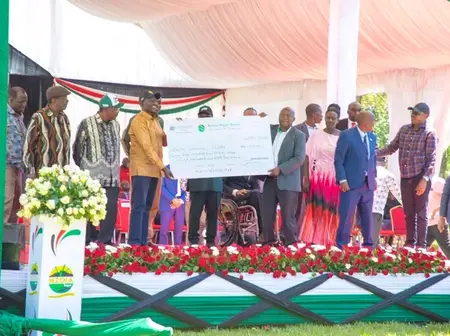
The President issued bonus cheques worth Sh195 million to Nzoia sugarcane farmers. The payment forms part of the Sh1.2 billion bonus package being distributed to farmers supplying public sugar factories across the country.
He also praised the changes at Nzoia Sugar Company, saying farmers were now receiving payments for delivered cane within a week, while factory workers were receiving their salaries on time.
Nzoia Sugar Company Managing Director Tejveer Rai said the factory had paid Sh1.6 billion to sugarcane farmers in 2026 and was investing Sh5.7 billion in modernising its operations.
The factory's recovery is expected to strengthen sugar production and improve the relationship between farmers and millers.
Ruto's promise of double bonuses in 2027 will therefore be welcome news to farmers who have depended on sugarcane farming for their livelihoods.
For Nzoia farmers, the bigger promise now creates fresh expectations as they look forward to another year of improved returns from their hard work.
According to details released on Monday, November 23, 2026, the farmers will receive an equivalent of KSh597.10 for every tonne of sugarcane delivered to the factory.
The government said the payout fulfils its commitment to ensure growers benefit directly from improved performance of the sugar factories operating under the leasing programme.
During the reporting period, Nzoia Sugar Company received 327,671.18 tonnes of sugarcane from 13,946 farmers. The bonus recognises the growers' role in supplying raw materials and supporting the factory's operations.
The disbursement is also part of broader government efforts to revive the country's sugar industry, strengthen local production and improve earnings for farmers.
Kenya's sugar production has reportedly registered growth in 2026, with the industry projected to surpass 900,000 tonnes by the end of the year.
The government views the increase as an important development towards strengthening domestic production capacity and reducing dependence on imported sugar.
The government has maintained that improved factory performance should translate into better returns for growers, who remain central to the country's sugar production chain.