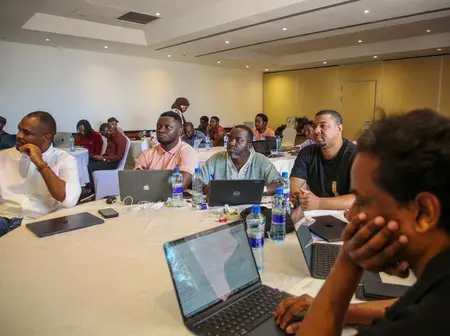
The government has launched a cybersecurity centre at Konza Technopolis to combat hacking, ransomware and phishing through centralised monitoring and response.
The security operations centre will use artificial intelligence (AI) to monitor networks, detect suspicious activity and coordinate responses to cyber incidents across systems and devices.
Samsung Electronics has taken the top spot in Africa's smartphone market for the first time since entering the continent in 1995.A payment model by Samsung built around irregular incomes appears to be the main driver of this climb to the peak.According to market research firm TechInsights, Samsung led the market by revenue in the first quarter of the year, then topped both revenue and unit sales in the second.
What you need to know:Husbands and partners account for the largest proportion of perpetrators of technology-facilitated abuse against women in Kenya, at 61 per cent, the 2025/2026 Kenya Mini Demographic and Health Survey (Mini DHS) has revealed.The survey, launched last week, found that online controlling behaviour is the most common form of abuse, affecting 19 per cent of women in the year preceding the 2025 survey.
Missing Safaricom M-PESA Messages: What You Need to KnowMissing Safaricom M-PESA messages can be frustrating, particularly when you need to confirm a payment, verify money received, provide proof of a transaction or reconcile your financial records.For millions of Kenyans who rely on M-PESA for daily financial transactions, SMS confirmations provide an important record of money sent, money received, withdrawals, deposits, bill payments and purchases.
Artificial intelligence (AI) is reshaping the global media landscape, opening up new possibilities for media organizations to improve efficiency and reach wider audiences, while posing pressing challenges to journalistic integrity, human judgment and the future of the very profession.At the 7th World Media Summit, held in Beijing from Nov. 5 to 9, media professionals from around the world explored ways to better harness AI to improve news production while avoiding ethical pitfalls that could undermine trust in their content.
Africa must invest in its own data centres and computing capacity or risk being locked out of the artificial intelligence economy, a pan-African ICT industry body has warned.
The Technology Information Confederation Africa (TICON Africa) said last week’s sell-off in US AI and data centre stocks showed the risks of the continent relying on infrastructure in other economies.
AI-related shares fell sharply after the US midterm elections, on investor concerns that the Democrats’ gains in Congress could lead to tighter rules on data centre development.
Swiss bank UBS has estimated that about 30 percent of expected 2028 US data centre capacity additions could be at risk from political uncertainty and grid bottlenecks.
“Africa’s ability to participate meaningfully in the global AI economy will depend not only on its ability to develop AI applications, but also on access to the infrastructure needed to train, run and deploy them,” said David Gowu, President of TICON Africa.
Mr Gowu warned that without enough local data centres and cloud infrastructure, Africa risks becoming mainly a consumer of AI built and hosted elsewhere.
That would leave African businesses paying foreign providers for services on infrastructure over which the continent has little control.
Africa accounts for about 0.6 percent of global data centre capacity, despite being home to around a fifth of the world’s population, according to the Africa Data Centres Association.
A 2025 report by consultancy Access Partnership estimates that by 2030, sub-Saharan Africa will face a 98 percent gap between demand for AI computing and available data centre capacity.
Data control
Mr Gowu said where data is stored and processed is becoming more important as AI systems handle more information about businesses, governments, financial transactions and citizens.
“This requires investment in local technological capacity and stronger data governance frameworks,” he said.
He added that data centres attract investment, create skilled jobs and boost demand for energy and connectivity.
Greater access to computing power could also lower costs for local start-ups, universities and researchers that struggle to afford processing resources, he said.
“Developing local capacity is therefore not simply about data sovereignty, but about ensuring the continent can participate in, and capture economic value from, the AI economy,” Mr Gowu said.
“Africa cannot expect to capture the full economic benefits of AI if it does not invest in the foundations that make AI possible.”
Samsung is preparing a Galaxy AI subscription that would give users access to advanced artificial intelligence features, larger usage allowances and additional services, while keeping core Galaxy AI tools available free of charge.
The proposed plans point to a paid model built around optional upgrades rather than a subscription requirement for every Galaxy owner. Samsung has said its core Galaxy AI features will remain free, while certain advanced capabilities and new services could be offered as paid options in the future.
The planned offering includes AI-powered video generation, automated actions across apps and a credit system that gives subscribers higher allowances for selected tasks. It would add a paid layer to the Galaxy AI experience, which Samsung has expanded across its smartphone range since introducing the platform with the Galaxy S24 series.
The development comes as Samsung moves beyond individual editing and translation tools towards AI features that can interpret context, generate content and assist with tasks across a device.
Samsung’s proposed subscription structure includes three tiers called Starter, Plus and Pro. The plans would provide different credit allocations, with Starter offering 10,000 credits, Plus providing 20,000 and Pro giving subscribers 50,000 credits.
Users would be able to use these credits for AI functions after exhausting their free allowances. The system would also allow customers to purchase additional credits for individual features or buy one-time credit packs separately from a subscription. Those packs would remain valid for three years from the date of purchase.
The proposed plans introduce several capabilities beyond the existing Galaxy AI tools. Gen Video would turn static photographs into short video clips, giving users another way to create content directly from their Galaxy devices. The feature follows a similar concept to AI video generation available through Google’s Gemini services.
Bixby Action would allow users to create commands, triggers and routines that automate everyday tasks. It is designed to carry out actions across apps and system functions, extending Bixby’s role beyond responding to voice commands.
Galaxy Claw is another reported addition, designed to automate routine daily tasks using Galaxy AI. Bixby Action is positioned among the higher-tier offerings, while Galaxy Claw forms part of the broader premium experience.
Daily Briefing would also feature in the Plus tier. It is separate from Now Brief, Samsung’s existing feature for presenting personalised information and updates to users. The subscription offering would also provide expanded usage limits for selected AI functions.
The reported credit allocations form part of a wider system that would determine how frequently users can access certain AI services. Starter, Plus and Pro would offer progressively larger credit balances, giving subscribers different levels of access depending on their chosen plan.
The proposed structure also includes separate daily allowances for selected tasks. Under the free allocation, users would receive up to 10 translations, five text summaries and two image generations per day. An Essential allowance would raise those limits to 100 translations, 50 summaries and 20 image generations, while the Premium allowance would provide unlimited daily usage for these three functions.
These daily limits sit alongside the credit allocations associated with the three subscription tiers. Users would be able to view their remaining credits and expiry dates, while additional credit packs would provide another way to access AI services after the allocated allowance runs out.
The structure gives Samsung room to charge for heavier use of its AI tools while retaining a free route to the existing experience. It also introduces a distinction between access to an AI feature and the number of times a user can use it within a given period.
An earlier version of the proposed subscription structure used the names Standard and Max. The Max option was associated with a fourfold increase in usage allowances, alongside features such as Gen Video, Bixby Action and Daily Briefing.
Pricing strings associated with that structure showed $4.99 per month or $47.99 annually. These figures were presented as placeholder values, rather than confirmed retail prices.
Samsung’s existing Galaxy AI capabilities are expected to remain available without a subscription. These include Browsing Assist, Creative Studio, Memory, Now Brief and Photo Studio, alongside other existing tools.
The distinction matters because Galaxy AI has become part of the experience Samsung promotes across its smartphone portfolio. Features such as Photo Assist, writing assistance, translation and summarisation have given Galaxy users practical ways to apply AI to everyday tasks without relying entirely on separate applications.
Samsung has also addressed the question of charging for its AI services. In a statement to Tech Advisor, the company said: “Samsung’s core Galaxy AI features will remain free of charge.” It added that certain advanced capabilities or new services could be offered as paid options or separate services in the future.
That position leaves room for a subscription offering built around new capabilities and higher usage limits. Existing tools could continue to serve users who rely on Galaxy AI for occasional tasks, while customers who generate more content or use advanced functions more frequently could pay for additional access.
The distinction also matters when considering how Galaxy AI works across different devices. Samsung’s AI experience combines on-device processing with cloud-based services, depending on the feature. Its partnership with Google Cloud helped bring Gemini Pro and Imagen 2 through Vertex AI to the Galaxy S24 series, while Gemini Nano supported on-device processing.
Samsung’s position on free Galaxy AI access has been part of the conversation since the Galaxy S24 launch in January 2024. At the time, Samsung’s product information indicated that some cloud-based Galaxy AI features could become paid services after the initial free-access period.
Galaxy Unpacked January 2024 launch raised the possibility that cloud-based AI capabilities could eventually sit behind a subscription. The discussion came as Samsung introduced Galaxy AI as a major part of the Galaxy S24 experience, combining its own software with Google’s generative AI models.
The Galaxy S24 FE launch in Kenya in October 2024 provided another indication of the initial free-access arrangement. Samsung’s stated position at the time was that some Galaxy AI features would remain free until the end of 2025.
Since then, Samsung has expanded the AI experience across its product range. The Galaxy S25 series brought deeper integration through One UI 7, while the Galaxy S26 series added more contextual assistance and agent-like functions. Features such as Now Nudge and Gemini-powered actions have extended the role of AI beyond individual commands and editing tools.
Samsung has also brought selected AI capabilities to devices outside its flagship S series, although feature availability varies across models. That broader distribution has helped make Galaxy AI a central part of the company’s smartphone software strategy.
A subscription model would add another layer to that strategy, allowing Samsung to retain core AI functions as part of the Galaxy experience while charging for additional services and higher usage allowances. For users, the practical distinction would be whether the free allocation covers their regular needs or whether advanced tools and more frequent use justify paying for an upgrade.
Under the newly introduced Online Safety Bill 2026, sponsored by Embakasi West MP Mark Mwenje, tech companies must institute strict safeguards to protect users under the age of 18 from illegal online material. The legislation also equips the Communications Authority of Kenya (CA) with robust enforcement powers to track compliance and penalize non-compliant platforms.
A cornerstone of the proposed law is its focus on parental oversight and age verification. The legislation mandates that children under 18 secure explicit parental approval before creating accounts or accessing social media services. Furthermore, parents retain the legal right to revoke this approval at any point, forcing platforms to cut off the child’s access within a designated timeframe.
“A parent or a person who exercises parental responsibility shall be responsible for giving or withholding consent to the access to, or use of, a regulated service by a child, having regard to the age, maturity and best interests of the child,” the Bill states.
To enforce these boundaries, tech platforms must deploy robust age-verification or age-estimation systems. Providers must also verify that the person granting permission actually holds legal parental authority over the minor.
If the Communications Authority of Kenya suspects a platform of ignoring these statutory duties, it can issue a formal compliance notice outlining specific violations and remediation timelines.
“A compliance notice shall specify the provision of this Act alleged to have been breached, the facts constituting the breach, the measures required to remedy the breach, and the period within which the measures shall be implemented,” the Bill reads in part.
Failure to uphold this basic duty of care carries heavy financial and legal consequences. Platforms that violate the rules face fines reaching up to Ksh. 500 million, or 10 percent of their global annual turnover, whichever sum is higher.
The legislation goes even further by holding corporate leadership directly accountable for systemic failures.
“Where an offence under this section is committed with the consent or connivance of, or is attributable to any gross negligence on the part of, a senior executive officer of the provider, that officer commits an offence and is liable on conviction to a fine not exceeding ten million shillings or to imprisonment for a term not exceeding five years, or to both,” the Bill states.
The scope of the Bill explicitly targets illegal content and online threats covered under Kenya’s Computer Misuse and Cybercrimes Act, the Prevention of Terrorism Act, and severe offenses involving child sexual abuse material (CSAM).
As Parliament reviews the proposal, tech providers targeting Kenyan users will need to re-evaluate their onboarding workflows, content moderation systems, and user data protections to meet these proposed standards.
The Future of Human Freedom, Privacy, and SurvivalThere are growing concerns around the world about the expansion of digital identification systems and the possibility that they could eventually become an essential requirement for participating in everyday life. What is being presented as technological progress and administrative convenience could, if implemented without adequate safeguards, raise serious questions about individual freedom, privacy, human rights, and government control.
BEIJING, Nov. 5 (Xinhua) — Global representatives at a sub-forum of the 7th World Media Summit on Thursday called on media organizations to harness intelligent technologies to deliver accurate, fair, authoritative and trustworthy reporting.Representatives of media, think tanks, government departments and other institutions, from home and abroad, attended the breakout meeting, where they discussed how media can adapt to changes, embrace opportunities and meet challenges together in the AI era.