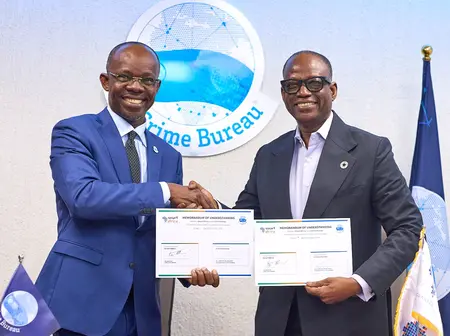
A cybersecurity company, e-Crime Bureau and the Smart Africa Secretariat, a continental digital alliance body, have signed a deal that will scale up cybersecurity resilience, innovation, and capacity across the continent.Move follows the e-Crime Bureau’s recent corporate restructuring into a global cybersecurity consulting firm, a move greenlit by its Board under a 2026 Transition and Growth Strategy.
Category: Technology
-

Why your digital identity is as important as your physical identity
For generations, we have relied on physical identity to tell us apart. The way we dress, walk, speak or even laugh can make us recognisable. But today, much of our lives no longer happen in the physical world.
We open bank accounts online. We apply for credit from our phones. We make payments, shop, communicate and access services without necessarily meeting another person face-to-face. As our lives become increasingly digital, another form of identity has emerged alongside our physical one: our digital identity. And protecting it is becoming just as important.
Think of it as your digital fingerprint. A digital identity is information that confirms who you are whenever you use an online service. It can include identification details, phone number or any other information used to verify your digital identity.
It becomes particularly important as more financial service providers move online. Otherwise, the same technology that makes financial services easier to access can also create opportunities for fraudsters.
Today, identity can be misused without anyone physically taking your identification document. Someone may use your personal information to create an account, access a service or obtain credit in your name. This is why the account-creation stage matters.
The latest TransUnion data shows that approximately 4.5% of account-creation attempts in Kenya in 2025 were suspected of digital fraud. Account creation was therefore one of the points in the consumer journey where fraud risk was particularly evident. This is where eKYC comes in.
Electronic Know Your Customer, or eKYC, may sound technical. But the principle is simple: verifying that the person opening an account or accessing a financial service is genuinely who they claim to be. When you accurately complete your eKYC information, you help a provider establish your identity and distinguish you from someone attempting to impersonate you.
As a digital financial services provider, Tala uses KYC identity verification to confirm customer identities and help protect customers and the business from fraud and other financial crimes. Its verification process requires a valid government-issued ID and a live selfie directly through the Tala app.
Financial services providers have a responsibility to invest in strong identity verification, fraud detection and consumer protection systems. Consumers have a role too. We need to become more conscious of the information we share, where we share it and why it is requested. That means identity protection must become part of how we think about everyday digital financial safety. As more transactions move online, trust becomes one of the most valuable currencies in the digital economy. We would not casually hand our identification document to a stranger. We should apply the same level of care to the digital information that increasingly represents us online.
Kenya’s digital economy will continue to grow, with more services and transactions moving online. That future will require more than convenience. It will require confidence. And building that confidence starts with something fundamental: knowing who is on the other side of the screen.
Our physical fingerprints have always helped tell us apart. Our digital identity is now helping do the same. The responsibility is to make sure that the digital identity belongs to us and stays ours.
-

E-citizen royalty system fully operational as parliament seeks artists payment accountability
The government has confirmed that the migration of copyright royalty collection and distribution to the E-Citizen digital platform has been fully implemented, marking a significant milestone in the country's efforts to reform the creative industry.
Director General of the Directorate of E-Citizen, Amb Isaac Ochieng, announced this while appearing before the Parliamentary Committee on Sports and Culture, where he outlined the progress made in implementing the presidential directive on digital royalty administration.
Ochieng told the committee that royalties collected through the platform are transferred from the National Treasury to licensed Collective Management Organisations (CMOs) twice a week, providing a more structured and predictable mechanism for remitting collections to the organisations responsible for distributing payments to copyright holders.
The parliamentary engagement, chaired by Committee Chairman Dan Wanyama, brought together representatives of the Directorate of E-Citizen, the Kenya Copyright Board (KECOBO) and the Performing and Audio-Visual Rights Society of Kenya (PAVRISK).
During the meeting, PAVRISK was represented by its Chief Executive Officer, Joseph Njagih, while KECOBO was represented by its Acting Executive Director, Mr George Nyakweba, alongside other officials from the respective institutions.
Notably, PAVRISK was identified during the engagement as the only CMO that has fully implemented the Government's directive to migrate royalty collection to the E-Citizen platform.
The development places PAVRISK at the forefront of the government's digital transformation agenda in copyright administration.
It also reinforces its position as a key institution in the protection and commercialisation of intellectual property rights in the country.
The committee sought clarification on compliance with the 70:30 royalty disbursement framework, which provides for at least 70 per cent of royalties collected to go directly to copyright owners, while the remaining 30 per cent caters for the administrative costs of the collecting organisation.
The committee was informed that under the guidance of the sector regulator, KECOBO, the royalties collected get transferred from the National Treasury to the CMOs and are held in two separate accounts: the Royalties Account (70 per cent) and the CMO Administration Account (30 per cent).
“It is the responsibility of the regulator, KECOBO, to ensure that the 70 per cent is disbursed to artists/copyright owners,” Amb Ochieng’ said.
Ochieng said upon distribution of royalties, the CMO is expected to upload the distribution logs on eCitizen to enable every artist to view total royalties collected, as well as their individual royalty earnings, thereby creating transparency and accountability.
PAVRISK's full implementation of the E-Citizen directive marks a notable development for Kenya's creative economy.
For businesses and other users of copyrighted works, the system offers a centralised digital channel through which they can obtain and pay for the requisite Unified Copyright Licences (UCL).
With the migration to E-Citizen fully implemented, businesses and establishments that commercially use copyrighted music and audio-visual content are required to obtain the requisite licences https://pavrisk.or.ke/ecitizen
-

How to Convert TikTok Videos to MP3
Learning how to convert TikTok videos to MP3 is useful when you want to extract audio from a video and save it as an audio file. MP3 files allow you to listen to audio without playing the entire video. You can use online conversion websites, mobile applications, or audio editing software to complete the process.
-
How to Convert Google Docs to PDF
Learning how to convert Google Docs to PDF is useful when you want to share documents while preserving their original formatting. PDF files are suitable for submitting assignments, sending business reports, sharing CVs, and printing official documents. Google Docs has a built-in download feature that allows you to convert documents into PDF files without installing additional software.
-

How to Convert Handwritten Notes to Word Online
Learning how to convert handwritten notes to Word online is useful when you want to turn information written in a notebook, on paper, or on a whiteboard into an editable digital document. Instead of typing everything manually, you can use Optical Character Recognition (OCR) technology to identify handwritten words and convert them into text.
-

How to Convert Excel to CSV
Learning how to convert Excel to CSV is useful when transferring spreadsheet data between different applications, databases, and computer programs. CSV stands for Comma-Separated Values. It is a file format that stores spreadsheet information as plain text, with commas separating individual values. Unlike Excel files, CSV files do not preserve features such as colours, formulas, charts, and cell formatting.
-

M-Pesa tops Kenya’s Superbrands 2026 ranking
M-Pesa has been ranked Kenya’s strongest brand for 2026 in Superbrands East Africa’s annual consumer rankings, with Safaricom, its parent company, in second place.
Samsung came third, followed by WhatsApp and Google. Naivas, Dettol, Bolt, Kenya Airways and YouTube completed the top 10. Tech and digital platforms took seven of the top 10 places.
The rankings are based on research by Kantar. About 2,250 consumers across Kenya rated more than 1,900 shortlisted brands in 112 categories on quality, reliability and distinction. M-Pesa scored 91.9 overall, with 98% awareness, the highest of any brand.
The study found that 86% of consumers surveyed are likely to buy a product or service carrying the Superbrands seal, and 84% say the recognition would increase their trust in a brand. However, only 63% would consider paying more for a brand with the seal, suggesting Kenyan consumers remain highly conscious of value.
“Kenyan consumers have many brands to choose from, but what ultimately matters is whether a brand delivers on its promises,” said Jawad Jaffer, project director and associate publisher at Superbrands East Africa.
“For businesses, this is a reminder that consumer trust must be earned consistently through brand building, not simply through advertising.”
Influencers face trust gap
The research also looked at the role of social media influencers in purchasing decisions. It found that 58% of consumers trust influencer recommendations at least some of the time, but only 10% trust them consistently. Another 42% said they do not trust them at all, either because they see endorsements as insincere or because they prefer to make their own decisions.
Product packaging remains the main way consumers see the Superbrands seal, cited by 64% of respondents, followed by television at 31% and social media at 29%. While 50% associate the seal with excellence, quality and trust, 26% mistake it for a manufacturer’s logo.
Keith Pere and Wetindi Patrick, project leads at Kantar Insights EA, said the strongest brands are those that meet consumers’ functional and emotional needs while offering something meaningfully different from competitors.
Other tech brands in the top 30 include TikTok at 13th, LG at 24th and Glovo at 27th. Equity Bank was the highest-ranked bank, at 21st.
Consumer willingness to recommend Superbrands-recognised brands has also improved, with the Net Promoter Score rising from 10 in 2024 to 31 in 2026.
Go to TECHTRENDSKE.co.ke for more tech and business news from the African continent and across the world.
Follow us on WhatsApp, Telegram, Twitter, and Facebook, or subscribe to our weekly newsletter to ensure you don’t miss out on any future updates. Send tips to editorial@techtrendsmedia.co.ke
-

How to Convert Excel to PDF Without Losing Formatting
Learning how to convert Excel to PDF without losing formatting is important when sharing spreadsheets, financial reports, invoices, budgets, or business records. Converting an Excel file incorrectly can cause columns to become cut off, tables to split across pages, or text to appear too small.