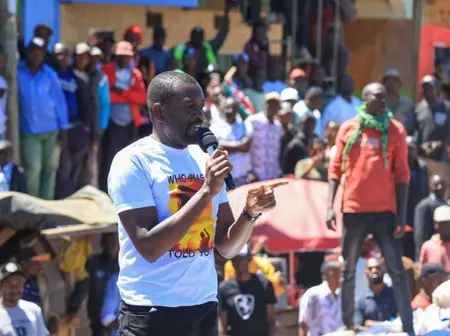
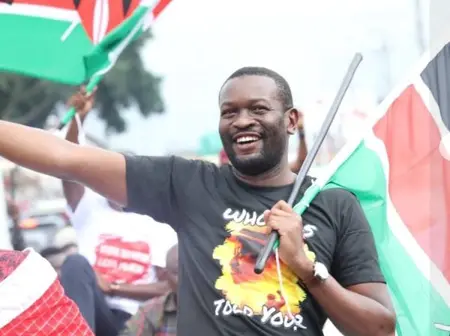
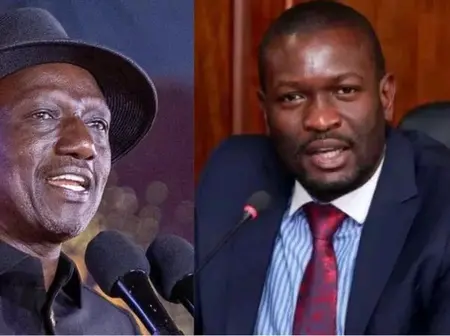
The survey indicates that Sifuna enjoys 39 per cent support among Nairobi respondents, placing him well ahead of Ruto, who has attracted 13 per cent.
Wiper Party leader Kalonzo Musyoka comes third with 11 per cent, followed by former Interior Cabinet Secretary Fred Matiang’i at 10 per cent. Former Deputy President Rigathi Gachagua trails with three per cent, while 17 per cent of respondents are yet to settle on their preferred candidate.
Despite his strong performance in the capital, Sifuna faces a much closer contest nationally, where he is tied with Ruto at 31 per cent, according to the findings.
The regional figures reveal that Sifuna's strongest support is in Western Kenya, where he commands 55 per cent. He also enjoys considerable backing in Nairobi at 39 per cent and the Coast region at 36 per cent.
Ruto maintains his strongest support in Northern Kenya, where he records 62 per cent, and Central Rift with 59 per cent. The President also attracts 40 per cent support in the Coast region.
Meanwhile, Kalonzo dominates Lower Eastern with 55 per cent, reflecting his continued political influence in the region. Matiang’i's strongest showing is in Nyanza, where he records 12 per cent.
Nationally, 15 per cent of respondents remain undecided, suggesting that the political landscape could still change significantly before the August 2027 General Election.
TIFA clarified that the survey sought to establish the candidate respondents would prefer to win the presidential election. It cautioned that the findings should not be treated as a direct forecast of actual voting patterns.
The survey released on Thursday, November 12, 2026, places Linda Mwananchi at 17 per cent, making it the second most preferred party nationally behind President William Ruto’s United Democratic Alliance (UDA), which commands 25 per cent support.
ODM, which previously occupied the second position with 20 per cent in TIFA’s June survey, has fallen to 10 per cent, leaving it in third place.
The findings mark a significant political breakthrough for Sifuna’s camp, which emerged from disagreements within ODM over the party’s cooperation with Ruto’s administration and its political direction following the death of longtime leader Raila Odinga.
TIFA observed that Linda Mwananchi had risen rapidly from an initially insignificant position to become a major political force, largely attracting supporters who previously identified with ODM.
The movement's growing popularity is also reflected in its regional performance. It enjoys 40 per cent support in Western Kenya, 26 per cent in Nairobi, 18 per cent in Nyanza and 16 per cent at the Coast.
ODM, meanwhile, maintains its strongest support in Nyanza at 33 per cent, followed by 14 per cent at the Coast, 10 per cent in Western and nine per cent in Nairobi.
The latest figures suggest that although ODM retains considerable influence in its traditional strongholds, Sifuna's political formation is increasingly challenging its dominance beyond those regions.
The rivalry between the two camps has intensified as they position themselves ahead of the 2027 General Election, with both seeking to consolidate the political support previously associated with Raila.
ODM leader Oburu Oginga faces growing pressure as his faction pursues possible cooperation with UDA, a position that has attracted resistance from supporters of the Linda Mwananchi camp.
On October 30, the movement unveiled its proposed national leadership, with Sifuna named party leader-designate and Trans Nzoia Governor George Natembeya selected to lead its presidential campaign.
The group is scheduled to hold its National Delegates Convention on November 13 to consider and ratify the proposed leadership arrangements, although the process has attracted legal challenges.
Despite the impressive polling figures, TIFA cautioned that popularity does not necessarily translate into electoral victory, noting that Linda Mwananchi must establish a strong nationwide organisational network before the 2027 elections.
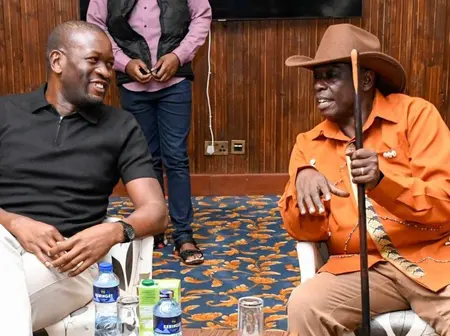
Orange Democratic Movement (ODM) leader Oburu Oginga has paid tribute to Senator Methu, recalling how the legislator visited him when he was unwell.
Oburu expressed his appreciation for Methu's gesture, describing the visit as a demonstration of friendship and concern during a difficult moment in his life.
The ODM leader's remarks highlighted the importance of standing with friends and colleagues during challenging times, particularly when they are dealing with health complications.
Oburu's tribute also offered a glimpse into his personal relationship with the senator, showing that their association goes beyond political engagements.
The remarks come as Oburu continues to attract attention following his recent return to the Senate after experiencing health complications that had kept him away from parliamentary proceedings.
His return was warmly received by fellow legislators and political supporters, with his appearance marking an important moment for the veteran politician.
Oburu has remained an influential figure in ODM politics, particularly following the death of his elder brother, former Prime Minister Raila Odinga, whose political legacy continues to shape the party.
His appreciation of Senator Methu has also drawn attention to the personal connections that exist among politicians despite their different political responsibilities.
The tribute has provided another moment of public interest surrounding Oburu's recovery and his interactions with fellow leaders.
The senator's visit appears to have left a lasting impression on Oburu, who chose to publicly acknowledge the gesture and express his gratitude.
Findings presented in the research firm's November 2026 survey indicate that 55 per cent of Ruto's supporters want Kindiki to remain in the position for another presidential term.
Kindiki's support places him ahead of several prominent political figures mentioned as possible alternatives in the Kenya Kwanza succession discussions.
ODM National Chairperson Gladys Wanga follows with 12 per cent, while Mining and Blue Economy Cabinet Secretary Hassan Joho attracts 9 per cent.
Other figures featured in the survey include ODM leader Oburu Oginga, Prime Cabinet Secretary Musalia Mudavadi and National Assembly Speaker Moses Wetang'ula, who each received 4 per cent.
The results indicate that the alternative candidates collectively account for 33 per cent of the preferences captured in the survey, although none individually matches Kindiki's reported support.
Kindiki took over the Deputy President's office in November 2024 after Parliament impeached his predecessor, Rigathi Gachagua.
His appointment followed a major political fallout within the Kenya Kwanza administration, which led to Gachagua's removal from office and opened the way for the former Tharaka Nithi Senator to join Ruto's administration.
Since his appointment, Kindiki has remained a regular presence alongside the President during government functions, development tours and public engagements.
The latest findings provide an indication of how Ruto's supporters view the current deputy president as political parties and their leaders begin positioning themselves for the 2027 General Election.
However, the survey captures the preferences of Ruto's supporters rather than the views of the entire Kenyan electorate.
The survey published on Thursday, November 12, 2026, indicates that 34 per cent of DCP supporters would prefer Sifuna to win the 2027 presidential election, compared to 25 per cent who favour Gachagua.
The findings come amid growing political engagements between the two leaders as opposition figures explore possible alliances ahead of the next General Election.
Sifuna and Gachagua have recently demonstrated a willingness to work together despite coming from different political backgrounds. Their October 20 meeting at Gachagua’s Wamunyoro residence in Nyeri County brought together several leaders associated with the Linda Mwananchi Movement.
During the engagement, Gachagua welcomed Sifuna and his delegation, describing them as his cousins and expressing optimism about their political partnership.
The former Deputy President has also indicated that he would be willing to deputise Sifuna should the Nairobi senator emerge as the opposition's preferred presidential candidate.
However, Gachagua has maintained that the Mt Kenya region will not automatically support any presidential aspirant without negotiations over its interests.
Speaking at the Ngemi cia Watho Cultural Festival in Thika on November 7, he recalled how the region supported President William Ruto in 2022 without securing sufficient political commitments.
Gachagua insisted that future political support would depend on consultations, trust, integrity and commitments from potential partners.
The TIFA survey also highlighted Sifuna's support within the Linda Mwananchi camp, where he recorded 90 per cent preference. Meanwhile, Ruto received 85 per cent support among UDA supporters.
The report further established that 69 per cent of Kikuyu respondents identified Gachagua as a community leader, a separate measure from presidential preference.
The findings come as opposition leaders continue navigating discussions over a possible joint presidential candidate for 2027.
Although the Sifuna-Gachagua engagement has attracted attention, the question of who will eventually lead the opposition ticket remains unresolved.
According to the poll released on November 12, 2026, 43 percent of respondents perceive Gachagua as the main individual responsible for the fragmentation currently witnessed in the political divide.
The data suggests that public sentiment places the burden of the opposition's internal conflicts squarely on the former second in command.
The survey indicates that Gachagua's actions and political maneuvers are widely seen as a divisive factor contributing to the lack of cohesion among those seeking to challenge the current administration.
In stark contrast to the focus on the former Deputy President, only 15 percent of those polled blamed President William Ruto and the United Democratic Alliance government for the rifts within the opposition.
This finding is particularly noteworthy as it suggests that the ruling party is not being widely viewed as the primary instigator of the splits occurring among their political rivals.
Instead, the electorate appears to believe that the discord is largely internally generated and driven by specific opposition personalities.
The findings highlight a challenging dynamic for the opposition coalition as it attempts to present a united front. With a substantial majority attributing the infighting to Gachagua, the survey underscores the deep rooted perceptions regarding his role in the current political realignment.
These insights from the TIFA study offer a critical look at public opinion regarding political accountability and the internal dynamics shaping the country's opposition politics.
Oburu said the party did not enter the arrangement out of political weakness or pressure from the government but because it believed cooperation would provide an opportunity to address challenges facing the country.
Speaking about the partnership, Oburu maintained that ODM remains an independent political party with its own identity, structures and political ambitions.
He explained that the arrangement was initiated by the late former Prime Minister Raila Odinga, who entered into an agreement with President Ruto to promote national dialogue and cooperation.
According to Oburu, ODM saw an opportunity to influence government policies and push for its development priorities rather than remain outside the administration.
He also maintained that the party had not abandoned its founding principles by working with Ruto's administration.
Oburu has previously cited areas such as affordable housing and universal healthcare as some of the issues where ODM and the government share common priorities.
The ODM leader has also insisted that the party will not be swallowed by the ruling United Democratic Alliance (UDA), maintaining that it joined the arrangement from a position of strength.
His remarks come amid growing political debate within ODM over its relationship with Ruto's administration and the party's position ahead of the 2027 General Election.
While some party members support continued cooperation, others have questioned the political direction of the arrangement.
Oburu has maintained that ODM will continue protecting its interests while participating in discussions concerning the country's future.
The party's next political decisions are expected to shape its relationship with Ruto's camp as the country moves closer to the 2027 elections.
Speaking about his health scare, Oburu revealed that his condition had become worrying, making him believe that he could die before getting an opportunity to express his views in Parliament.
“I thought I was going to die,” he said while reflecting on the difficult experience.
The veteran politician also took time to appreciate Nyandarua Senator John Methu for visiting him while he was admitted to hospital. He used the opportunity to dismiss any suggestion that the two were political enemies, insisting that their political differences did not make them personal rivals.
“We are not enemies,” Oburu said, acknowledging Methu's gesture during his hospitalisation.
However, the moment also attracted attention when Oburu appeared to mix up the names of political parties while referring to Methu. He mentioned DCP as DGP, prompting fellow senators to quickly correct him as he spoke about Methu's position in the party.
The exchange brought a lighter moment to the discussion, but Oburu's account of his illness remained the main highlight.
His appreciation of Methu also sent a message about the possibility of maintaining cordial personal relationships despite belonging to opposing political camps. The senator's hospital visit appeared to be a gesture Oburu genuinely valued, showing that political competition does not necessarily have to translate into personal hostility.
Nyeri Woman Representative Rahab Mukami has received good news after the latest opinion poll ranked her ahead in the race for the seat she currently holds.
Second place goes to Anita Thumbi at 15.6%, followed by Karen Mwangi and Jacinta Wahome with 13.8% and 12.3%, respectively.
Wangechi Wahome has 9.7%, followed by Wangu Mathenge at 7.2%, Brenda Wangui Gatere at 5.9%, and Faith Muita at 4.9%. Nyawira wa Kariuki has 4.3%, while Hellen Mwangi closes the top ten with 2.7%.
Mukami is serving her second term as Nyeri Woman Representative. She was first elected in 2017 on a Jubilee Party ticket. Mukami successfully retained the seat in 2022 on a United Democratic Alliance (UDA) ticket.
Despite being an ally of President William Ruto, Mukami voted against the impeachment of former Deputy President Rigathi Gachagua when the motion was tabled in the National Assembly in 2024.
Mukami is seeking a third term on a UDA ticket, even though she comes from Nyeri, Gachagua's home county. The Woman Representative is expected to face a Democracy for the Citizens Party (DCP) candidate whom Gachagua will front for the seat in his political backyard.
The poll was conducted between October 26 and November 5, 2026, using face-to-face interviews in households involving a nationally representative sample of 2,036 respondents drawn from nine regions: Central Rift, Coast, Lower Eastern, Mt Kenya, Nairobi, Northern, Nyanza, South Rift and Western. Most interviews were conducted in Kiswahili, while others were carried out in English.The survey carries a margin of error of plus or minus 2.16 percentage points, although the margin is higher when analysing smaller respondent groups.
Sifuna has recorded a remarkable increase in his presidential ratings, moving from zero per cent in August 2022, September 2025 and November 2025 to 10 per cent in May 2026. His support subsequently climbed to 15 per cent in June before reaching 31 per cent in November.
Ruto’s popularity has followed a more gradual upward trajectory. He garnered 16 per cent in September 2025 and 19 per cent in November of the same year. His rating increased to 24 per cent in both May and June 2026 before rising to 31 per cent in the latest findings.Former Interior Cabinet Secretary Fred Matiang’i, who had previously occupied the leading position in presidential preference rankings, registered the biggest decline among the major contenders.
His support dropped from 32 per cent in August 2022 to 21 per cent in September 2025 and 18 per cent in November that year. The figure further declined to 14 per cent in both May and June 2026 before falling to just five per cent in November.
Former Vice-President Kalonzo Musyoka has similarly experienced a decline in his ratings after attaining a high of 25 per cent in November 2025. His support decreased to 19 per cent in May 2026, 13 per cent in June and nine per cent in the latest survey.
Former Deputy President Rigathi Gachagua has also witnessed fluctuations in his popularity. After reaching nine per cent in May 2026, his rating stood at seven per cent in June and dropped to four per cent in November. He had previously recorded two per cent in August 2022, six per cent in September 2025 and three per cent in November 2025.
Meanwhile, support for other potential presidential candidates has fallen considerably, declining from a high of 14 per cent in September 2025 to just one per cent in the latest survey.The proportion of undecided voters stood at 15 per cent in November, representing a decline from 20 per cent recorded in June. Respondents who declined to state their preferences accounted for four per cent, maintaining a relatively small and stable share.
Despite the latest rankings, the figures reflect voters' declared preferences at the time the research was conducted rather than determining who will eventually win the 2027 presidential election. Political realignments, campaign strategies, policy agendas, official candidature announcements and other developments could significantly influence voter choices before the polls.
Sifuna's emergence at the top is particularly notable given that he had not registered measurable support in the earlier survey periods. His latest 31 per cent rating places him above established presidential contenders, including Matiang’i, Kalonzo and Gachagua.
For Ruto, the latest findings indicate an improvement from the 24 per cent support he recorded in June 2026, with his rating rising to 31 per cent in November.Overall, the survey offers a glimpse into the changing political landscape ahead of the 2027 General Election, showing Ruto and Sifuna sharing the leading position while other presidential hopefuls trail considerably behind.