The Kenya Defence Forces has announced recruitment for General Service Officer Cadets and Specialist Officers and General Duty Recruits and Tradesmen and women in December 2026.
In a notice on November 12 KDF said the exercise will cover regular and graduate officer cadets. It will also cover candidates seeking to join through specialist and technical positions.
Applicants must be Kenyan citizens with valid national identity cards and no criminal records. They must also present original documents alongside four copies of their national ID cards and KRA PIN certificates and academic certificates.
Regular cadets must be aged between 18 and 23 years. Graduate cadets and general duty recruits and tradesmen and women must be between 18 and 26 years. Specialist officers must not be above 30 years.
KDF has also set minimum physical requirements. Men must be at least 1.60 metres tall while women must be at least 1.52 metres. Men must weigh at least 54.55 kilogrammes and women at least 50 kilogrammes. Applicants must have a Body Mass Index of between 18.5 and 30.0. Female candidates must not be pregnant.
Regular cadets need a minimum KCSE mean grade of B plain with at least C plus in English and Mathematics and one Science subject. They will train for three years and earn a Bachelor of Science degree in Defence and Security Studies.
Graduate cadets must meet the same academic requirements and hold a bachelor’s degree in a discipline specified by KDF. Their training will last 15 months.
General duty recruits need a minimum KCSE mean grade of D plain. Those who completed National Youth Service training have an added advantage.
Tradesmen and women applying for diploma level positions need at least a C minus.
President William Ruto has directed the Ministry of Education and the Teachers Service Commission (TSC) to review government capitation for public schools, raising hopes of increased funding for learning institutions across the country.The Head of State said the government was considering increasing the amount allocated per learner to enable schools to meet operational expenses and improve the quality of education.
Mining, Blue Economy and Maritime Affairs Cabinet Secretary Hassan Joho has explained why he scored a D in his Kenya Certificate of Secondary Education (KCSE) exams.
Joho said he did not perform poorly because he lacked intelligence. Instead, he blamed his low grade on the financial problems his family faced while he was in school.
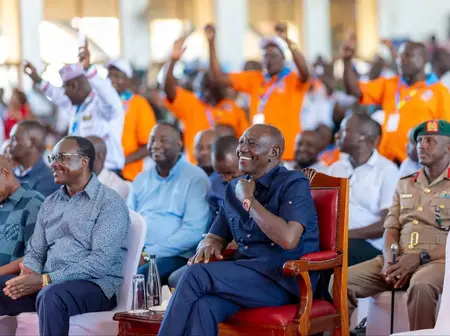
He spoke on Thursday, November 11, during the Kenya Comprehensive School Heads Association (KECSHA) conference in Mombasa. President William Ruto was also present.
Joho told the school heads that his parents struggled to pay his school fees. As a result, he sometimes missed an entire school term because his family could not afford the fees.
He said he was a bright student and believed he would have scored an A if he had studied under the current government system.
According to Joho, students should be judged by their ability and not by how much money their parents have.
He praised President Ruto's Usawa Wa Maendeleo agenda, saying it could give children from poor families a fair chance to succeed in school.
Joho added that many bright students in Kenya fail to reach their full potential because their families cannot afford their education.
His story has brought attention to the challenges faced by students from poor families and the need to give every child equal access to education.
Innovative teachers in Embu County are putting to use tablets distributed to schools more than a decade ago, giving rural learners a chance to build digital and computer literacy skills. Many of the devices elsewhere remain idle in stores or have been damaged.In some schools in Mbeere North, learners take photos and record videos of school activities, including outdoor lessons, under the guidance of teachers with basic ICT skills who volunteer their time.
Mining Cabinet Secretary Hassan Joho has joined President William Ruto at the Kenya Comprehensive School Heads Association (KECSHA) Annual General Meeting and National Conference in Mombasa County.
The meeting was held at the Sheikh Zayed Children Welfare Centre under the theme, “Re-imagining the Comprehensive School of the Future: Strengthening Leadership, Systems, Skills and Values for Sustainable Quality Education.”
In a statement shared on his official X account, Joho said the conference came at an important time as the government continues to implement major education reforms.
He noted that school heads have an important role beyond managing schools.
They are responsible for creating good learning environments, nurturing talent, teaching learners good values and ensuring every child gets an opportunity to succeed.
Joho said building future-ready schools requires strong leadership, better systems and support for teachers.
“Ultimately, re-imagining the school of the future requires visionary leadership, strong systems, empowered educators and a collective commitment to placing the learner at the heart of our education agenda,” he stated.
Kenya's long-settled debate over caning in schools has resurfaced, after members of the National Assembly Committee on Education have hinted at scrapping the legal provisions that outlaw corporal punishment.
The signal has come at a time when worries about student indiscipline and violence against teachers have grown steadily, and when several schools have been torched by rogue students this year.
The development has been reported by KTN News Kenya, which has drawn on a story first published by The Standard, and the two outlets have framed it as a real possibility rather than a settled decision. No law has been changed yet, but the committee's hint has been enough to set tongues wagging.
Online, Kenyans have responded in large numbers, and their views have split sharply. Some have rejected the idea outright, with one commenter pleading that the cane should never be introduced again. Another has argued that parents should discipline their own children at home instead.
Others have taken a more conditional stance. A few have suggested that the Ministry of Education should hire dedicated disciplinarians to administer the cane, so that teachers are not the ones holding it.
A similar voice has proposed employing people specifically for caning, a suggestion that has drawn laughter from fellow commenters.
Supporters have not been shy either. One reader has endorsed the proposal wholeheartedly, while another has simply said lawmakers should do what they see fit.
Some have turned the question back on the legislators. One woman has asked whether MPs would accept the same treatment for their own children, or whether the rules have been meant only for public schools.
Her question has pointed to a fairness gap that lawmakers have yet to address.
So far, the idea has remained a hint rather than a bill. Yet the strength of public feeling has made one thing clear: any move to restore corporal punishment now has to answer hard questions about who administers it, who it covers, and how teachers can be protected without reviving methods the country has deliberately left behind. Parents, teachers and lawmakers have not yet found common ground.
A new proposal targeting the cost of school uniforms could bring significant relief to Kenyan parents struggling to meet their children's education expenses. The recommendation seeks to introduce standardised school uniforms across learning institutions, potentially changing how schools prescribe clothing and how parents purchase it.
The proposal emerged from discussions on education reforms during the National Education Conference in Naivasha. It aims to address the financial burden associated with purchasing school uniforms, particularly for families with several children attending different schools.
Currently, many schools prescribe unique uniform designs, colours and styles. This arrangement sometimes forces parents to purchase uniforms from specific suppliers, limiting their options and increasing costs.
Under the proposed changes, learners across different schools could wear standardised uniforms, with individual institutions maintaining their identities through school badges and other distinctive insignia.
The recommendation is intended to promote equality among learners while reducing unnecessary differences in uniform costs. It could also make it easier for parents to purchase replacement uniforms without being restricted to particular suppliers.
Another key proposal involves regulating the prices of school uniforms to protect parents from excessive charges. The government would seek ways to ensure that schools and suppliers do not impose unreasonable costs on families.
However, the proposal has attracted opposition from some school administrators. The Kenya Secondary School Heads Association (KESSHA) has raised concerns that standardising uniforms could undermine the identity, heritage and traditions of individual institutions.
School heads argue that uniforms are an important part of institutional culture and help learners develop a sense of belonging. They also believe distinctive designs make it easier to identify students, particularly when disciplinary issues arise outside school compounds.
The association has further questioned whether a common uniform would accommodate the different climatic conditions across the country. Schools in colder regions require heavier clothing than those located in warmer areas, making a completely uniform approach difficult to implement.
Instead of introducing identical uniforms, school administrators have advocated for measures that would make existing designs more affordable while allowing institutions to retain their identities.
The debate comes amid wider government efforts to address the financial challenges facing parents under the basic education system.
Education Cabinet Secretary Julius Migos Ogamba has previously indicated that the government was considering amendments to the Basic Education Act to prevent schools from forcing parents to purchase uniforms from specific suppliers.
The proposed legal changes are intended to give parents greater freedom to buy uniforms from the open market, provided they meet the requirements established by individual schools.
Nyeri Town MP Duncan Mathenge has also pushed for measures to protect learners from discriminatory practices that prevent them from accessing education because their parents cannot afford certain school requirements.
His proposal seeks to ensure that learners are not denied access to education because of their families' financial circumstances.
Despite the growing debate, the proposal to standardise school uniforms should not be confused with a confirmed government programme to distribute free uniforms to all learners. The recommendations currently focus on reducing costs, promoting standardisation and giving parents more affordable purchasing options.
The government has yet to announce a nationwide implementation date, meaning parents should continue following existing school requirements until official guidelines are issued.
If adopted, the proposed reforms could significantly change the school uniform system and reduce some of the financial pressure experienced by Kenyan households. However, the final decision will depend on consultations between the government, school administrators and other education stakeholders.
President William Ruto has defended the Affordable Housing Levy, saying proposed changes to Pay As You Earn (PAYE) tax rates will leave workers, including teachers, with more money in their monthly take-home salaries.Speaking during the official opening of the Kenya Comprehensive School Heads Association (KECSHA) meeting in Mombasa on Thursday, Ruto explained that the proposed tax adjustments would more than compensate workers for deductions made under the Affordable Housing Programme.
Interview SMS Out: TSC Lists Documents Junior School Teachers Must CarryThe Teachers Service Commission (TSC) has begun sending SMS invitations to teachers who applied for the 20,000 junior school teaching jobs, in a recruitment exercise that is expected to end with successful candidates reporting to their schools in January 2027 under new terms of service.
The University of Southern California will teach MBA students how the global superstar transformed musical success into a diversified business empire spanning entertainment, beauty, fashion and spirits.Beyoncé is heading to business school, although this time she will be the subject of the lesson rather than a student.