
The order arrives with congratulations. The invoice leaves with a promise. Three months later, the entrepreneur is borrowing to pay the workers who made the delivery possible. The customer has bought goods and quietly obtained a second product: credit financed by the supplier.Late payment is therefore more than an administrative irritation.
Category: Economy&Finance
-

Sudan lifts ban on Kenyan tea imports, reopening export market
Kenya’s tea industry has regained access to the Sudanese market after the North African country lifted a 20-month ban on tea imports from Kenya, reopening an important export destination for local producers.The decision was formalised through Ministerial Order No. 25 of 2026, issued by Sudan’s Ministry of Industry and Trade on Sunday, November 8, and signed by Industry and Trade Minister Mahasin Ali Yaqoub.
-
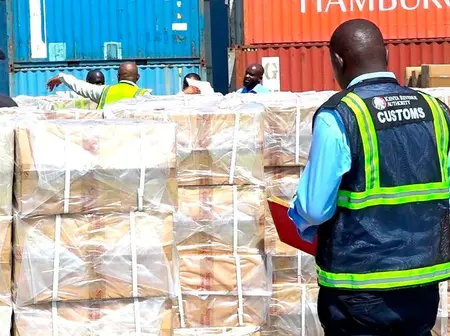
Why Uganda supplies 95 percent of Kenya’s illicit cigarettes
Kenya’s booming illicit cigarette market is largely fed by Uganda, which accounts for most contraband tobacco products entering the country. This has deprived the government of Sh47 billion in tax revenue over the five years.
The study by Kantar Insights East Africa, a market research firm, shows that 95 percent of illicit cigarettes entering Kenya originate in Uganda. The remaining five percent comes from South Sudan and Somalia.
-

Court Grants Defense Four Months To Peruse Ksh1.57Bn Treasury Scandal Files
In Summary:Defense lawyers in the KSh1.57 billion National Treasury scandal have been granted four months to peruse voluminous prosecution documents ahead of the hearing.Lawyer Danstan Omari separately urged the court to direct the EACC to bring the outstanding documents to court and serve all parties in person to avoid logistical challenges associated with their delivery.
-

Kenya’s ksh2.6T Investment Pipeline: Dangote, Devki Projects Take Centre Stage
Investments, Trade and Industry Cabinet Secretary Lee Kinyanjui has announced that Kenya attracted a record Ksh 414 billion in foreign direct investment in 2025, as the government steps up efforts to establish the country as a manufacturing and investment centre for the African market.The latest investment figures come amid plans for major industrial developments, including a Ksh 2.2 trillion petroleum refinery in Lamu, a Ksh 389.4 billion electric vehicle manufacturing project and several manufacturing facilities across different counties.
-
Kenya extends temporary fuel sulphur limit for six months amid global supply uncertainty
The government has extended by another six months the temporary adjustment of sulphur limits in petrol and diesel, citing continued geopolitical uncertainty in the Middle East and disruptions to global petroleum supply chains.
The decision allows fuel supplied in Kenya to contain a maximum of 50 milligrams of sulphur per kilogram (50mg/kg), extending a temporary measure introduced to widen the country's access to fuel supplies and guard against potential shortages.
In a notice, Investments, Trade and Industry Cabinet Secretary Lee Kinyanjui said the extension followed a request from the Ministry of Energy and Petroleum and a recommendation by the National Standards Council.
“The decision follows a technical assessment and monitoring of the continuing geopolitical uncertainty in the Middle East and related disruptions affecting global petroleum supply chains, including the Strait of Hormuz,” Kinyanjui said.
The adjustment applies to two fuel standards: KS EAS 177:2025, which governs automotive gas oil (diesel), and KS EAS 158:2025, covering automotive gasoline, commonly known as premium motor spirit (petrol).
Kinyanjui said the decision was informed by a technical assessment and continued monitoring of international petroleum markets, particularly disruptions linked to tensions in the Middle East.
The Strait of Hormuz, a critical global shipping route through which a significant share of the world's oil supplies passes, remains a major concern for energy-importing countries amid geopolitical uncertainty.
The government said the temporary adjustment would give Kenya access to a wider range of compliant fuel sources at a time when disruptions to international supply chains could affect availability.
"The decision follows a technical assessment and monitoring of the continuing geopolitical uncertainty in the Middle East and related disruptions affecting global petroleum supply chains, including the Strait of Hormuz," Kinyanjui said.
He added that the extension was intended to widen available sources of compliant fuel and safeguard the country against supply shortages.
The move comes as Kenya remains exposed to fluctuations in international oil prices and supply disruptions because it relies heavily on imported petroleum products to meet domestic demand.
Any prolonged disruption to shipments through major international shipping routes could affect the cost and availability of petroleum products, with possible consequences for transport, manufacturing, agriculture and the wider economy.
Fuel prices are particularly sensitive to international market movements because petroleum products account for a significant share of Kenya's import expenditure and influence the cost of transporting goods and delivering services.
The government said the adjustment was a temporary intervention aimed at maintaining uninterrupted fuel availability and protecting economic stability.
The extension will remain in force for six months, after which authorities will review the measure.
It may also be reconsidered earlier if international supply conditions improve.
The latest decision effectively gives fuel suppliers additional flexibility in sourcing petroleum products while maintaining the specified sulphur ceiling under the temporary arrangement.
Sulphur content is an important fuel quality parameter because burning sulphur-containing fuels releases sulphur dioxide, a pollutant associated with respiratory problems and environmental damage.
The temporary adjustment therefore raises the importance of balancing energy security and affordability with environmental and public health considerations.
The government has maintained that the measure is driven by exceptional international supply conditions rather than a permanent change to Kenya's fuel quality standards.
Kinyanjui said the six-month review period would allow authorities to assess developments in global petroleum markets and determine whether the temporary adjustment remains necessary.
-
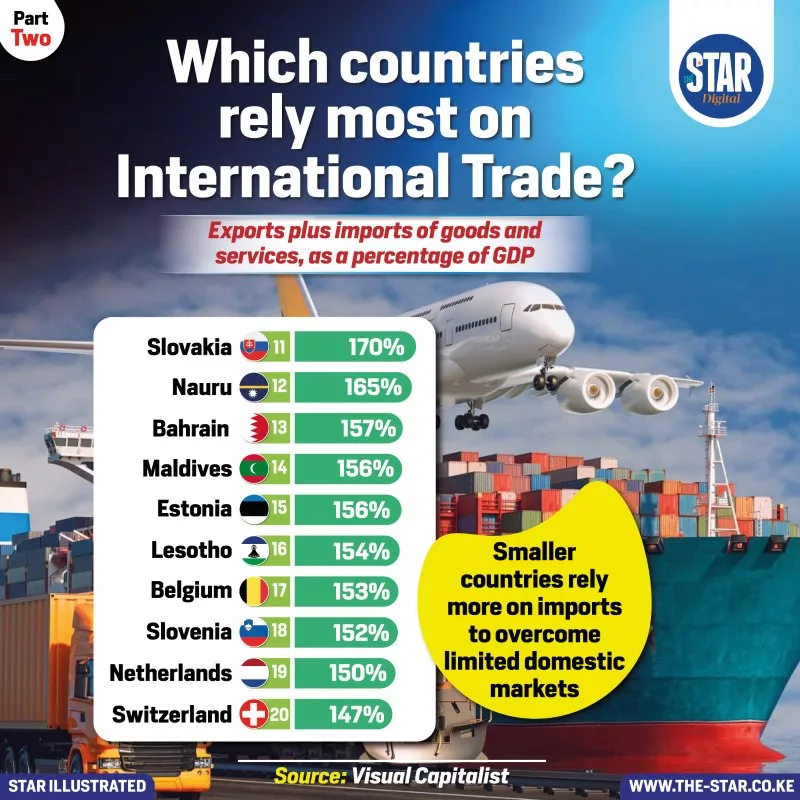
Which countries rely most on international trade?
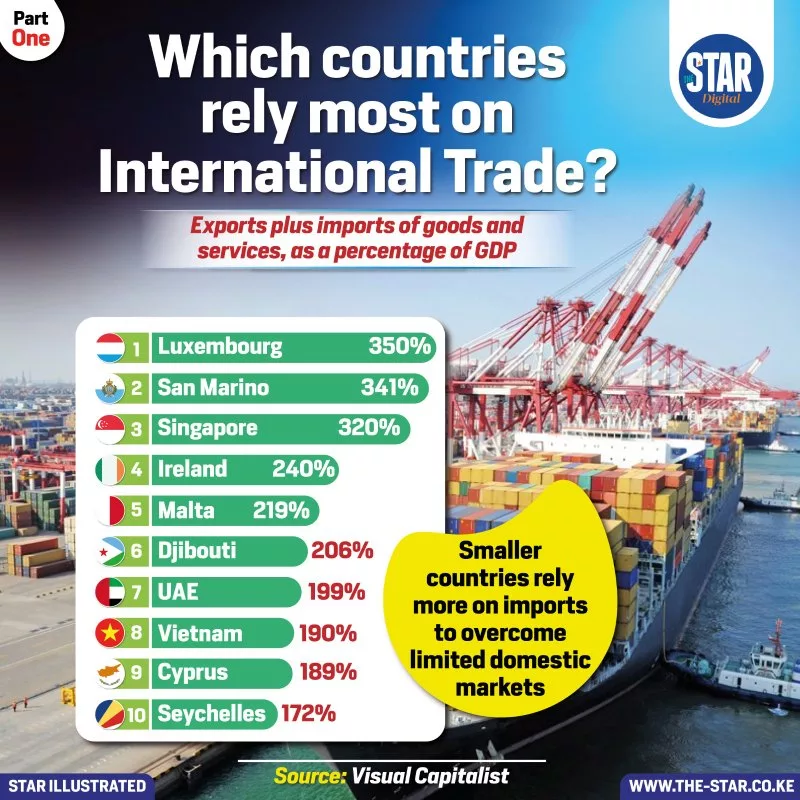
Global economic data measuring international trade—calculated as the sum of exports and imports of goods and services as a percentage of gross domestic product—reveals that smaller nations heavily rely on trade to overcome limited domestic markets.
Luxembourg leads the global rankings by a significant margin, recording a trade-to-GDP ratio of 350 percent.
San Marino follows closely behind in second place at 341 percent, while Singapore secures third place with 320 percent.
The rankings continue with Ireland registering 240 percent and Malta standing at 219 per cent. Djibouti records 206 per cent, closely followed by the United Arab Emirates at 199 per cent, Vietnam at 190 per cent, and Cyprus at 189 per cent.
Seychelles rounds out the top ten economies with a trade ratio of 172 percent.
Moving further down the global index, Slovakia registers 170 per cent, Nauru follows at 165 per cent, and Bahrain stands at 157 per cent.
Both the Maldives and Estonia share a ratio of 156 percent, while Lesotho records 154 per cent and Belgium registers 153 per cent.
Slovenia follows at 152 percent, the Netherlands at 150 per cent, and Switzerland concludes the upper tier of the rankings at 147 per cent.
Across all these nations, extensive engagement in cross-border commerce serves as a vital economic driver, frequently exceeding the entire monetary value of their domestic economic output.
-
Kenyan avocados eye bigger China market as zero tariffs open new opportunities
Kenyan avocado exporters are targeting a bigger share of the Chinese market after Beijing scrapped import tariffs for Kenya and 52 other African countries, creating fresh opportunities for agricultural trade.
The opportunity was highlighted at the ninth China International Import Expo (CIIE) in Shanghai, where Kenya showcased avocados, tea and fresh-cut flowers as it seeks to strengthen its presence in the Asian market.
China extended zero-tariff treatment to all 53 African countries with which it maintains diplomatic relations on May 1, 2026. The move brought another 20 countries, including Kenya, Ghana and South Africa, under the arrangement.
The expanded policy is expected to make African products more competitive in China by reducing the cost of accessing the market. For the newly covered countries, the arrangement is set to remain in place until April 2028.
According to the Chinese Embassy in Nairobi, 6.9 tonnes of fresh Kenyan avocados arrived at Guangzhou Port on May 1, while another 320 tonnes of Kenyan crude avocado oil docked at Dalian Port on May 9.
The shipments formed part of the inaugural exports flagged off on March 24 at the Standard Gauge Railway terminus in Nairobi by Chinese Vice President Han Zheng and Kenya’s Deputy President Kithure Kindiki.
China Ambassador to Kenya Guo Haiyan noted that the initiative is expected to deepen trade cooperation between the two countries while increasing earnings for Kenyan farmers and exporters.
The policy removes tariffs on selected products from African countries, making them more competitive in the Chinese market and encouraging higher exports.
China has also upgraded its green channel for African agricultural and food products, streamlining quarantine procedures to facilitate imports.
The benefits are already being felt by other African exporters. China Daily reported that tariffs on South African citrus imports had fallen from between 10 and 12 per cent to zero.
Chinese fruit importer Joy Wing Mau said its imports of South African citrus had increased by 50 per cent year-on-year since the policy took effect.
Beyond fresh produce, the expanded trade arrangement is opening opportunities for African businesses to explore new markets and develop partnerships with Chinese companies.
The ninth CIIE has provided a platform for exporters to showcase their products, meet potential buyers and pursue business partnerships. Kenya's pavilion features agricultural products, including avocados, tea and fresh-cut flowers.
The broader trade relationship is also expanding. China-Africa trade reached 312.11 billion US dollars in the first nine months of 2026, representing a 22.3 per cent increase year-on-year. China's imports from Africa rose by 18.5 per cent to 109.14 billion dollars over the same period.
For Kenyan exporters, the zero-tariff arrangement offers an opportunity to grow shipments, reach more consumers and strengthen the country's agricultural export market in China.
According to Beijing, the policy demonstrates China’s commitment to deepening economic cooperation with Africa and supporting the continent’s exports through easier market access.
This makes China the first major economy to voluntarily extend such broad tariff exemptions to African states.
For Kenya, the development is being viewed as a major boost for exporters who have been pushing for better access to the Chinese market to help narrow the long-standing trade imbalance between Nairobi and Beijing.
President William Ruto is among African leaders who have welcomed the initiative, seeing it as an opportunity for African products to become more competitive in China.
African Union Commission Chairperson Mahmoud Ali Youssouf also praised the move, describing it as ‘very timely’ and calling it a ‘brotherly gesture.’
Kenya’s avocado sector is expected to be among the immediate beneficiaries of the policy.
With tariffs now removed, Kenyan avocados could gain a stronger pricing advantage, potentially increasing demand among Chinese consumers.
Industry stakeholders say the policy could also create new export opportunities for Kenyan tea, macadamia nuts, coffee, flowers and seafood if producers meet China’s strict quality and phytosanitary requirements.
Chinese authorities say the zero-tariff policy is accompanied by other trade facilitation measures aimed at making it easier for African products to access Chinese markets.
These include upgraded ‘green lanes’ for African agricultural imports, with quarantine clearance procedures made simpler.
China has also committed to risk-based customs management systems intended to reduce delays at ports.
The measures are particularly important for the country’s fresh produce exporters whose products require fast clearance to maintain quality.
Faster customs processing and lower import costs are believed to improve profitability for Kenyan exporters while making African goods more attractive to Chinese buyers.
The initiative also comes as Kenya seeks to diversify export destinations and strengthen economic ties with Asian markets.
China remains one of Kenya’s biggest trading partners, although the country still heavily imports manufactured goods from China.
Kenya is being rallied to increase production capacity, improve value addition and strengthen logistics systems to fully benefit from the preferential access.
-
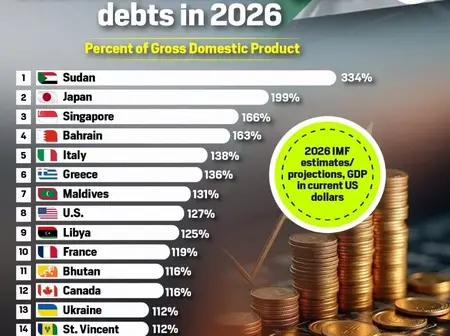
Countries with the highest debts in 2016
Recent IMF estimates and projections measuring debt as a percentage of gross domestic product in current US dollars reveal stark global fiscal pressures, with several nations carrying debt burdens exceeding the size of their entire economies.
At the top of the global ranking, Sudan records the highest debt-to-GDP ratio at a staggering 334 per cent. Japan follows significantly behind in second place at 199 per cent, while Singapore rounds out the top three nations with a debt ratio of 166 per cent.
The data highlights widespread sovereign debt challenges across multiple continents. Bahrain stands at 14th with 163 per cent, followed by European economies such as Italy at 138 per cent and Greece at 136 per cent.
Further down the list, the Maldives registers 131 percent, and the United States stands at 127 per cent. Libya follows closely at 125 per cent, while France records 119 per cent.
Bhutan and Canada share identical ratios at 116 percent, ahead of Ukraine and St. Vincent at 112 per cent, and Cabo Verde and Belgium at 110 per cent.
As the rankings progress into double-digit percentages of economic output, China registers 104 per cent and the United Kingdom records 102 per cent.
Both Bolivia and Dominica sit at 100 per cent, marking the threshold where national debt equals total economic output. Spain follows at 98 per cent, Brazil at 97 per cent, and Sri Lanka at 95 per cent.
Barbados records 94 per cent, while Mozambique and Finland tie at 91 per cent. Mauritius stands at 88 percent, Tunisia at 86 per cent, and Portugal and Suriname conclude the recorded rankings at 85 per cent.
These IMF figures underscore the heavy fiscal liabilities managed by governments worldwide as economic conditions evolve.
-

Kang’ata seeks to turn Kenol into major industrial and commercial hub
Murang’a county is stepping up plans to transform Kenol into a major industrial and commercial centre.
The county is banking on infrastructure development and manufacturing to attract investors and extend Nairobi’s economic growth into the region.
Speaking while commissioning the upgraded Githanji access road in Kenol, Governor Irungu Kang’ata said his administration was prioritising infrastructure projects to prepare the fast-growing municipality for increased business activity and urban expansion.
“We, as a county, must ensure we build a new city here at Makenji. There is no society that develops without manufacturing, and urbanisation is a force for good,” he said.
Kang’ata said Kenol was strategically positioned to benefit from Nairobi’s outward expansion along the Thika Road corridor, where urban growth has extended towards Ruiru, Juja and Thika.
He said Murang’a needed to prepare for the next phase of this expansion by improving infrastructure and creating an environment that would attract businesses and investors.
“Nairobi county must grow towards this region. We are seeing the city developing towards Ruiru, developing towards Juja, and now Thika will go towards Kenol,” he said.
The governor said the county was implementing infrastructure projects to improve connectivity, support Kenol’s growth and stimulate economic activity in surrounding areas.
He argued that urbanisation would increase demand for goods and services, creating business opportunities and employment for residents.
“Urbanisation creates cities, cities create demand, and through demand, that is how people are lifted out of poverty. They create employment,” he said.
The latest infrastructure push builds on Kang’ata’s wider ambition to establish a 1,400-acre industrial city near Del Monte, which he has positioned as a manufacturing and commercial investment destination.
The proposed development comprises a 500-acre Export Processing Zone and an 800-acre Special Economic Zone. Plans include industries, a technology hub, commercial facilities, a stadium, schools, recreational spaces and residential developments.
Within the SEZ, 276 acres have been earmarked for light, medium and heavy industries, while another 75 acres will accommodate a MediCity.
The county is offering investors land at subsidised rates, with leases of up to 99 years, to encourage businesses to establish operations in the proposed industrial zone.
Kang’ata previously said one acre was being offered at Sh7 million, against an estimated market value of Sh35 million. He added that about 60 per cent of the available land had already been booked.
In June, the county issued 44 allotment letters to investors, including companies in healthcare, food processing, agriculture and manufacturing, as it stepped up efforts to attract private capital.
On Monday, Kang’ata met Director of Public Prosecutions Renson Ingonga and handed him an allotment letter for the establishment of an Office of the Director of Public Prosecutions at the site.
The industrialisation drive is anchored on Murang’a’s agricultural potential. The county is seeking to promote the local processing of tea, coffee, milk, avocado and macadamia to increase the value of its produce and create jobs.