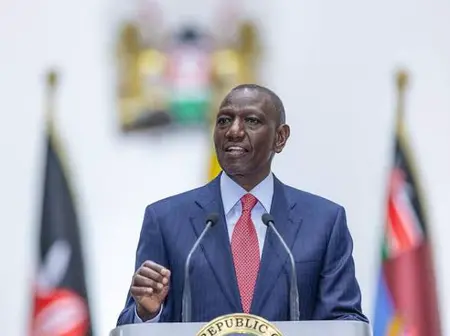
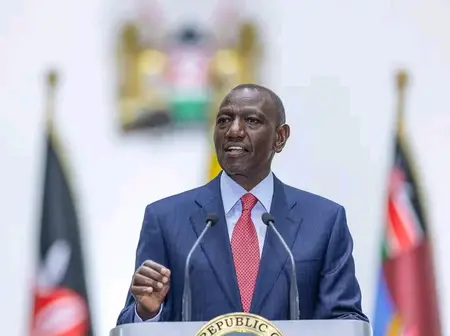
President William Ruto has explained how teachers and other salaried workers could take home more money under proposed changes to the Pay As You Earn (PAYE) tax system, despite continuing to pay the Affordable Housing Levy.
Speaking during the official opening of the Kenya Comprehensive School Heads Association (KECSHA) meeting in Mombasa on Thursday, November 12, 2026, the President defended the housing levy while outlining the financial benefits of the planned tax adjustments.
Ruto said the government intends to increase the monthly income exempted from PAYE taxation from the current KSh24,000 to KSh32,000, meaning workers would pay no income tax on the first KSh32,000 they earn.
According to the President, the proposed adjustment would provide an additional KSh8,000 in tax-free income, translating into monthly savings of KSh2,000 for employees taxed at the 25 per cent rate.
To illustrate the impact, Ruto used the example of a teacher earning KSh50,000 per month.
Under the example, the teacher would contribute KSh750 towards the Affordable Housing Levy, which is calculated at 1.5 per cent of gross salary. However, the proposed PAYE reduction would save the same employee KSh2,000 in monthly taxes.
"So we are saying, you are not going to pay KSh2,000 from your salary, so the KSh750 that you pay, I have returned to you KSh2,000. So the difference is KSh1,250," Ruto explained.
The President argued that the proposed tax relief would leave the employee with an additional KSh1,250 after accounting for the housing levy contribution.
He also dismissed criticism surrounding the housing levy, saying the programme had generated employment and supported the construction of affordable homes, markets and student accommodation facilities.
Ruto disclosed that approximately 1.1 million people were working under the housing programme, while contracts covering houses, markets and student hostels had reached KSh1.2 trillion.
He further revealed that accommodation facilities with a combined capacity of more than 180,000 learners were under construction across the country.
The proposed tax adjustments form part of a wider government plan to raise the monthly tax-free income threshold to KSh32,333 while abolishing the existing KSh2,400 personal relief.
However, the proposed changes have not yet taken effect, meaning workers will continue operating under the existing PAYE structure until the new arrangements are implemented.
President William Ruto's proposed changes to Pay As You Earn (PAYE) taxation could increase the take-home pay of thousands of Kenyan teachers from January 2027.
The proposal seeks to raise the monthly income tax exemption threshold from KSh24,000 to KSh32,333, allowing workers earning within the new limit to retain more of their salaries.
The announcement has attracted attention among teachers employed by the Teachers Service Commission (TSC), many of whom have expressed concerns about statutory deductions and the rising cost of living.
Ruto announced the proposed tax relief during the 2026 Mashujaa Day celebrations, describing it as part of his administration's efforts to ease the financial burden on salaried Kenyans.
National Treasury Cabinet Secretary John Mbadi subsequently explained the expected financial impact, including how much additional money some workers could retain every month.
Under the proposed arrangement, employees earning KSh32,333 or less monthly would be exempted from PAYE. Currently, the income tax exemption threshold stands at KSh24,000.
Mbadi explained that an employee earning KSh32,333 could save approximately KSh2,083 in monthly PAYE deductions if the proposal is approved and implemented.
For teachers whose taxable earnings fall within this bracket, the exemption could provide additional money for household expenses, transport, food and other essential needs.
The Treasury estimates that approximately 362,846 additional formally employed Kenyans would benefit from the proposed changes. This would increase the number of workers exempted from PAYE from approximately 1.33 million to 1.69 million.
The government estimates that Kenya has about 3.47 million formally employed workers, making the proposed adjustment a significant change to the country's income tax structure.
Another example of the potential benefits was provided by Kenya Bankers Association Chief Executive Raimond Molenje, who discussed a teacher earning KSh60,000 monthly.
Molenje used a five-percentage-point adjustment to illustrate how a teacher earning that amount could potentially gain an additional KSh3,000.
However, this was an illustrative calculation and not a confirmed increase in take-home pay for every teacher earning KSh60,000. The actual benefit will depend on the final tax provisions and an employee's taxable income.
The proposed changes come amid continued discussions about teachers' salaries and deductions. In June 2026, TSC explained adjustments to PAYE deductions following corrections to its payroll system to ensure compliance with existing tax requirements.
The commission attributed the adjustments to a payroll configuration issue involving the treatment of certain statutory contributions.
Meanwhile, the latest PAYE proposal is not a salary increment. Instead, it is a proposed tax adjustment that could allow eligible employees to retain a larger portion of their existing earnings.
The Treasury is expected to prepare the necessary legislative proposals for consideration by Parliament. The government is targeting January 2027 for implementation, subject to the completion of the legislative process.
Teachers will therefore be watching closely as Parliament considers the proposal and the Treasury provides further clarification on how different salary brackets will be affected.
If approved, the new tax arrangement could offer meaningful relief to lower-income teachers and other salaried workers struggling with the rising cost of living.
For educators across the country, the key issue will be how much of their monthly earnings they will finally retain once the proposed PAYE changes take effect.
Kenya Power has issued fresh guidance to electricity consumers and business owners, explaining what they should consider before deciding whether to use prepaid electricity tokens or the postpaid billing system.
The electricity distributor says customers should not make the decision based on convenience alone but should also examine their financial situation, daily routines and the amount of electricity they consume every month.
The two payment arrangements work differently, with each offering benefits depending on how a household or business manages its electricity expenses.
In its explanation, Kenya Power noted that the prepaid option is designed for consumers who prefer paying for electricity before using it. Customers purchase tokens in advance and use the available units until their credit runs out.
The arrangement allows households to control how much money they spend on electricity because they can purchase tokens according to their available income.
One of the features highlighted by the company is the Nunua mdogo mdogo option, which allows customers to purchase electricity in smaller amounts rather than having to spend a large sum at once.
This arrangement can be particularly useful for people who receive income daily or weekly and want to spread their electricity expenses across different periods.
Prepaid customers can also monitor their consumption and adjust their usage depending on their remaining tokens. Since electricity is purchased in advance, they do not accumulate unpaid bills.
However, the system has a major consideration. Once the purchased electricity units are exhausted, the supply automatically stops until the customer buys additional tokens.
On the other hand, Kenya Power explained that the postpaid arrangement allows customers to consume electricity throughout the month before receiving a consolidated bill for payment.
Unlike prepaid users, postpaid customers do not have to keep purchasing tokens to maintain their electricity supply. This makes the arrangement suitable for households and businesses that require consistent electricity and have relatively high consumption.
The company noted that the system can benefit busy consumers who may not have time to monitor their electricity meters or regularly purchase tokens.
Businesses that depend on uninterrupted electricity for their daily operations may also find postpaid billing more convenient because they do not face interruptions simply because prepaid units have run out.
Kenya Power advised customers to examine four important considerations before settling on either arrangement.
These include their financial habits, ability to budget for electricity, daily consumption patterns and the need for a continuous power supply.
For consumers who want strict control over their spending and prefer purchasing electricity in manageable amounts, prepaid may be the better option.
Meanwhile, households and businesses with heavy or unpredictable electricity needs may find postpaid more convenient.
The utility company's latest explanation comes as electricity costs remain an important consideration for Kenyan households and businesses seeking ways to manage their monthly expenses.
Kenya Power has also previously advised consumers to unplug appliances that are not in use. The company warned that some electrical devices can continue drawing power even when switched off but left connected to sockets, potentially increasing electricity consumption.
Ultimately, the company wants customers to understand how both arrangements work before making a decision that could affect their household budgets or business operations.
Journalist Sam Gituku has taken Kenyans down memory lane after revealing that he once worked as a train driver.
In a post shared online, he looked back on that chapter of his life with obvious pride, and the message has quickly drawn attention from people who only know him from the newsroom.
According to Gituku, his best ride during that time was one he remembers by its number, 8723. He did not say much about the journey itself, but the way he singled it out suggests it left a lasting mark on him.
Trains are often a source of fond memories for many Kenyans, and the number alone was enough to get his followers talking.
He also shared a moment from his time on the job, saying he was loading at the Eldoret NCPB depot.
The National Cereals and Produce Board depot is a familiar site for farmers and traders in the grain growing region, and the mention paints a picture of a working life spent moving goods across the country. He ended the post with the hashtag KasiNiKasi, a Swahili phrase that loosely means work is work.
The hashtag sends a simple message. Whatever job a person does, it deserves respect, and it can be the foundation for something bigger later on.
For many young Kenyans who are still searching for their footing, a story like this is a reminder that careers do not always follow a straight line.
Reactions online have been warm, with many followers saying they never imagined the journalist once sat in the driver's seat of a train. Others used the moment to share their own stories of jobs they did before settling into their current careers.
For Gituku, the post is a lighthearted look back at where his journey began, and it has given his followers a fresh reason to admire how far he has come.
KCB Foundation, in partnership with the Nandi County Government, is addressing youth unemployment through vocational training, enterprise development, and improved access to job opportunities, following the graduation of the second cohort of beneficiaries under the KCB Foundation’s 2Jiajiri Programme.
The graduates, who have completed training in various technical trades, will be supported in transitioning into employment and entrepreneurship through business development services, access to financing, mentorship, and market linkages.
According to the county projections, the working–age population is forecasted to reach 647,981 by 2027 in Nandi County, therefore, to keep pace with the growing population, there is a need to invest in practical skills that match labor market needs and support business growth.
Speaking during the graduation ceremony, held at the Eliud Kipchoge Sports Complex, KCB Foundation Head of Programmes Joblin Omari said, “Skills development must go hand in hand with job creation. Training provides the foundation, but its true value is realized when a graduate secures employment, establishes a sustainable business or creates opportunities for others. This is why our approach goes beyond the classroom to address the barriers that prevent skilled young people from participating fully in the economy.”
Nandi Governor Stephen Sang said the partnership would support the county’s human capital development agenda by equipping young people with practical skills needed to access employment and establish businesses.
“We must equip our young people with practical, market-relevant skills that enable them to secure employment, start businesses and create jobs for others. Our partnership with KCB Foundation through 2Jiajiri is an important step towards building a skilled and economically empowered generation,” said Governor Sang.
The latest graduation marks the completion of training by the second cohort in Nandi County, while a third group of young people is currently undergoing training under the programme.
Since its establishment in 2016, the 2Jiajiri Programme has addressed youth unemployment by providing vocational and technical training, helping beneficiaries start businesses, and access job market opportunities.
According to the Foundation, the initiative has supported the creation of more than 150,555 jobs and trained 35,195 young people so far. It has also supported 10,954 youth-owned businesses through business development services.
The programme has further facilitated more than USD 2 million in startup loans and distributed 2,225 toolkits to help graduates establish or expand their businesses.
Furthermore, through partnerships with county governments, training institutions and industry players, KCB Foundation aims to strengthen the connection between vocational training and labour market opportunities, with a focus on employment, entrepreneurship and sustainable livelihoods.
For decades, China’s presence in Kenyan shops was difficult to miss. From plastic toys and cheap electronics to furniture, clothes and household appliances, relatively cheap Chinese products became a familiar feature of everyday life.
But a different generation of Chinese products is increasingly finding its way into Kenya. Solar wafers, industrial machinery, telecommunications equipment and commercial vehicles are changing the nature of what the country buys from the Asian manufacturing giant.
Grounded under Section 55 of the Tax Procedures Act and Article 159(2)(c) of the Constitution, ADR provides a collaborative, confidential, and cost-effective framework designed to settle tax disputes through structured negotiation and mediation.
To initiate the out-of-court process, a taxpayer is required to file a formal application using the prescribed ADR application form, attaching all relevant supporting documentation—such as assessment notices, objections, financial statements, and eTIMS records.
Applications can be submitted physically to the Tax Dispute Resolution Office or via email to KRA's dedicated ADR portal.
Once accepted, the Commissioner appoints a neutral facilitator to guide discussions between the taxpayer and tax officials.
The process aims to reach a mutually agreeable resolution within statutory timelines, typically concluding within 120 days.
KRA notes that ADR can be initiated at multiple stages, including while a tax objection is pending or even after an appeal has been filed before the Tax Appeals Tribunal or formal courts, provided both parties consent.
Once a consensus is reached, a binding settlement agreement is signed, updating the ledger balances accordingly and helping businesses avoid frozen management time, heavy legal fees, and prolonged litigation.
What are your thoughts about this article? Share your reactions in the comment section and don't forget to share and follow for more updates..
Teachers stand to benefit from upcoming changes that could put more money in their wallets, without having to revise their basic salaries or benefits.
According to the proposed plan, teachers earning KSh32,333 or less will no longer have to deal with PAYE deductions once the new tax structure is approved by Parliament.
Those whose earnings exceed this threshold could also see a reduction in their tax liabilities, depending on how the final tax framework is set by the government.
John Mbadi, the Treasury CS previously pointed out that those affected by this adjustment could see their monthly take-home pay increase by around KSh2,083.
The planned changes aim to raise the number of officially employed Kenyans who are exempt from PAYE, increasing the figure from about 1.329 million to 1.692 million.
President Ruto introduced the tax relief initiative during the Mashujaa Day celebrations in Eldoret, emphasizing the government's goal of alleviating the financial strain on workers, especially those with lower incomes.
He highlighted that the extra funds would assist families in covering essential expenses such as food, transportation, school fees, and other daily needs.
However this proposal doesn’t change teachers' gross salaries directly; rather, its effects will be felt through adjustments in mandatory tax deductions.
Before these reforms can take effect, they will need to go through the required legislative processes.
The Kenya Revenue Authority (KRA) has explained how taxpayers can resolve disagreements with the taxman without necessarily pursuing lengthy court battles.
The taxman has urged individuals and businesses to consider Alternative Dispute Resolution (ADR).
In a message shared on Thursday, November 12, 2026, encouraging taxpayers to embrace the mechanism, KRA said ADR provides an opportunity for the authority and taxpayers to discuss disputed tax matters and work towards mutually acceptable solutions.
The authority described the process as a faster and more cost-effective alternative to conventional litigation, encouraging taxpayers to engage with it through dialogue rather than allowing disagreements to escalate into prolonged legal battles.
KRA explained that ADR offers a platform where taxpayers can present their concerns and seek an amicable resolution.
“Not every tax dispute needs a courtroom. Through Alternative Dispute Resolution (ADR), KRA and taxpayers can resolve eligible tax disputes through dialogue in a faster, more cost-effective and confidential process. ADR encourages collaboration, builds trust, and helps parties reach mutually acceptable solutions without prolonged litigation,” KRA stated.
According to KRA, taxpayers who wish to use the mechanism are required to complete an ADR application form and submit it together with supporting documents relating to the dispute.
The application is submitted to the Tax Dispute Resolution Office at Ushuru Pension Towers, Block B, 7th Floor, in Upper Hill, Nairobi.
KRA’s published application form also provides for submission of scanned applications and supporting documents through the email address ADR@KRA.GO.KE.
The application should provide the taxpayer’s details, information about the dispute and its status, as well as the relevant supporting evidence.
Once the process begins, three key parties are involved: the taxpayer, the Commissioner or the Commissioner’s representative, and a facilitator who guides the discussions.
Unlike arbitration, where an arbitrator can make a binding decision, KRA’s ADR process is facilitated mediation. The facilitator does not impose a settlement but helps the parties explore areas of agreement and arrive at a solution acceptable to both sides.
KRA expects participants to engage openly and fairly, disclose all material information relevant to the dispute, attend scheduled meetings and observe agreed timelines.
The process is also guided by confidentiality requirements, allowing the parties to discuss the disputed issues in a structured environment.
If the parties reach an agreement, the settlement is documented in an ADR agreement setting out the terms accepted by both sides.
However, ADR is voluntary. Neither the taxpayer nor KRA can be forced to participate in the process, and a settlement must remain within the Constitution and applicable tax laws.
KRA’s guidelines provide for ADR in a wide range of tax disputes, but the mechanism has exceptions.
The authority says ADR cannot be used where a proposed settlement would go against the Constitution, revenue laws or other applicable legislation.
It may also be unsuitable where a dispute requires a technical interpretation of the law, where judicial clarification would be in the public interest, or where there is already an undisputed court judgment or ruling on the matter.
The process also cannot proceed where one of the parties is unwilling to participate.
KRA’s current guidance provides for a 120-day timeline for ADR proceedings under Section 55 of the Tax Procedures Act. Where a court initiates ADR, the applicable timeline depends on the directions issued by the court.
KRA’s latest appeal builds on a framework that has existed for several years.
The mechanism is anchored in Article 159(2)(c) of the Constitution, which recognises the use of alternative forms of dispute resolution, including reconciliation, mediation and arbitration.
It is also provided for under Section 55 of the Tax Procedures Act, 2015, and Section 28 of the Tax Appeals Tribunal Act, 2013.
KRA adopted ADR for tax and customs disputes in 2015 and subsequently developed a framework to guide negotiations between taxpayers and the authority.
The mechanism is designed to complement the existing tax dispute resolution process, which can involve a taxpayer objecting to a tax decision by the Commissioner before proceeding to the Tax Appeals Tribunal or the courts.
KRA has previously said ADR can help reduce the time and costs associated with litigation, ease the backlog of disputes and preserve working relationships between the authority and taxpayers.
The authority has also described the process as free of charge, although taxpayers may still incur their own expenses where they choose to engage professional advisers.
For taxpayers facing disputed assessments or other tax disagreements, ADR therefore provides another avenue to explore before committing to lengthy proceedings, provided the matter qualifies and both parties agree to participate.