Category: Economy&Finance

  • Quickmart makes stock market debut with KSh40 billion valuation as shares open 33% higher

    Quickmart makes stock market debut with KSh40 billion valuation as shares open 33% higher

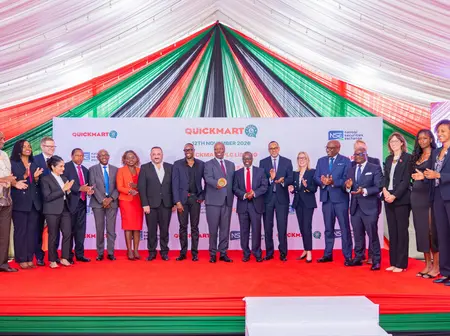
    A group of Quickmart executives and NSE officials smiling and applauding on a stage during the official NSE listing ceremony on November 12, 2026. The main banner reads "QUICKMART PLC LISTING" and "12TH NOVEMBER 2026," with "QUICKMART" and "NSE" logos. The ceiling of the large tent is decorated with drapes in the colors of the Kenyan flag (black, red, green).

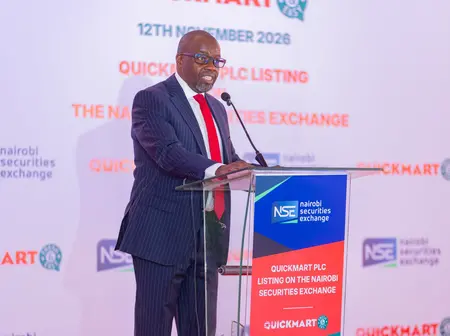
    Quickmart’s shares opened trading at KSh10 on the Nairobi Securities Exchange (NSE), giving the supermarket chain an implied market capitalisation of KSh40 billion, against the KSh30 billion valuation attached to its initial public offering (IPO).

    The opening price represented a 33.3% gain over the IPO price of KSh7.50, although the stock later traded at an average of KSh9.26 by midday on Thursday, November 12. A total of 6.32 million shares had changed hands by that point, putting the retailer’s implied market value at approximately KSh37.04 billion.

    The trading debut gives investors their first opportunity to establish a market price for Quickmart after its founders and private equity investor Adenia Partners offered half of the company to the public and institutional buyers.

    The KSh15 billion transaction involved the sale of existing shares rather than a fresh equity injection into the supermarket business. Quickmart therefore entered the public market with a new shareholder base but without receiving the proceeds from the offer.

    Quickmart’s opening trade placed its market value KSh10 billion above the KSh30 billion valuation implied by the IPO price.

    The company has approximately four billion shares outstanding, based on the two billion shares offered representing a 50% stake. At KSh10 per share, the implied market capitalisation reached KSh40 billion before easing to approximately KSh37.04 billion at the reported midday average.

    The KSh9.26 average represented a 23.5% premium over the IPO price, suggesting that demand remained strong beyond the opening transaction, which involved 1,000 shares.

    The initial valuation also puts Quickmart at approximately 24.5 times its FY2025 statutory earnings, compared with about 19.9 times at the IPO price.

    Quickmart reported revenue of KSh50.43 billion for the year ended December 2025, representing growth of 9.3%. Its statutory net profit increased by 33% to KSh1.51 billion, while adjusted profit after tax stood at KSh1.7 billion, according to the company’s IPO disclosures.

    The financial performance provides a basis for examining the premium investors were willing to pay when trading began. However, the first session’s pricing does not establish whether the valuation will hold as more investors trade the shares.

    The IPO attracted 18,492 applications for approximately 2.45 billion shares against the two billion available, representing an oversubscription of 22.7%.

    Foreign investors acquired 1.1 billion shares, equivalent to 27.5% of Quickmart, while institutional investors received 700.17 million shares, representing 17.5%.

    Kenyan and East African Community retail investors acquired another 199.64 million shares, equivalent to approximately 5% of the supermarket chain.

    The allocation gave foreign investors the largest share of the offer, accounting for 55% of the shares sold. Local and regional retail investors accounted for approximately 10%, with institutional investors taking the remaining 35%.

    The final ownership structure also includes Adenia Partners’ retained interest. Following the transaction, foreign ownership of Quickmart stood at 52.9%, including the private equity investor’s remaining stake and holdings acquired by other international investors.

    Four cornerstone investors secured significant positions through the IPO. The International Finance Corporation (IFC) acquired a 6.45% stake, while US-based investment firm 337 Frontier and UK government-backed MOBILIST each held approximately 6.5% in the final allocation reporting. UK fund manager RWC LLC acquired approximately 4.32% in the earlier reported allocation.

    The final allocation figures reported by TechTrendsKE on November 11 put the four cornerstone investors’ combined holding at approximately 21.6%, following revisions to preliminary subscriptions.

    Quickmart entered the NSE with a network of 72 stores across 16 counties, having grown from four outlets as it expanded its presence in Kenya’s supermarket industry.

    The retailer serves approximately five million customer transactions monthly and employs more than 8,000 people. Its Q-Points loyalty programme has also accumulated approximately 2.5 million members.

    The company’s FY2025 revenue of KSh50.43 billion and statutory net profit of KSh1.51 billion provide a financial picture of the business now available to public-market investors.

    Quickmart has also outlined ambitions to expand its store network beyond 100 outlets. In the six months to June 2026, the retailer recorded revenue of KSh27.3 billion, according to its IPO disclosures.

    Its expansion prospects come against competition from other large supermarket operators, including Naivas and Carrefour Kenya. The three retailers accounted for approximately 60% of Kenya’s supermarket revenue in 2025, according to industry figures reported by TechTrendsKE.

    The listing allows investors to participate in the performance of a business operating in a sector where store networks, purchasing power, distribution capabilities and customer retention are important competitive factors.

    Quickmart’s debut adds another major company to the Nairobi Securities Exchange during a year that has seen renewed activity in Kenya’s equity market.

    Kenya Pipeline Company conducted its IPO in March 2026, while Family Bank joined the exchange through a listing by introduction in June.

    The NSE had recorded 2.36 million investors by September 2026, following the addition of 333,043 investors during the first nine months of the year. Equity turnover reached KSh395 billion over the same period, compared with KSh145 billion recorded throughout 2025.

    The turnover increase included significant block transactions, meaning it does not represent ordinary retail trading activity alone.

    For Quickmart, the immediate market response has placed its valuation above the level established during the IPO. The subsequent trading sessions will show whether investors continue to support that premium as the retailer begins its life as a publicly traded company.

  • Global startup ecosystems converge in Dubai to unlock international growth at Expand North Star 2026

    Global startup ecosystems converge in Dubai to unlock international growth at Expand North Star 2026

    thumbnail

    Running from 7 December at the Dubai World Trade Centre (DWTC) and 8-10 December at Dubai Exhibition Centre (DEC) in Expo City Dubai, Expand North Star will reunite with GITEX GLOBAL, the world’s largest tech, AI and startup showThe UAE is a strategic partner for us, especially in industrial AI, healthcare and sustainability

  • Ruto Explains Why Kenya Paid French Firm KSh6.5 Billion After Cancelling Mau Summit Highway Deal

    Ruto Explains Why Kenya Paid French Firm KSh6.5 Billion After Cancelling Mau Summit Highway Deal

    President William Ruto has explained why the Kenyan government paid billions of shillings to a French consortium following the cancellation of its contract to construct the Rironi-Mau Summit highway.

    The controversial payment, which amounted to approximately KSh7.3 billion according to government disclosures, was made to settle obligations arising from the termination of the agreement with the French contractors.

    The consortium comprised Vinci Highways SAS, Meridian Infrastructure Africa Fund and Vinci Concessions SAS, which had been awarded the contract during former President Uhuru Kenyatta's administration.

    Speaking about the decision, Ruto's administration has maintained that the original agreement exposed Kenya to significant financial risks that could have placed an additional burden on taxpayers.

    The French consortium had been expected to finance the construction of the highway through a Public-Private Partnership arrangement and recover its investment through toll charges collected from motorists.

    However, the government raised concerns about the proposed financing structure, particularly the substantial service payments it would be required to make during the initial years of the agreement.

    Treasury officials also questioned the affordability of the arrangement amid increasing public debt and limited fiscal space.

    The government eventually terminated the contract and transferred the highway project to Chinese contractors, with the construction programme subsequently revised.

    The compensation payment was intended to settle the dispute and prevent a potentially expensive international legal battle involving the French companies.

    However, the payment has continued to attract public scrutiny, particularly after the Auditor-General questioned the manner in which the KSh7.31 billion was withdrawn from the Road Maintenance Levy Fund.

    The audit raised concerns about the use of funds originally intended to support road maintenance and settle outstanding contractors' payments.

    The Rironi-Mau Summit highway remains one of the government's major infrastructure projects, with authorities promising improved connectivity, reduced traffic congestion and easier transportation between Nairobi and Western Kenya.

    The compensation controversy continues to raise questions about government contracting, accountability and the financial consequences of cancelling major infrastructure projects.

    Sources;

    https://peopledaily.digital/news/ruto-reveals-why-kenya-paid-french-firm-ksh6-5-billion-over-flopped-rironi-mau-summit-contract?fbclid=IwdGRjcAVitbZjbGNrBWK1VWV4dG4DYWVtAjExAHBkb2YFc3J0YwZhcHBfaWQMMzUwNjg1NTMxNzI4AAEf8_b39vQVech2RDXLzaAsklZTAWS36tmxoQfN6MsQbHVcfKv3nUxxxbo1BYg_aem_hc672FzrdcWdYGaLC7Divg

  • IMF wants Kenya to ease stablecoin reserve rules, review crypto capital thresholds

    IMF wants Kenya to ease stablecoin reserve rules, review crypto capital thresholds

    The International Monetary Fund (IMF) wants Kenya to allow foreign-denominated stablecoin issuers to keep their reserves abroad, a departure from requirements that compel crypto firms to hold part of their backing assets locally.

    Under the proposal, global stablecoin issuers would maintain reserves in their home jurisdictions or with foreign custodians, subject to strict conditions on the transfer of funds and regulatory oversight. Kenya would restrict how such digital currencies are used in the domestic market.

  • Ruto Sets One-Year Timeline for Nairobi-Mombasa Highway Dualling Plans

    Ruto Sets One-Year Timeline for Nairobi-Mombasa Highway Dualling Plans

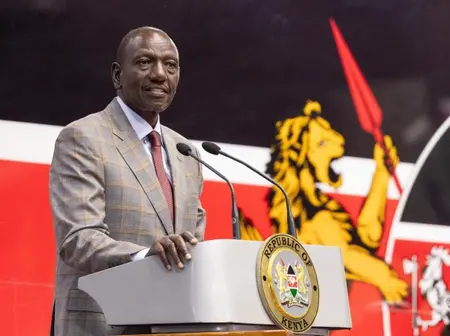
    Speaking in Mombasa on Thursday, November 12, 2026, the Head of State said the administration had already developed a framework for expanding the highway and would soon communicate details of the proposed project to Kenyans.

    Ruto described the planned upgrade as necessary to improve transport efficiency between Nairobi and Mombasa, particularly given the importance of the route in facilitating the movement of passengers and goods to and from the Port of Mombasa.

    He assured Kenyans that the government was committed to implementing the project, adding that preparations and communication surrounding the expansion would take place within the next 12 months.

    "We already have a plan. In a very short time, we're going to inform the country how we are going to dual the road from Mombasa to Nairobi," Ruto said.

    He further dismissed concerns about the government's ability to finance the ambitious infrastructure programme, maintaining that the proposed developments would not require additional taxes or increased public borrowing.

    "And we are going to do it without burdening Kenyans with additional taxes or additional debt," he stated.

    The President's announcement comes amid a broader infrastructure expansion agenda that also includes upgrading the Rironi-Mau Summit road and extending the proposed highway network towards Eldoret, Kericho, Kisii, Kisumu and Malaba.

    The planned developments are expected to strengthen connectivity between major towns, improve access to markets and support the movement of agricultural and commercial goods across the country.

    Ruto maintained that infrastructure investment remains central to his administration's development agenda, arguing that improved transport networks are necessary for transforming Kenya's economy.

    However, his latest remarks indicate that the one-year deadline concerns unveiling the Nairobi-Mombasa dualling programme, rather than completing the construction works.

    https://peopledaily.digital/news/ruto-gives-timeline-for-unveiling-nairobi-mombasa-highway-dualling

  • You can now send DHL parcels from 60 Rubis petrol stations in Kenya

    You can now send DHL parcels from 60 Rubis petrol stations in Kenya

    thumbnail

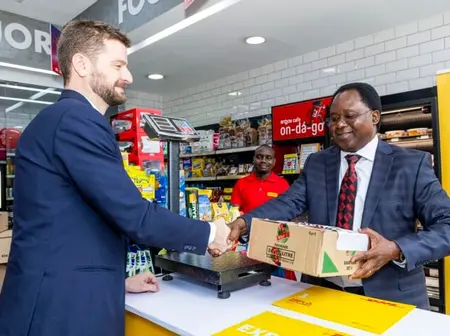
    DHL Express Kenya and Rubis Energy Kenya announced on 12th November 2026 that 60 Rubis service stations will work as DHL Service Points. A DHL Service Point is a counter where you hand over a document or parcel for DHL to ship, instead of booking a courier to collect it from your door.

  • Rising inflation: What it means for investors

    Rising inflation: What it means for investors

    Inflation has increased in recent months, reaching a multi-year high of 7.3 percent in October 2026. However, returns have remained low, with real yields falling sharply. Can investors expect higher returns going forward to cushion against a faster depreciation of their purchasing power? In this episode of the Make Money podcast, Gertrude Njeri, the Head of Research at Hisa, weighs in.

    Make Money, a podcast series hosted by Kepha Muiruri, from Business Daily Africa, unravels ways to be financially savvy. Get practical tips and advice on how to increase your income, build wealth, and achieve financial freedom in Kenya. Whether you’re just starting out or a seasoned investor, we’ve got something for everyone.

    Listen here:

    Are stablecoins the future of money? – Episode 4

    NSE rally: Is it too late to invest? – Episode 7

    Episode 1: The allure of infrastructure bonds

    Episode 2: Maximising the dividend earning season

    Episode 3: Minting generational wealth

    Episode 4: Is the MMF party over?

    Episode 5: Is your money safe in Saccos?

    Episode 6: Insurance: Investment or Illusion?

    Episode 7: Why Kenyans are going into business

    Episode 8: Willy Kimani’s leap: Business insights from corporate to entrepreneurship

    Episode 1: Government bonds: Risk-free or low risk?

    Episode 2: MMFs: Who really needs a fund manager?

    Episode 3: How to protect your investments as interest rates fall

    Episode 4: Is the stock market still a way make to money?

    Episode 5: Does it still make sense to buy dollars?

    Episode 6: How time directly impacts your investments

    Episode 7: Hacking home ownership

    Episode 8: Money matters: To bank or not to bank?

    Episode 9: Trading 101: Separating wheat from chaff

    Episode 10: What music can teach us about money

    Episode 1: Redefining your money goals

    Episode 2: Making money work for you

    Episode 3: Where to make money in 2024

    Episode 4: Make your side hustles worthwhile

    Episode 5: Loan and Behold: The art and science of borrowing

    Episode 6: Career driven – Triumph at your job

    Episode 7:  Better Together – The Power of Group Investing

    Episode 8: Make your networks shape your net worth

    Episode 9: Buy now, Pay later – The A to Z of consumer credit

    Episode 10: What would you do if you had Sh500,000?

    Episode 1: Financial fitness – walk before you can run

    Episode 2: Myths about investing 

    Episode 3: Baby steps…Little is more

    Episode 4: A cheque from government

    Episode 5: NSE – Taking stock of the market

    Episode 6: Going offshore – cast your bread in many waters

    Episode 7: Kenya’s black gold

    Episode 8: Investor’s edge – Saccos

    Episode 9: How wife’s wake-up call led Ken to make more money

  • How a one percent CBR increase would impact banks

    How a one percent CBR increase would impact banks

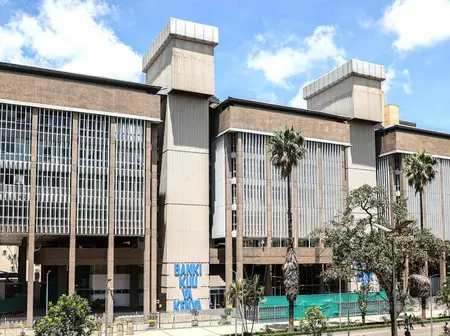
    Eight commercial banks would require up to Sh16.5 billion in fresh capital to cover for revaluation losses from Treasury bonds if the Central Bank Rate was to be hiked by one percentage point, underscoring how exposed lenders are to government securities.

    A stress test conducted by the Central Bank of Kenya (CBK) in May to gauge the stability of the banking sector revealed that an increase of the CBR by the monetary policy committee would cause government bonds held by banks, as available for sale or held for trading, to lose value, eroding their capital position.

  • Quickmart debuts on the NSE as retail investors back Sh15 billion IPO

    Quickmart debuts on the NSE as retail investors back Sh15 billion IPO

    thumbnail

    Quickmart PLC debuted on the Nairobi Securities Exchange (NSE) on Thursday after a Sh15 billion initial public offering (IPO).Retail investors put in Sh2.9 billion, and 60 per cent of them applied through Ziidi Trader.Ziidi Trader is a mobile investment platform developed by Safaricom in collaboration with the NSE and licensed brokerage company Kestrel Capital.

  • Teachers to Gain Ksh1,250 More Monthly Under Proposed PAYE Cut, Ruto Says

    Teachers to Gain Ksh1,250 More Monthly Under Proposed PAYE Cut, Ruto Says

    Using a teacher earning Ksh50,000 as an example, Ruto said the worker pays Ksh750 a month towards the 1.5 per cent Housing Levy. He said the extra Ksh8,000 left untaxed would save the teacher Ksh2,000 in tax. “The net effect is that you will get Ksh1,250 more into your salary,” he said, according to Citizen Digital.

    Ruto also urged teachers to dismiss claims that the government takes a large share of their pay. He said 100,000 teachers have been hired in three years and 20,000 more will be hired next month. He added that 50,000 teachers will be promoted this financial year and that 20 per cent of affordable housing units are set aside for teachers.

    The proposal is not yet law. Lawmakers must consider the changes before they take effect, according to People Daily. Treasury estimates cited by the paper show that workers earning between Ksh32,334 and Ksh50,000 would save up to Ksh596 a month. It adds that those earning above Ksh50,000 could face higher PAYE deductions.

    Reports also note that mandatory deductions such as the Housing Levy, SHA and NSSF would continue. Critics have said the Housing Levy erodes workers’ take-home pay, according to Mwakilishi.

    In February, Ruto proposed cutting the PAYE rate for workers earning up to Ksh50,000 from 30 per cent to 25 per cent, according to Kenyans.co.ke. He said earners below Ksh30,000 would be fully exempt.

    Source: https://web.facebook.com/share/p/1EWPeU2Tvt/