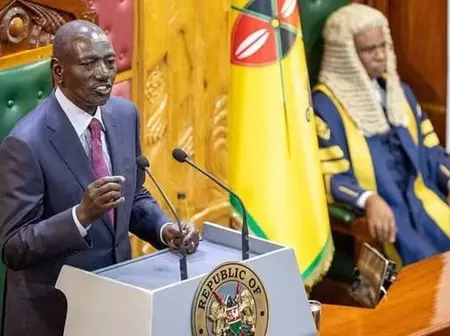
President William Ruto says Kenya’s new health financing system is helping protect families from selling land, livestock and draining their savings to pay for treatment, as the government seeks to reduce the financial burden of illness on households.
Speaking during his State of the Nation Address, Ruto said medical emergencies have pushed families into debt, forced them to dispose of property or abandon treatment because they could not afford hospital bills.
“For too many Kenyans and their families, falling ill has meant borrowing from friends, selling their livestock, disposing land, or abandoning treatment altogether,” he said on Wednesday, November 18, 2026.
The President said the Social Health Authority (SHA) reforms were intended to change that reality by shifting the cost of medical care from individual households to a shared financing system, cushioning families against the financial shock of serious illness.
He said the reforms were particularly significant for patients requiring expensive and prolonged treatment, including those battling cancer and kidney disease, whose medical costs can consume family savings or force households to seek financial assistance.
Ruto cited 53,465 patients receiving cancer treatment and 24,468 undergoing dialysis, alongside 89 patients who have undergone kidney transplants, saying their treatment costs were being financed through the shared health system.
“These are among the most expensive forms of medical care, often beyond the financial reach of ordinary households,” he said.
The President argued that financing such treatment collectively was reducing the amount families would otherwise have to raise through savings, borrowing from relatives or selling assets.
For households facing chronic illnesses, the financial pressure often extends beyond hospital bills to transport, lost income and the cost of supporting relatives during prolonged treatment.
Ruto said the government’s ambition was to ensure that falling ill no longer pushed families that had been making economic progress into poverty.
The President said 33.7 million Kenyans had registered with the Social Health Authority, compared with approximately eight million registered under the National Hospital Insurance Fund in 2022.
He said the significance of the expanded registration should be measured not only by the number of Kenyans enrolled but also by the treatment they could access and the medical bills families no longer had to shoulder alone.
However, Ruto acknowledged that the transition to SHA had encountered challenges, noting that the government had recognised concerns raised by Kenyans and continued working to address them.
“The transition to SHA had initial challenges, and we recognized the legitimate concerns of Kenyans,” he said.
The reforms have faced scrutiny over access to care, registration, claims processing and patients’ experiences at health facilities, leaving actual treatment access and the cost borne by households as important measures of the system’s performance.
Ruto said the government’s ultimate goal was to progressively eliminate the crushing burden of medical expenses, protect family savings and ensure illness did not become a pathway into poverty.
“Our undertaking is to progressively and eventually remove the crushing burden of medical expenses from Kenyan households, protect family savings, and ensure that illness does not become a sentence to poverty,” he said.
He linked the reforms to the broader cost-of-living agenda, arguing that reducing healthcare expenses would ease pressure on household finances.
For families confronting cancer, kidney failure and other costly illnesses, the promise of SHA is ultimately whether treatment can be accessed without sacrificing the assets they depend on for survival.
Leave a Reply