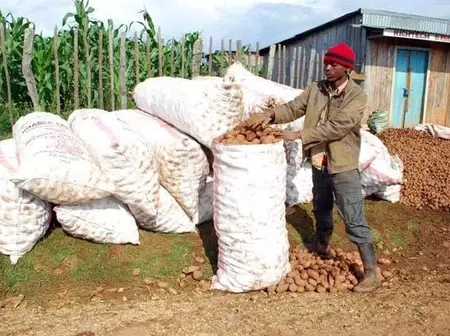
Potato farmers in Nakuru are losing up to 40 per cent of their produce due to poor post-harvest handling, a new study shows.
It warns that inadequate storage, packaging and pest management practices are hampering farmers' earnings.
The study on factors influencing the uptake of post-harvest loss reduction practices among smallholder Irish potato farmers in Nakuru County, was published in the African Journal of Agricultural, by a team of researchers from Egerton University.
The researchers noted post-harvest losses were a major constraint to smallholder Irish potato production in Kenya, with Nakuru experiencing losses of up to 40 percent at the farm level.
The study examined the socio-economic and institutional factors influencing the uptake of four post-harvest loss reduction practices including on-farm storage, packaging, pest and disease management and curing among 328 Irish potato farmers in Molo subcounty.
Data was collected using multistage sampling and analysed using a Multivariate Probit (MVP) model.
Although most farmers stored their potatoes on the farm, adoption of other recommended practices remained low.
“Only 25 per cent of farmers used appropriate packaging, while 12.2 per cent practised curing and just 8.2 per cent adopted pest and disease management measures, while only 1.8 per cent of the farmers had adopted all four recommended practices, exposing their produce to avoidable damage and deterioration after harvesting,” the study says.
On-farm storage was the most widely adopted practice, with 81.7 per cent of farmers using it. However, the low uptake of packaging, curing and pest and disease management suggests that farmers are not doing enough to minimise losses along the post-harvest chain.
Curing is particularly important because it allows minor injuries on harvested potatoes to heal and helps develop a protective skin, improving their ability to withstand storage and handling.
Appropriate packaging protects tubers from physical damage, while proper pest and disease management helps prevent deterioration and spoilage.
The study identified several factors influencing farmers' decisions to adopt these practices, including education levels, experience, household income, access to agricultural extension services, membership in farmer groups and distance to markets.
Access to extension services was particularly important in encouraging farmers to adopt more technically demanding practices, especially pest and disease management.
The researchers found that farmers who adopted on-farm storage were more likely to use appropriate packaging, while those practising pest and disease management were more likely to undertake curing.
They recommended that agricultural extension services be strengthened to equip farmers with practical skills on post-harvest management, particularly curing and pest and disease control.
They also called for farmer groups to be used as channels for sharing information and encouraging members to adopt improved handling practices.
“Television and other mass media platforms could also help spread information on appropriate packaging and curing, particularly among farmers with limited access to extension officers.”
They also recommended improved access to credit, demonstration plots and farmer-to-farmer learning to help overcome financial and knowledge barriers.
The crop is second to maize in terms of consumption in Kenya, with an average per capita consumption of 29.9 per cent according to the International Potato Centre (IPC).
Irish potatoes are cultivated in 20 counties, including the slopes of Mt Kenya, the Aberdare ranges, the Mt Kilimanjaro region, the Rift Valley, and parts of Nyanza, Western, and Coastal regions.
Nyandarua county leads national production at 29.8 per cent, followed by Nakuru and Elgeyo Marakwet counties at 18.9 and 16.2 per cent respectively. Other notable producing counties include Meru, Narok, Bomet, Bungoma and West Pokot.
Leave a Reply