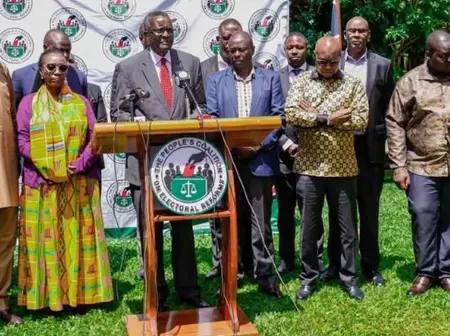
The leaders, operating under the banner of The People's Coalition, accused the commission of failing to adequately address concerns they had raised about the credibility and preparedness of the electoral process.
They insist that critical questions surrounding election technology, voter registration and the legal framework for handling and transmitting election results must be addressed before further engagements with the commission.
The latest boycott followed a similar confrontation on Thursday, November 19, when opposition representatives walked out of an engagement with IEBC, claiming their concerns had not been given sufficient attention.
The commission subsequently explained that the November 19 meeting had been organised to update political parties on preparations for the 2027 elections, receive their concerns and identify areas requiring cooperation.
IEBC Chairperson Erastus Ethekon said the opposition representatives left after presenting their demands but before the commission delivered its presentation and substantive discussions began.
He also maintained that the commission had adjusted the meeting programme to accommodate the delegation's request to change the starting time.
IEBC further stated that it remained willing to receive formal submissions from political parties and consider proposed electoral reforms within its constitutional and legal mandate.
However, speaking during a press conference in Nairobi on Wednesday, November 25, the opposition leaders said they wanted the commission to establish a technical committee to examine their concerns before another high-level meeting could take place.
The delegation included former Chief Justice David Maraga, United Green Movement leader; People's Liberation Movement leader Martha Karua; Democratic Party leader Justin Muturi; Jubilee Party leader Fred Matiang'i; and Democracy for the Citizens Party (DCP) leader Rigathi Gachagua, among others.
Maraga, who spoke on behalf of the opposition delegation, said the leaders were prepared to engage IEBC but were dissatisfied with the agenda presented by the commission.
He argued that their concerns required technical examination rather than another general meeting where the commission would simply present its preparedness report.
"There are issues we want to attend to, and we want IEBC to set up a technical committee. One of the issues that was important was the issue of technology," Maraga said.
The former Chief Justice maintained that the opposition had requested a meeting involving the proposed technical committee and was willing to participate in such an engagement.
However, he said the commission had invited them to a different meeting, prompting their decision to stay away.
Maraga also questioned the emphasis placed on livestreaming the engagements, arguing that the opposition wanted substantive answers to its concerns rather than an opportunity to endorse positions already communicated by IEBC.
Another major issue raised by the leaders concerns Section 39 of the Elections Act, which provides the legal framework for determining, declaring and transmitting election results.
Maraga argued that repeated amendments to the provision, some of which were subsequently declared unconstitutional by courts, had created uncertainty over the legal framework governing election results.
He said the opposition had prepared a Bill seeking to restore Section 39 and wanted to discuss the proposed legislation with the electoral commission.
The leaders also raised concerns about the national voter register, calling for an audit and cleaning exercise ahead of the 2027 General Election.
They argued that verifying the register was necessary to address potential irregularities and strengthen public confidence in the electoral process.
Gachagua, meanwhile, said the opposition wanted IEBC to organise another engagement before the end of November.
He indicated that January 2027 could be considered as an alternative if the commission was unable to meet the proposed November deadline.
The former Deputy President warned that failure by IEBC to address the leaders' concerns could trigger a nationwide mobilisation campaign aimed at bringing ordinary Kenyans directly into discussions about electoral preparedness.
He proposed public engagements across all 290 constituencies, arguing that citizens should have an opportunity to question the commission about its readiness for the next General Election.
"We are asking IEBC to listen to us, this month, if possible; if it's not, next month in January, we mobilise Kenyans to talk to IEBC directly," Gachagua said.
He further maintained that the commission should be ready to engage members of the public if it failed to reach an understanding with opposition leaders.
The proposed constituency-level engagements would expand the dispute beyond discussions between political parties and IEBC, potentially drawing more voters into conversations about election technology, voter registration and the management of results.
With the 2027 General Election approaching, the disagreement places renewed attention on the commission's preparations and the need to address stakeholders' concerns within the country's constitutional and electoral laws.
IEBC, on its part, has maintained that it is open to continued consultations and formal proposals from political parties.
Source
Leave a Reply