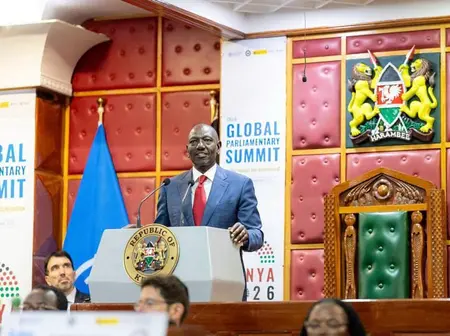
President William Ruto’s latest address on food security has presented an ambitious picture of Kenya’s agricultural transformation, but the figures contained in his own speech reveal a difficult question: why are millions of Kenyans still struggling with hunger despite a sharp increase in maize production?
The President said Kenya’s maize production had increased from 34.3 million bags in 2022 to 71 million bags in 2025, while the government had distributed more than 38 million bags of subsidised fertiliser to nearly two million farmers since 2022.
He also said the price of a 50-kilogramme bag of fertiliser had fallen from Ksh7,500 to Ksh2,000, representing a 73 per cent reduction.
These figures form a central part of the administration’s argument that lowering farmers’ production costs can increase agricultural output and strengthen national food security.
However, the same address acknowledged that 2.7 million Kenyans were facing crisis levels of food insecurity, with hundreds of thousands of children and pregnant and breastfeeding women requiring nutritional support.
The contrast exposes a fundamental weakness in measuring food security primarily through agricultural production.
A country can produce more maize without necessarily ensuring that every household can afford sufficient and nutritious food.
Kenya’s agricultural challenge is increasingly about the relationship between production, household incomes and the cost of accessing food.
While increased maize production is an important indicator of agricultural performance, it does not independently establish whether households are eating adequately.
Food security depends on several interconnected factors, including availability, affordability, access, nutritional quality and the ability of households to maintain access to food throughout the year.
This distinction is particularly important for households that depend on irregular incomes, small-scale farming or food purchases from markets.
Even when national production improves, the benefits may not automatically reach households struggling with purchasing power.
Ruto acknowledged this wider challenge in his address, arguing that producing more food is not enough if people cannot access sufficient, safe, affordable and nutritious diets.
He cited an estimated 6.9 per cent economic cost of malnutrition, underscoring that the consequences extend beyond agriculture into healthcare, education, productivity and national economic growth.
The implication is that Kenya’s food security performance must be judged not only by the number of bags harvested but also by whether families can afford balanced meals.
Perhaps the most consequential part of the President’s address was his emphasis on shifting agricultural investment towards large-scale irrigation.
Ruto said his administration was pursuing plans to construct at least 50 mega dams, 200 medium and small dams, alongside thousands of micro dams.
The programme is intended to bring an additional 2.5 million acres under irrigation within the next five to seven years.
The proposal reflects an acknowledgement that Kenya’s dependence on rainfall continues to expose agricultural production to climate shocks, particularly in arid and semi-arid regions.
His statement that Kenya must no longer allow clouds to determine whether people eat captures the policy direction behind the proposed infrastructure expansion.
However, the ambition also raises questions about financing, implementation timelines, water distribution, maintenance and the actual number of farmers who will benefit.
The President said the National Infrastructure Fund would mobilise domestic and international capital, alongside public-private partnerships, to finance major infrastructure without unnecessarily increasing the public debt burden.
But the success of the irrigation programme will depend on more than the construction of dams.
Water must reach farms, irrigation systems must remain operational, farmers must access affordable inputs, and agricultural produce must have reliable storage, processing and markets.
Without these complementary investments, expanded water infrastructure may fail to translate into the expected improvements in food production and household incomes.
Ruto also placed school feeding at the centre of his administration’s nutrition strategy.
He said approximately three million learners currently benefit from school meals, with the government intending to extend the programme across all 47 counties from 2027 and reach 10 million learners by 2030.
The programme is significant because it links three policy objectives: improving children’s nutrition, supporting school attendance and creating a dependable market for smallholder farmers.
Through home-grown school feeding, the government wants public food procurement to support local agricultural production while ensuring learners receive nutritious meals.
However, expanding the programme to 10 million learners will require substantial and sustained financing, reliable procurement systems and effective monitoring to ensure meals reach the intended beneficiaries.
It also raises the question of whether local farmers will have the capacity, financing and infrastructure to consistently supply the programme.
The school meals ambition therefore presents another test of whether agricultural policy can deliver benefits beyond national production statistics.
He specifically urged legislators to follow public money through to the delivery of fertiliser, irrigation projects and school meals.
This is particularly important given that Article 43 of the Constitution guarantees every person the right to be free from hunger and to have adequate food of acceptable quality.
The President also cited the Kampala Declaration, which sets continental agricultural targets, including increasing agri-food output by 45 per cent by 2035, reducing post-harvest losses by 50 per cent and mobilising $100 billion in investment.
However, the bigger question for Kenya is how these commitments will be reflected in measurable improvements in household food security.
The administration’s agricultural achievements should therefore be assessed alongside the number of households still unable to afford adequate food, the reliability of water access, the performance of irrigation investments and improvements in child nutrition.
Ultimately, Kenya’s food security test will not be settled by the number of fertiliser bags distributed, dams announced or maize bags harvested.
It will be determined by whether these investments make food consistently available and affordable to ordinary households.
For an administration that has placed farmers at the centre of its economic transformation agenda, the next measure of success is ensuring that increased agricultural production translates into fewer hungry Kenyans.
Leave a Reply