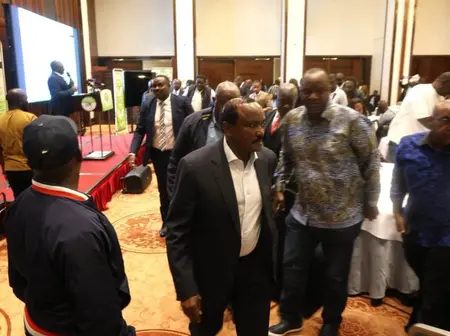
Wiper Patriotic Front Party leader Kalonzo Musyoka on Thursday, November 19, led a group of opposition leaders in a dramatic walkout from a meeting with the Independent Electoral and Boundaries Commission (IEBC), accusing the electoral agency of failing to address their concerns ahead of the 2027 General Election.
The leaders had visited the commission’s headquarters at Anniversary Towers in Nairobi to discuss electoral preparedness and present proposals they consider necessary to safeguard the credibility of the August 10, 2027 polls.
However, the engagement ended in a confrontation, with Kalonzo announcing that the opposition delegation had walked out after failing to find what he described as an independent, impartial and prepared commission.
Former Deputy President Rigathi Gachagua subsequently issued a statement backing the decision, accusing the IEBC of being unresponsive to concerns raised by opposition leaders on behalf of Kenyans.
“We came to the IEBC today in good faith, and we expected the same in return. Good faith is shown in deeds: an independent, impartial and prepared Commission. Today, we did not find it,” Kalonzo said.
He warned that the opposition would not participate in discussions that could give legitimacy to what he described as a bundled election ahead of the 2027 polls.
“Let it be clear: we will not sit in a room and lend our names and faces to the formalisation of a bundled election before the August 2027 General Election. Not today, not ever, and certainly not under our watch!” he added.
In a separate statement, Gachagua said the opposition had attended the meeting expecting the IEBC to listen to concerns raised by Kenyans but left dissatisfied with the commission’s approach.
He argued that electoral decisions should not be made without public participation, insisting that the commission must engage citizens and address questions surrounding the conduct of the next General Election.
“The People of Kenya have instructed us that there should be no decision, no discussion that should go on without their involvement,” Gachagua said.
The DCP leader accused the IEBC of repeatedly failing to respond to requests for engagement and clarification on issues that opposition leaders wanted resolved before the 2027 polls.
He described the situation as a mockery of democracy and the freedoms Kenyans had fought for.
Gachagua further criticised what he termed public trickery by an institution funded by taxpayers, warning that the opposition would resist any process that did not involve meaningful public participation.
“To IEBC, once you decide to listen to the 55 million Kenyans, we shall engage accordingly,” he said.
The former Deputy President maintained that the opposition would continue standing together on electoral reforms and the protection of voters’ rights.
Kalonzo said the opposition wanted an election in which every Kenyan’s vote would be counted at the polling station, verified openly and declared as cast.
He raised concerns about the possibility of voter register manipulation, warning against the inclusion of names of people who were not on the official register.
“Kenyans deserve their voices to be heard and every vote counted at the polling station, verified in the open and declared as cast. Not manufactured. Not padded with the names of people who are not on the voter roll,” he said.
The opposition leaders have repeatedly questioned the IEBC’s independence and preparedness, arguing that unresolved electoral issues could undermine public confidence in the 2027 election.
Their latest confrontation with the commission came after they agreed on a set of four major electoral reforms that they intended to present during the engagement.
Before meeting the commission, the opposition leaders convened under the People’s Coalition on Electoral Reforms and agreed on four proposals they described as irreducible minimums for a credible election.
The proposals include:
Former Chief Justice David Maraga, who convened the coalition alongside Democratic Party leader Justin Muturi and Linda Mwananchi Movement Secretary General Caroli Omondi, outlined the proposals ahead of the IEBC meeting.
The leaders said the proposals should be incorporated into the legal framework governing elections, including amendments to the Elections Act.
The coalition argued that the measures would strengthen transparency, protect the integrity of the voter register and ensure that the outcome of the election reflects the will of voters.
The opposition delegation brought together leaders from different political parties and political movements.
Those named by Gachagua in his statement included:
The broad political representation reflected the coalition’s effort to present a common position on electoral reforms ahead of the next General Election.
Leave a Reply