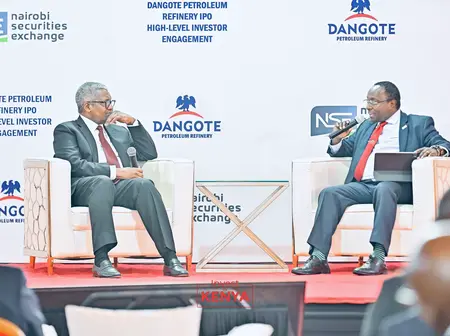
Kenya Pipeline Company is preparing to commit billions of shillings to new infrastructure while seeking a permanent chief executive and adjusting its board composition following a major change in ownership. The arrival of Aliko Dangote as a 24.99% shareholder adds another influential investor to decisions over the company’s expansion, financing and regional commercial strategy.
Dangote’s Greenview Oil Trading Corp acquired the stake for approximately KSh42.5 billion, paying KSh9.36 per share through a transaction involving local institutional investors. The acquisition made the Nigerian businessman KPC’s second-largest shareholder, behind the Kenyan government, which retains 35%, and ahead of Uganda’s 20.15% holding through the Uganda National Oil Corporation (UNOC).
Greenview Oil is now expected to nominate a director to KPC’s board, replacing Ronald Nyamosi, the National Social Security Fund’s (NSSF) general manager for finance and investments, who has served as an alternate director to the fund’s chief executive.
The nomination comes as KPC considers an expansion programme worth approximately KSh110 billion through 2030, according to the company’s management. Dangote has separately proposed investing $1.5 billion (approximately KSh195 billion) in the pipeline operator, creating the possibility of a much larger infrastructure investment involving the company’s existing network and his planned East African refining operations.
The scale of KPC’s existing operations provides some indication of the infrastructure business behind the share acquisition. The company’s FY2025/26 results, reported by TechTrendsKE on October 14, showed revenue of KSh42.98 billion and profit after tax of KSh11.58 billion. Petroleum transportation volumes reached 10.61 billion litres, while its operating network covered approximately 1,342 kilometres.
KPC also reported EBITDA of KSh25 billion and operating cash flow of KSh17.39 billion during the financial year. Its cash and cash equivalents stood at KSh20.54 billion, while outstanding borrowings had fallen to KSh400 million after an 83.4% reduction.
The company has identified additional pipelines, pumping facilities and storage capacity as priorities for its investment programme. Its management has estimated that a new pipeline comparable to the Mombasa-Nairobi line could cost between KSh60 billion and KSh70 billion, with other pipeline and capacity improvements requiring another KSh40 billion to KSh50 billion.
Financing these projects will require decisions on the balance between internal resources, borrowing and external investment. KPC has discussed commercial debt, project financing, infrastructure bonds and partnerships as possible funding sources. Management has also outlined a financing structure in which equity could account for approximately 30% of project costs, with debt providing the remaining 70%.
Dangote’s proposed investment would therefore enter a company that already has its own capital expenditure priorities. His board representative would participate in governance discussions involving the allocation of capital, infrastructure development and the company’s commercial direction, although the investment proposal does not establish that KPC has approved the full amount.
The company’s potential expansion also extends beyond conventional fuel transportation. KPC is considering a petroleum trading hub at the Kenya Petroleum Refineries Limited (KPRL) site, where it has approximately 377 acres. The proposed facility could accommodate additional storage, bunkering, transshipment and storage-for-hire services.
KPC management has said transportation and storage account for approximately 97% of its revenue. Expanding these services could provide additional commercial opportunities as petroleum trading and distribution requirements grow across the region.
Greenview Oil’s acquisition has altered the composition of KPC’s institutional shareholders, several of which sold portions or all of their investments following the company’s listing on the Nairobi Securities Exchange in March 2026.
The NSSF, Public Service Superannuation Fund (PSSF) and County Pension Fund (CPF) participated in the disposal of shares. Smaller schemes, including Lapfund, Laptrust, Kenya Power Pension Scheme and the Kenya Ports Authority Pension Scheme, exited their investments completely.
TechTrendsKE reported on October 26 that NSSF reduced its KPC holding from 22% to approximately 6% following the transaction. The fund therefore remains a shareholder but no longer holds the stake that previously supported its position among the company’s major institutional investors.
The sale process also involved negotiations over the price received by the pension schemes. According to the October 26 report, the sellers initially sought KSh10 per share before lowering their asking price during negotiations. The reported cash consideration was KSh9.04 per share, with a KSh0.32 dividend arrangement bringing the effective economic value to KSh9.36.
The transaction transferred a substantial block of shares to Greenview Oil while reducing the collective ownership of local pension schemes to below 15%, according to the reporting.
KPC’s articles of association provide a mechanism for significant shareholders to secure board representation. They state that oil marketing companies collectively, or another shareholder individually, holding at least 20% of the company’s issued capital 30 days before an AGM are entitled to nominate one director.
Greenview Oil’s reported 24.99% holding exceeds that threshold, providing the basis for its expected nomination. Its nominee will replace Nyamosi, whose position represents the NSSF’s previous institutional board participation.
Greenview Oil is registered outside Kenya, and its ownership records were not available through the Business Registration Service in the enquiries described in the November reporting. The company is identified as an affiliate of Dangote.
The December 2 AGM will also bring changes beyond the replacement of the NSSF’s representative. Five Kenyan directors appointed to fill casual vacancies are expected to leave the board after the meeting. They are Joyce Emanikor, Mutungwa Wambua, Christopher Karani, Martha Miano and Irene Wachira.
The Kenyan and Ugandan governments have exercised their rights to nominate five directors who already serve on the board. Kenya’s representatives are chairperson Faith Boinett, Samson Burgei and Meshack Kidenda, while Uganda is represented by Ramathan Ggoobi and Irene Pauline Bateeba.
Boinett is expected to retain her position despite a petition by the Kenya Petroleum Oil Workers Union challenging her appointment. The union alleged that her links to Fastnett Energy Limited, a company doing business with KPC, presented a conflict of interest. The High Court struck out the petition on jurisdictional grounds.
The board changes coincide with an unresolved management appointment. KPC has operated under acting chief executive Pius Mwendwa since Joe Sang resigned in April 2026 following a fuel scandal that emerged a month after the company’s IPO.
Mwendwa previously served as KPC’s general manager in charge of finance. The board failed to appoint a substantive chief executive earlier in the year as disagreements emerged over whether recruitment should proceed without a fully constituted board.
Dangote’s incoming representative will join the board during this leadership transition. However, the investor’s shareholding does not give him unilateral authority over the appointment. TechTrendsKE’s October reporting on KPC’s governance arrangements identified reserved government shareholder rights covering matters including the appointment of the managing director, tariff-setting and material changes to the company’s business plan.
Kenya’s 35% holding and Uganda’s 20.15% stake give the two governments substantial influence over these decisions. The incoming shareholder will therefore participate in a governance structure where important strategic and operational matters remain subject to existing shareholder arrangements.
Dangote’s interest in the pipeline operator is also connected to his plans to establish a refining business in eastern Africa. He is developing a proposed refinery in Lamu with a planned capacity of 700,000 barrels per day and an estimated investment of KSh2.1 trillion, according to the November reporting.
The project would require substantial infrastructure to transport crude oil, store refined products and distribute fuel to domestic and regional markets. Dangote has proposed connecting the refinery to KPC’s existing network, with additional distribution infrastructure potentially extending into neighbouring countries.
One proposed development involves a heated crude oil pipeline connecting Kenya’s oil fields in Turkana to the Lamu refinery. This would serve a different purpose from the existing refined-product network, which transports petrol, diesel and jet fuel from the coast to inland markets.
KPC has separately discussed opportunities to participate in crude oil logistics, including modifying storage facilities at the KPRL site to accommodate crude from Kenya’s emerging oil operations. Its management has also considered a potential equity and operating role in a future Lokichar-Lamu crude pipeline.
The regional distribution network provides another commercial consideration. KPC transports petroleum products from Mombasa to domestic markets and neighbouring countries, including Uganda, Rwanda, South Sudan and the Democratic Republic of Congo.
According to figures attributed to KPC management in TechTrendsKE’s October 22 reporting, the company accounts for approximately 96% of refined-fuel supplies to Uganda, 71% to South Sudan and 77% to eastern Democratic Republic of Congo.
KPC has also considered expanding storage and distribution services through LPG facilities in Nairobi and the proposed petroleum trading hub. These initiatives could broaden its role in regional energy logistics beyond transporting conventional refined products.
The proposed Lamu refinery would therefore have a potential commercial relationship with an established transportation and storage business serving several eastern African markets. Dangote has said he intends to invest in KPC’s expansion, although the proposed infrastructure connections remain distinct projects requiring their own development and financing arrangements.
For KPC, the immediate challenge is to manage its existing operations while financing a substantial investment programme and addressing its leadership vacancy. Dangote’s expected board representation places his interests within those decisions, as the company prepares to determine how its pipeline network, storage facilities and regional distribution operations will develop over the coming years.
Leave a Reply