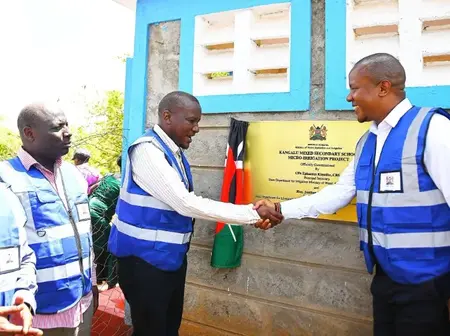
The government has commissioned a micro-irrigation project at Kangalu Mixed Secondary School in Kitui County, aimed at improving food and nutrition security while expanding access to water for learners and the surrounding community.
Irrigation Principal Secretary Ephantus Kimotho and Principal Secretary for Livestock Development Jonathan Mueke commissioned the project in Mulango, Kitui Central.
The completed project is expected to benefit 1,312 learners in the school's primary section, 109 learners in the secondary section and approximately 1,000 members of the surrounding community.
Implemented through the State Department for Irrigation, the project aims to demonstrate how water infrastructure can support agricultural production in learning institutions while addressing wider community needs.
Its interventions include improving food and nutrition security, environmental conservation, land reclamation and sanitation through reliable water supply, tree planting and irrigated agriculture.
The infrastructure includes a 139-metre borehole with a tested yield of 3.8 cubic metres per hour, a solar-powered pumping system and an elevated steel tower fitted with a 20-cubic-metre water storage tank.
Other facilities include a pump house, a community water point and two dedicated student water points serving the primary and secondary school sections.
The project also has two shade-net greenhouses, one in each school section, and a quarter-acre drip irrigation system at the primary school. In addition, 1,000 tree seedlings have been planted to support environmental conservation and increase the institution's green cover.
The water supply system has been fenced, with infrastructure connecting the borehole, storage tank and designated water points.
The project is also expected to provide learners with practical agricultural skills in crop production, irrigation management and environmental conservation.
The availability of water will support school gardening, improve access to fresh produce, strengthen sanitation and promote a healthier learning environment.
Speaking during the commissioning, Kimotho said the Government was committed to expanding irrigation and water infrastructure across Kitui County and other arid and semi-arid regions.
He highlighted the importance of reliable water sources in supporting agricultural production, improving livelihoods and strengthening community resilience.
He said seven projects had been earmarked for implementation in Kitui County under the Kenya Resilient Irrigation for Sustainable Economy (KRISE) Programme, complementing other planned investments in boreholes, water storage and irrigation infrastructure.
Kimotho also highlighted plans to mobilise resources for water development at constituency level, including a proposed allocation of Sh60 million for borehole development in constituencies under the outlined programme.
He said the interventions would be complemented by the development of dams and irrigation systems to ensure water resources support productive economic activities.
The investments align with the Government's broader water security and agricultural transformation agenda, including a presidential commitment to develop 1,250 dams comprising 50 large dams, 1,200 medium-sized dams and additional smaller water-harvesting facilities across the country.
The investments are intended to expand water storage, support irrigation development and increase agricultural production, particularly in areas that rely on rain-fed agriculture.
Mueke commended the Government's integrated approach to development, recognising the role of the State Department for Irrigation and other government agencies in delivering infrastructure to improve community welfare.
He emphasised the importance of collaboration between government departments in addressing food security, improving livelihoods and strengthening rural economies.
The two Principal Secretaries also presided over the distribution of chicks and beehives to organised community groups. The initiative aims to diversify household incomes, promote livestock and apiculture enterprises and expand economic opportunities at the grassroots.
The Kangalu project is part of efforts to extend irrigation beyond conventional large-scale schemes through investments in smallholder and community-based systems, including schools.
Also present were Irrigation Secretary Joel Tanui, National Irrigation Authority (NIA) Board Chairperson Gilbert Maluki, NIA Chief Executive Officer Charles Muasya, Deputy Director of Land Reclamation Esther Masavi and other senior National and County Government officials.
Leave a Reply