
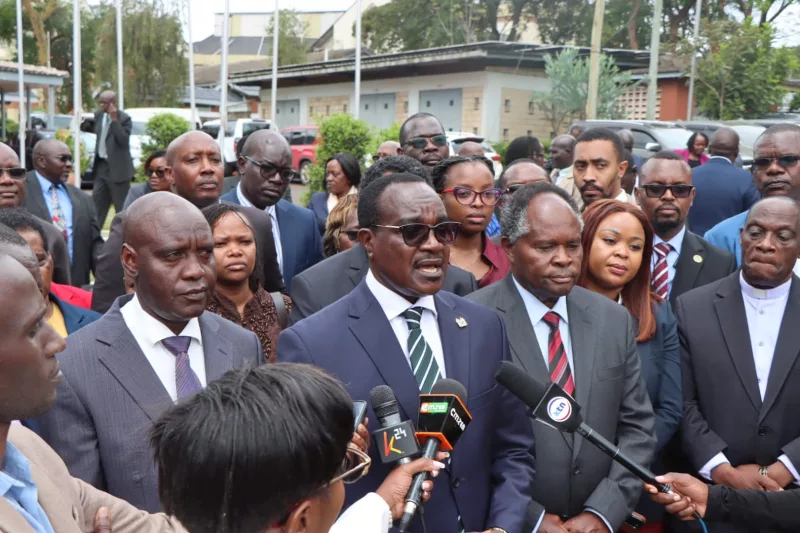
The government has inaugurated a multi-stakeholder task force to investigate the causes of student unrest and recommend lasting measures to restore safety, discipline and order in learning institutions.
The team, drawn from various sectors, has been given 90 working days to examine the factors fuelling school unrest and propose solutions to protect learners and prevent recurrent incidents.
Speaking during the inauguration of the Multi-Stakeholder Task Team on Unrest in Schools at the Centre for Mathematics, Science and Technology Education in Africa (CEMASTEA) in Karen, Nairobi, on Wednesday, Education Cabinet Secretary Julius Migos Ogamba urged members to go beyond previous investigations and focus on practical reforms.
Ogamba challenged the team to confront the underlying problems in schools and recommend lasting solutions, warning against producing another report that would not be implemented.
“The true measure of success will not be the report produced, but the lives protected, the institutional reforms implemented and the recurrence of school unrest prevented,” he said.
He said the government was seeking practical measures to address the root causes of school unrest, urging the team to identify institutional weaknesses and propose workable solutions.
Ogamba revealed that more than 687 incidents of school unrest were reported nationally during the second term of 2026, underscoring the urgency of addressing the problem.
“The situation witnessed during the second term of 2026, when more than 687 incidents of unrest were reported nationally, underscores the urgency of addressing this challenge comprehensively,” he said.
The CS said education is a fundamental right guaranteed under Article 53 of the Constitution and a strategic investment in the country's human capital, social cohesion and national development.
He stressed that schools must remain safe, secure, inclusive and supportive environments where every learner can realise their full potential.
Ogamba noted that recurring cases of arson, violence and destruction of property, some resulting in loss of life, had raised serious concerns about school governance, learner welfare and institutional accountability.
Citing the Hillside Endarasha Academy tragedy in 2024 and the Utumishi Girls Academy fire in May 2026, he said the incidents highlighted the need to strengthen safety measures in learning institutions.
“These incidents cannot be treated as isolated disciplinary matters. They point to broader questions concerning school governance, learner welfare, institutional accountability, safety standards and the effectiveness of our education management systems,” he said.
The task force has been directed to audit recommendations from previous inquiries, including the Sagini, Macharia, Wangai and Koech reports, establish their implementation status and identify institutions responsible for addressing outstanding gaps.
“We must address the unfinished business of previous enquiries while responding to emerging challenges in our education system,” Ogamba told the team.
He said the priority should be to consolidate existing evidence, avoid duplication and ensure previously agreed interventions translate into tangible improvements.
The team will also review school safety standards, fire prevention systems, emergency procedures, boarding facilities, security arrangements and disaster risk management, with particular attention to dormitories, emergency exits and evacuation procedures.
“Particular attention should be given to boarding institutions, including dormitory conditions, emergency exits, fire safety equipment, supervision and evacuation procedures,” he said.
The assignment will also examine learner discipline, guidance and counselling, bullying, substance abuse, peer pressure, psychosocial support and grievance redress mechanisms.
“Our response must embrace positive discipline, responsible behaviour, dialogue and meaningful learner participation. We must also ensure that learners with special needs and disabilities are adequately protected and supported,” he added.
The team is further expected to investigate emerging factors contributing to school unrest, including social media influence, smartphone use, misinformation, online mobilisation, criminal gangs and religious extremism.
Ogamba said the final report would provide a comprehensive assessment of the causes of school unrest, including gaps in implementing recommendations from previous inquiries.
It will also review school safety, boarding arrangements, governance and learner welfare, while proposing specific policy, legislative, regulatory and administrative reforms.
The report is expected to outline a prioritised and costed implementation framework, identify responsible institutions and timelines, and establish monitoring, evaluation and accountability mechanisms to ensure the recommendations are implemented.
The task force will undertake consultations across all 47 counties, incorporating the views of learners, parents, teachers, school administrators and affected communities.
“I expect the Task Team to undertake rigorous analysis, comprehensive stakeholder engagement and meaningful consultations across all forty-seven counties,” Ogamba said, urging members to base their recommendations on credible evidence.
He said the final report must include an implementation framework outlining responsible institutions, timelines, resource requirements and measurable indicators to ensure accountability.
Ogamba said the team would submit its final report on or before March 2, 2027, after which the government would consider appropriate policy, administrative, regulatory and legislative measures.
He emphasised that school unrest could not be addressed by the Ministry of Education alone, calling for coordinated action involving security agencies, health institutions, child protection bodies, parents, teachers and communities.
The CS urged members to approach the assignment with independence, integrity and urgency, insisting that the safety, dignity and wellbeing of every learner must remain central to education reforms.
Leave a Reply