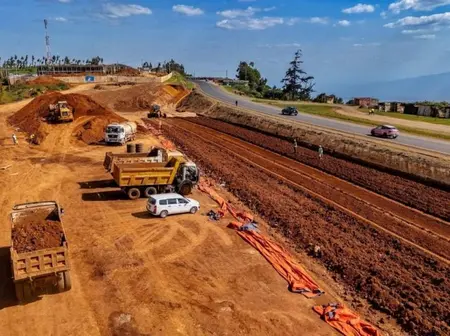
The government is undertaking major road safety improvements along the Rironi-Mau Summit highway as part of the ongoing expansion works aimed at reducing fatal accidents and improving traffic movement.
The project will introduce physical separation of vehicles travelling in opposite directions, a measure expected to minimise head-on collisions and prevent runaway vehicles from crossing into oncoming traffic.
Speaking in a documentary shared by the Kenya National Highways Authority (KeNHA) highlighting progress on the ongoing construction works on Wednesday, November 25, 2026, Resident Engineer for the Rironi-Gilgil section, Cornelius Kibet, said the expansion would address some of the major safety challenges experienced along the highway.
Kibet identified the time taken by motorists to travel along the corridor and the frequency of fatal accidents as some of the key issues the project seeks to address.
“One of the big things for me in terms of the transformation of this road would be the time taken to traverse this section of the country,” Kibet said.
He noted that the highway had experienced major accidents, many of them fatal, making the separation of opposing traffic an important intervention.
“The accidents that have been happening on this road are major and largely fatal accidents. So for sure, when we are going to do works, we are going to separate this road from oncoming vehicles on different directions,” he explained.
Kibet added that the design would help reduce head-on collisions and prevent runaway vehicles from crossing into lanes carrying traffic in the opposite direction.
“In that case, we reduce the head-on collisions and even runaway vehicles crossing over from one side to the other. And in this case, for sure, we are going to ensure safety is enhanced on this corridor,” he stated.
Beyond separating traffic, the project will introduce grade-separated interchanges at major intersections to minimise conflicts between vehicles joining or leaving the highway.
Kibet said the construction would also incorporate underpasses at designated U-turn points to allow motorists to change direction without interfering with traffic on the main carriageway.
“On all major intersections, we are going to do grade separation interchange. Also, for U-turns on the continuous regions, we are going to have grade-separated U-turns, specifically what you call underpasses,” he explained.
The facilities will allow vehicles joining or turning along the highway to do so without creating danger for other motorists.
The expansion will also incorporate pedestrian footbridges and underpasses to provide safer crossing points for people living and working along the highway.
Kibet said the project had made provisions for pedestrian crossing facilities to reduce interactions between pedestrians and fast-moving vehicles.
“We also have the pedestrians, so we have made provision under this project for adequate pedestrian crossings, either pedestrian footbridges or pedestrian underpasses,” he said.
The project will additionally incorporate service roads to allow residents and businesses along the corridor to access their properties without disrupting traffic on the main highway.
“We also have adequate service roads which will allow the community to be able to access their properties without posing safety risks or reducing capacity for slow-moving vehicles on the main carriageway,” Kibet added.
The highway expansion is also expected to reduce travel time along one of the country’s important transport corridors, which connects Nairobi to Nakuru and other parts of western Kenya.
The project will feature a dual carriageway between Rironi and Naivasha, with two lanes in each direction, while the Naivasha-Nakuru section is planned to have three lanes in each direction.
The improvements are expected to strengthen regional connectivity by easing the movement of people and goods towards western Kenya and neighbouring countries, including Uganda, Rwanda, South Sudan, Burundi and the Democratic Republic of Congo.
For motorists who have endured years of congestion and dangerous road conditions along the corridor, the new infrastructure is expected to bring significant changes in road safety and travel efficiency.
Leave a Reply