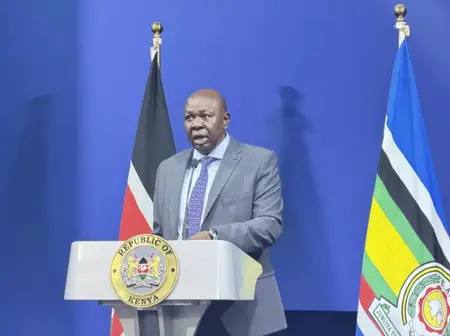
Government Spokesperson Charles Owino said the reforms were aimed at improving accountability, reducing unnecessary medical expenses and ensuring patients receive quality healthcare without exhausting their insurance benefits prematurely.
Speaking during a media briefing at the Government Spokesperson's Media Centre in Nairobi on Thursday, November 26, Owino also addressed questions surrounding the controversial two per cent Health Information Management System (HIMS) utilisation fee.
He said the government remained committed to complying with court directives concerning the levy following a High Court ruling in Vihiga that declared the charge on SHA pre-authorised claims invalid.
However, the court suspended the declaration for 120 days, allowing the Health Cabinet Secretary an opportunity to consider subjecting the fee to public participation, if advised to do so.
Owino maintained that digital health systems should support healthcare facilities rather than introduce financial difficulties for providers.
"Digital health systems must facilitate healthcare delivery and must not undermine the financial sustainability of the healthcare facilities," he said.
The government also defended the financing arrangement behind the Digital Health Superhighway, a major programme expected to transform how medical information and services are managed across the country.
The 10-year project was launched in February 2025 and is being implemented by a consortium comprising Safaricom, Apeiro Limited and Konvergenz Network Solutions.
It is projected to cost KSh104.8 billion.
According to Owino, the arrangement operates through a service-based model rather than the conventional purchase of information technology equipment.
Under the agreement, the consortium finances the development, installation, maintenance and technical support of the digital infrastructure, while the government makes payments for services delivered through monthly deductions from SHA funds.
The arrangement covers equipment, internet connectivity, cloud hosting, cybersecurity, technical support, staff training and system maintenance.
The service provider is also responsible for upgrading and maintaining the infrastructure throughout the contractual period. At the end of the 10 years, the system is expected to be handed over to the government.
Owino explained that the programme was designed to replace fragmented, paper-based healthcare processes with an integrated digital platform.
The infrastructure is expected to support biometric patient identification, electronic processing of medical claims, secure sharing of medical records, authentication of healthcare providers and registration of medical facilities.
It will also support emergency response services, including the National Ambulance Dispatch Centre.
The system is expected to facilitate the administration of three major health financing programmes: the Social Health Insurance Fund, Primary Healthcare Fund and Emergency, Critical and Chronic Illness Fund.
The government believes the changes will reduce administrative delays, strengthen fraud prevention and improve the timely reimbursement of healthcare facilities.
Owino said the success of the investment would ultimately be judged by improvements in patient outcomes, healthcare delivery and the responsible use of public funds.
On cancer treatment, the government sought to reassure patients that the approved benefit had not been reduced despite recent changes to treatment approvals and reimbursement arrangements.
Owino confirmed that the KSh800,000 cancer benefit per patient remained unchanged.
The package consists of KSh400,000 provided through the Social Health Insurance Fund and another KSh400,000 through the Emergency, Critical and Chronic Illness Fund.
He explained that the review followed complaints about differences in the amounts hospitals charged for similar cancer treatments.
In some cases, patients reportedly exhausted their available benefits before completing their treatment because of variations in hospital charges.
The revised approach is intended to standardise treatment costs, align medical services with national cancer treatment guidelines and ensure the available funds cover patients more effectively.
The changes were developed through consultations led by the Ministry of Health's National Cancer Control Programme.
The discussions involved oncologists, pharmacists, nurses, healthcare providers and relevant professional associations.
Under the revised arrangements, patients seeking cancer treatment through SHA must meet the approved treatment guidelines, tariffs and eligibility requirements.
Hospitals are also required to explain any additional charges for services falling outside the approved benefit package before treatment begins.
The government maintained that patients should not be charged separately for services already covered by SHA.
The latest clarification comes amid public scrutiny of SHA's implementation, particularly concerns about medical charges, treatment approvals and the financial sustainability of the new health insurance system.
Source
Leave a Reply