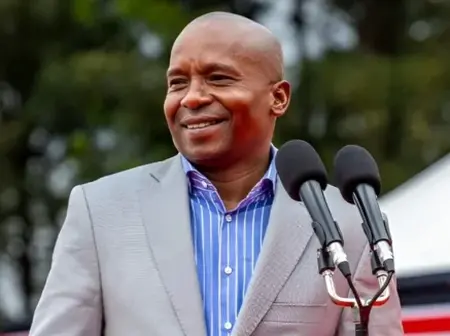
A fresh poll from TIFA Research indicates that Deputy President Kithure Kindiki holds a commanding position in the competition to serve as President William Ruto’s vice-presidential candidate for 2027, securing 55 percent of the backing.
Occupying the runner-up spot with 12 percent of the vote is Homa Bay Governor and ODM chairperson Gladys Wanga. Cabinet Secretary Hassan Joho secures the third position with 9 percent.
According to TIFA’s May survey, Kindiki led among Ruto backers with 59 percent, surpassing Wanga’s 12 percent.
Joho is the most significant shift, as his backing rose threefold from 3% in May to 9%.
Wanga’s share of 12 percent remains the same as it was in May. Meanwhile, Oburu Odinga, leader of the ODM, who also received 3 percent in May, fails to make the top three.
A previous Infotrak survey placed Kindiki at 34 percent, Wanga at 11, Oburu at 5, and Joho at 4.
At the Coast, Infotrak placed Joho at 11 percent, while Kindiki received 23 percent.
According to TIFA, the electorate seemed to lean toward maintaining consistency and steadiness under Ruto, with Kindiki emerging as the candidate most readily accepted by the public.
Musalia Mudavadi, who serves as the Prime Cabinet Secretary, has eliminated himself from the running, citing his goal to become president in 2032.
Analysts suggest that a Kindiki candidacy might enable Ruto to garner over 1.3 million votes in Mt Kenya East.
Amidst demands from certain Kenya Kwanza figures urging Ruto to look into selecting an alternative running mate, the survey was conducted.
Oburu Odinga, the head of the ODM, declared that the party will not nominate a presidential contender for 2027 and will support Ruto’s campaign for another term, sparking debate over what concessions ODM expects in return.
Surveys gauge preferences rather than choices, and Ruto holds the power to make the final decision.
On Thursday, TIFA published its presidential polling figures, showing Ruto and Sifuna locked in a dead heat at 31 percent.
As the contest grows more competitive, selecting a vice-presidential candidate might be the deciding factor. The ascent of Joho and Wanga’s consistent performance indicate that ODM’s position remains up for grabs.
Professor Herman Manyora, a political analyst, has voiced new worries regarding President William Ruto’s standing in Western Kenya, noting that Nairobi Senator Edwin Sifuna’s rise has altered the area’s political trajectory leading up to the 2027 General Election.
According to Manyora, the old political setup where key figures like National Assembly Speaker Moses Wetang’ula and Prime Cabinet Secretary Musalia Mudavadi steered the Mulembe community’s voting choices is under significant pressure.
His evaluation suggests that Sifuna’s rising clout has unsettled the political math that once rendered Western Kenya a safe haven for the Kenya Kwanza government.
Through the Linda Mwananchi Movement, which has drawn notice in multiple counties across the area, the senator has increasingly established himself as a prominent advocate for a fresh wave of voters.
His strategy seems focused on contesting current authority, scrutinizing the administration’s record, and urging Western Kenya to seek its own presidential bid rather than waiting for 2032.
This approach has put him at odds with Mudavadi and Wetang'ula, who keep pressing locals to back Ruto’s campaign for re-election in return for greater regional influence within the administration.
Collaboration with figures like Trans Nzoia Governor George Natembeya and Vihiga Senator Godfrey Osotsi has likewise aided Sifuna, as these individuals have emerged as key voices within the developing political movement.
These events have sparked doubts regarding whether Mudavadi and Wetang'ula retain the political clout they held during the 2022 General Election.
Mudavadi stepped up his campaign to secure backing for Ruto from Western Kenya on November 11, calling on locals to vote in additional UDA lawmakers in 2027. Furthermore, he revealed intentions to hold a significant political rally in December together with COTU Secretary General Francis Atwoli.
Yet the rising fame of Sifuna has rendered the mobilization campaign more complex.
A decline in backing from Western Kenya would pose further challenges for Ruto’s re-election strategy, especially given that opposition figures are actively working toward forming a cohesive political coalition.
The evolving struggle indicates that Western Kenya might turn into one of the most intensely fought areas during the 2027 polls, as Sifuna tries to upend the prevailing political framework.
A new opinion poll on Kenya's opposition politics has brought fresh attention to the disagreements among leaders seeking to challenge President William Ruto in the 2027 General Election.
The findings come at a time when opposition principals are facing growing pressure to agree on a common political direction and settle on one presidential candidate.
Former President Uhuru Kenyatta recently challenged opposition leaders to put aside their individual ambitions and work together ahead of the 2027 elections.
Speaking during the burial of Mama Beatrice Wambui Muturi in Nairobi on Wednesday, November 11, Uhuru warned that competing presidential ambitions could weaken the opposition's efforts.
He reminded the leaders that only one person can occupy the presidency at a time, urging them to listen to Kenyans and prioritise unity.
His remarks came as several opposition figures, including former Deputy President Rigathi Gachagua, Wiper leader Kalonzo Musyoka and DAP-K leader Eugene Wamalwa, continue positioning themselves ahead of the next election.
The opposition has also witnessed growing political activity around Nairobi Senator Edwin Sifuna and the Linda Mwananchi Movement, adding another dimension to discussions about the possible presidential contest.
Meanwhile, Gachagua has previously dismissed claims of serious divisions within the opposition, describing disagreements among the leaders as normal differences within a large political family.
The latest debate comes as President Ruto continues preparing his political camp for another election contest.
The opposition's ability to agree on a common candidate and maintain cooperation could become an important factor in the coming campaigns.
The poll's reported findings have therefore attracted attention amid renewed calls for unity.
However, the specific leader identified by the poll as most responsible for the divisions and the percentage recorded should be confirmed from the full survey before being reported as fact.
Former Deputy President Rigathi Gachagua has emerged as the politician most frequently blamed for disagreements within Kenya's opposition, according to a new opinion poll released by TIFA Research and Consulting on Thursday, November 12, 2026.
The survey indicates that 43 per cent of opposition supporters believe Gachagua is responsible for the divisions affecting the opposition camp as political leaders prepare for the 2027 General Election.
President William Ruto and his United Democratic Alliance (UDA) administration follow in second place, with 15 per cent of respondents attributing the disagreements to them.
Nairobi Senator Edwin Sifuna was mentioned by seven per cent of respondents, while Wiper Party leader Kalonzo Musyoka attracted six per cent.
Former Interior Cabinet Secretary Fred Matiang'i and Embakasi East MP Babu Owino each received four per cent. Former President Uhuru Kenyatta, Siaya Governor James Orengo and Kiharu MP Ndindi Nyoro were each mentioned by two per cent.
Trans Nzoia Governor George Natembeya received one per cent.
The findings come at a time when opposition leaders are exploring possible political partnerships and strategies to challenge President Ruto in the next general election.
Gachagua, who leads the Democracy for the Citizens Party (DCP), has been among the prominent figures involved in efforts to build an opposition alliance.
However, disagreements over leadership positions, political influence and the selection of a possible joint presidential candidate continue to present challenges to the coalition-building process.
The survey was conducted between October 26 and November 5, 2026, involving 2,036 respondents across all 47 counties. TIFA reported a margin of error of plus or minus 2.16 percentage points.
The findings have sparked fresh political debate over who bears responsibility for the opposition's internal disagreements as the race towards the 2027 elections gathers momentum.
The latest poll is expected to generate further reactions from political leaders and supporters across the country.
In a Swahili post on his X account, Natembeya said that instead of continuing to depend on the old leaders who have been at the forefront for a long time, it is time to think about and nurture a new generation of leaders with strength, vision and fresh thinking.
He said the change should begin in 2027 and should not wait until 2032, adding that the time to bring new blood into leadership is now.
He did not name anyone in the post, but the remarks are believed to be aimed at Prime Cabinet Secretary Musalia Mudavadi and National Assembly Speaker Moses Wetang'ula, who have dominated Luhya politics for decades.
The two leaders have been under growing pressure in the region from younger politicians, and Natembeya's message adds to that challenge.
The governor has already declared his support for Nairobi Senator Edwin Sifuna, who has been building the Linda Mwananchi Movement and is seen as one of the faces of the younger wave in Western Kenya.
His reference to 2032 also echoes the debate sparked earlier by Mudavadi's critics, who have said the Prime CS is waiting to inherit the presidency in that year, and by Wetang'ula's remarks that Sifuna should wait until 2032 for his own ambitions.
Natembeya's call comes as the Tifa Research survey released this week put Sifuna at 31 per cent as the preferred winner of the 2027 presidential election, level with President William Ruto. The figures have encouraged his allies, who argue that the region should place its bet on a new generation.
Mudavadi and Wetang'ula, on the other hand, are working to defend their influence ahead of the 2027 General Election, with Mudavadi recently telling residents to stop expecting government benefits without supporting the leadership that advocates for them.
Both remain allied to President Ruto and are expected to deliver Western Kenya votes for his re-election bid.
How the Luhya community responds to the call for generational change will be one of the most closely watched contests of the next election cycle, given the number of votes the region carries.
President William Ruto and Nairobi Senator Edwin Sifuna have tied as Kenya's most popular potential presidential candidates, according to the latest opinion poll released by TIFA Research.
The survey, released on Thursday, November 12, shows both leaders commanding 31% support among respondents asked about their preferred presidential candidate ahead of the 2027 General Election.
The findings mark a notable change in the political landscape, particularly for Sifuna, whose popularity has increased significantly in recent months.
According to the survey, Ruto's support has increased from 24% recorded in the previous TIFA ratings to 31% in the latest findings.
Sifuna has also registered a remarkable rise, moving from 15% to 31%, placing him at the same level as the sitting Head of State.
The Nairobi senator has attracted growing national attention through his political engagements and activities associated with the Linda Mwananchi Movement.
His rising popularity comes amid increasing discussions about the opposition's plans to challenge Ruto's administration in the next General Election.
Meanwhile, the latest figures also provide an interesting picture of the changing political fortunes of other prominent leaders seeking to influence the 2027 contest.
Former Interior Cabinet Secretary Fred Matiang'i reportedly received 5%, while Wiper Party leader Kalonzo Musyoka garnered 9%.
Former Deputy President Rigathi Gachagua recorded 4% in the latest survey.
The findings come as political leaders continue positioning themselves ahead of the next election, with questions surrounding possible coalitions and presidential alliances dominating national discussions.
The latest TIFA survey is expected to generate fresh debate among Kenyans, particularly supporters of Ruto and Sifuna, following the two leaders' identical ratings.
However, opinion polls reflect public preferences at the time of research and should not be interpreted as predictions of the eventual election results.
The Linda Mwananchi Movement has taken a commanding lead in Nairobi’s political popularity rankings, emerging as the most popular political outfit with 26 per cent support, according to the latest survey by Trends and Insights For Africa (TIFA).
The survey places the movement ahead of the Democracy for the Citizens Party (DCP), which secured 11 per cent, while the United Democratic Alliance (UDA) and Orange Democratic Movement (ODM) are tied at 9 per cent each.
The results highlight the growing political prominence of Linda Mwananchi, which enjoys a 15-percentage-point advantage over its closest competitor, DCP.
The latest figures could signal a changing political environment in Nairobi, where emerging political formations appear to be attracting attention alongside established parties with longstanding grassroots networks.
Linda Mwananchi’s 26 per cent rating places it ahead of parties that have traditionally played a significant role in Kenya’s political landscape. The development could attract interest from political observers and rival formations seeking to understand the factors behind the movement’s growing popularity.
DCP's second-place position at 11 per cent also points to its presence in the capital's political contest, while the joint third-place ranking for UDA and ODM demonstrates that the two established parties continue to command considerable attention among Nairobi residents.
The survey comes as political players increasingly focus on Nairobi because of its strategic importance in determining national political conversations and electoral outcomes.
With its diverse population and significant number of young voters, the capital remains a crucial battleground for political mobilisation.
The findings are likely to trigger fresh political debate over whether emerging movements are gaining ground at the expense of established political parties.
Although the Linda Mwananchi Movement leads the latest rankings, the 26 per cent support indicates that a significant proportion of respondents either support other political outfits or have not identified with the leading movement.
The latest TIFA survey therefore presents an interesting picture of Nairobi's political landscape, with Linda Mwananchi enjoying a clear lead as competition for the city's political support continues.
While President William Ruto and Nairobi Senator Edwin Sifuna tied at the top with 31 percent support each, several veteran opposition heavyweights recorded sharp declines in national voter preference.
According to Capital FM, Wiper Party leader Kalonzo Musyoka fell to 9 percent support in the November 2026 poll.
This marks a steady downward trajectory from his peak of 25 percent recorded in November 2025.
His rating had previously slipped to 19 percent in May 2026 and 13 percent in June 2026, leaving him a distant third behind the two frontrunners.
Jubilee Party presidential aspirant Fred Matiang’i registered 5 percent support, placing him fourth overall in the national ranking.
Data reported by People Daily shows the former Interior Cabinet Secretary has experienced the longest slide among major contenders.
His backing stood at 32 percent in August 2022 before falling to 21 percent in September 2025, 18 percent in November 2025, and 14 percent across May and June 2026.
Former Deputy President Rigathi Gachagua garnered four percent support in the November 12 survey, placing him fifth among potential presidential candidates.
Despite his public push to unite opposition factions, People Daily notes that the survey flagged Gachagua as a divisive figure within opposition ranks.
The poll further indicates that Sifuna has overtaken Gachagua as Mount Kenya's most preferred presidential choice.
The findings highlight a rapidly changing opposition dynamic as coalition negotiations intensify across the country.
Ultimately, their combined influence may depend on whether they rally behind a single candidate or run separate campaigns.
Nairobi Senator Edwin Sifuna has registered a higher presidential preference than former Deputy President Rigathi Gachagua among supporters of Gachagua’s Democracy for the Citizens Party (DCP), according to a new TIFA Research survey released on Thursday, November 12, 2026.
The finding comes amid growing political engagement between the two leaders as opposition figures explore possible cooperation ahead of the 2027 General Election.
In its analysis of presidential preferences across supporters of the main political parties, the survey revealed:
“The preferred 2027 presidential winners among declared supporters of the main political parties are largely what one would expect, with nearly all supporters of UDA, Linda Mwananchi and Wiper hoping their respective party leaders win (UDA: Ruto, Linda Mwananchi: Sifuna, Wiper: Kalonzo, and Jubilee: Matiang’I, though support for the latter is rather weak by comparison (just 57%). What stands out, however, is that Sifuna is more popular than Gachagua among DCP supporters (34% vs. 25%), and is almost as popular among ODM supporters as Ruto (33% vs. 42%). Also, aside from Matiang’I, Ruto is more popular among Jubilee supporters than any possible Opposition candidate.”
The findings provide a glimpse into how presidential preferences are distributed within political parties, showing that party affiliation does not necessarily mean supporters will favour their own leaders in a presidential contest.
The DCP figures are particularly notable because Gachagua leads the party, yet Sifuna records a higher preference among its supporters.
The survey also found that Sifuna attracts considerable support among ODM supporters, where he records 33 per cent against Ruto’s 42 per cent.
Within UDA, President William Ruto commands 85 per cent preference among the party’s supporters, while Sifuna receives 90 per cent among Linda Mwananchi supporters.
Wiper supporters largely favour their party leader, Kalonzo Musyoka, while 57 per cent of Jubilee supporters prefer former Interior Cabinet Secretary Fred Matiang’i.
The results suggest that presidential preferences are not entirely confined to party boundaries, with candidates attracting support from outside their established political formations.
However, the DCP findings represent respondents who support the party and should not be interpreted as proof that Sifuna is more popular than Gachagua across the entire Mt Kenya region.
The survey comes against the backdrop of Gachagua’s insistence that Mt Kenya voters should not automatically support a presidential candidate without first negotiating the region’s interests.
Speaking during the Ngemi cia Watho Cultural Festival in Thika on Saturday, November 7, Gachagua recalled the region’s decision to support Ruto in the 2022 General Election.
“We gave Kasongo our votes without thinking or even talking. We simply handed them over. This time, before getting the votes of the mountain, there must be discussions,” Gachagua said.
He further warned against making political endorsements without proper consultations.
“Never again shall we just give our votes to anybody just like that? We have to look and study, interrogate, consult, review and make an informed decision,” he said.
The TIFA findings add another dimension to that debate by showing that a section of DCP supporters currently prefer a potential opposition partner over their own party leader in the presidential contest.
The relationship between the two politicians has attracted attention following their October 20 meeting at Gachagua’s Wamunyoro residence in Nyeri County.
Gachagua welcomed Sifuna and other Linda Mwananchi leaders, describing them as “my cousins from Linda Mwananchi” and adding: “When we come together great things must happen.”
The meeting brought together politicians from different political backgrounds, including Trans Nzoia Governor George Natembeya, Vihiga Senator Godfrey Osotsi and Embakasi East MP Babu Owino.
Gachagua has also indicated that he could take a deputy position in a possible opposition ticket led by Sifuna.
“I can deputise Sifuna,” he said while discussing possible opposition ticket arrangements.
Sifuna has defended his political engagement with leaders from different regions, arguing that cooperation should not be restricted by geographical or political boundaries.
“Yesterday, some people saw us somewhere with someone, and they now want to tell us that there is a region in this country where none of us is supposed to associate with,” Sifuna said after the meeting.
Although Sifuna records a higher preference than Gachagua among DCP supporters, the survey does not establish whether those supporters would back a joint ticket or whether their preferences would translate into support across the wider Mt Kenya region.
The figures also show that Ruto retains considerable support among some opposition party supporters, including ODM and Jubilee, complicating assumptions about how political support would shift in a coalition contest.
For Sifuna and Gachagua, the findings provide a measure of the preferences within one section of the opposition electorate. The wider question remains whether the political relationships being built between opposition leaders can produce an agreed presidential arrangement acceptable to their respective supporters.
Listen to article55 per cent of Ruto’s supporters want Kindiki to remain his deputy in the next election, placing him ahead of other politicians identified as possible contenders for the position.Deputy President (DP) Kithure Kindiki has emerged as the preferred choice among President William Ruto’s supporters to retain the running mate position in the 2027 General Election, amid growing pressure from the Orange Democratic Movement (ODM) to secure the slot in a possible pre-election deal.