
The crude oil discovered in Turkana County is moving closer to the international market, with the government now considering four names that could eventually become the identity of Kenya’s petroleum exports.Energy Cabinet Secretary Opiyo Wandayi says the Ministry of Energy and Petroleum has reduced the proposed names to four following submissions from members of the public.
Category: Economy&Finance
-
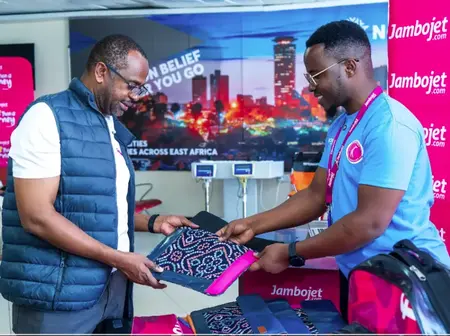
Jambojet cuts fuel costs by 16% through efficiency drive as it expands
Jambojet has reduced its fuel costs by 16 per cent over the past four years through operational efficiencies and data-driven flight planning.
This highlights how airlines are increasingly turning to technology and improved aircraft management to contain costs and reduce their environmental footprint.
The regional low-cost carrier said the savings have been achieved through changes in ground operations, aircraft descent procedures and more accurate fuel planning, which have helped minimise unnecessary fuel consumption across its network.
Managing director and chief executive Karanja Ndegwa said the initiatives demonstrate how airlines can achieve financial savings while reducing carbon emissions without necessarily investing in expensive new aircraft or technologies.
“Over the last four years, we have saved about 16 per cent of our fuel costs by having these initiatives in place,” Ndegwa said.
The measures include single-engine taxiing, where pilots switch off one engine after landing whenever safety and operational conditions permit, reducing fuel consumed while aircraft move between the runway and parking bays.
The airline has also adopted gradual descent approaches, allowing pilots to reduce engine power progressively as aircraft approach their destinations, rather than maintaining higher thrust levels for longer.
Data analytics has become another important component of the strategy, with the airline monitoring individual flights to establish actual fuel consumption against planned requirements.
Network analyst Felix Ogutu said the airline uses information on planned and actual fuel consumption, aircraft speed, temperature and route conditions to refine its calculations.
The analysis enables the operations team to establish more accurate fuel requirements for individual flights while retaining the mandatory safety reserves.
Final fuel decisions remain subject to operational requirements and the captain's judgement.
The cost savings come at a time when fuel price volatility continues to squeeze airline margins.
Kenya Airways, Jambojet's parent company, reported a 32 per cent increase in fuel costs in the first half of 2026, with fuel accounting for 32 per cent of its total operating expenses.
Jambojet's efficiency drive also coincides with an expansion strategy aimed at strengthening its regional footprint.
The airline generated Sh14.4 billion in revenue in 2025, up from Sh13.6 billion in 2024, although passenger numbers remained relatively flat at about 1.2 million.
It is targeting revenue of Sh17.2 billion and 1.5 million passengers in 2026.
In October, the carrier resumed daily Nairobi-Entebbe flights after a six-year suspension, restoring a connection expected to serve business travellers, tourists and cross-border traders.
It is also planning to introduce flights to Dar es Salaam by March next year, subject to fleet expansion.
The expansion comes against a mixed aviation industry outlook.
Kenya National Bureau of Statistics data show that commercial air passenger traffic declined by 1.2 per cent to 12.68 million in 2025, from 12.83 million the previous year.
However, air cargo volumes increased by 12.5 per cent to about 419,752 tonnes, pointing to opportunities beyond passenger transportation.
-

US Consortium Wins Sh8 Trillion Mrima Hill Rare Earths Mining Tender
A United States led consortium has won the competitive tender to develop Kenya's strategic Mrima Hill niobium and rare earth mineral deposits in Kwale County, estimated to be worth more than Sh8 trillion.Mining, Blue Economy and Maritime Affairs Cabinet Secretary Hassan Ali Joho announced that Frontier Minerals Consortium emerged victorious after defeating seven rival international bidders from China, Australia, and other jurisdictions.
-

Kenya overtaken by 3 African countries in real estate investment despite being the pioneer
Kenya has been overtaken by South Africa, Morocco and Zimbabwe in Africa’s real estate investment trust (REIT) market despite introducing its regulatory framework in 2013, as limited institutional investment, low market liquidity and competition from government securities continue to constrain the sector’s growth.
A September 2026 report by real estate research firm Fortren & Company estimates Kenya’s REIT market capitalisation at approximately $247.6 million (Ksh32.19 billion), placing it fourth in its comparison of African markets.
South Africa leads with $18.9 billion (Ksh2.46 trillion), followed by Morocco at $667.4 million (Ksh86.76 billion) and Zimbabwe at $270.9 million (Ksh35.22 billion), while Nigeria comes fifth with $233.25 million (Ksh30.32 billion).
The findings highlight the challenges facing Kenya’s property investment sector, which has struggled to attract institutional investors despite establishing its regulatory framework alongside South Africa in 2013.
According to Fortren, South Africa’s dominance is supported by deeper capital markets, a strong institutional investor base and established corporate governance structures.
The country’s pension funds and asset managers collectively hold an estimated 60 to 70 per cent of listed REITs, providing property investment companies with access to substantial long-term capital.
In Kenya, however, institutional participation remains relatively limited, with high-net-worth individuals playing an important role in supporting the market.
Fortren identifies limited pension fund participation as one of the major challenges affecting Kenya’s real estate investment market.
Although pension schemes increased their allocation to REITs by 13.1 per cent in 2025, total pension-sector investment in the asset class stood at approximately $100 million (Ksh13 billion).
Explaining the investment dynamics, the report states, “Demand is therefore institution-led, driven mainly by pension schemes, insurance companies and asset managers seeking stable, inflation-beating dividend yields and portfolio diversification.”
However, institutional investors have been reluctant to increase their exposure to REITs because of competition from fixed-income investments offering comparatively attractive returns.
In Nigeria, for instance, REIT yields of below eight per cent are often considered insufficient compared with government bonds offering returns of up to 15 per cent annually.
The report observes that this difference in returns affects institutional investment decisions, noting that government securities can offer “significantly higher and safer returns” compared with REIT investments.
Fortren argues that deepening institutional participation requires policy support, including potential minimum pension fund allocations to listed real estate.
The report further identifies limited market liquidity, restrictive investment rules, low investor awareness and a shortage of investment-grade properties as obstacles affecting the development of African REIT markets.
It attributes the slow development of the sector to “Limited market depth, weak regulatory frameworks, low investor awareness and the absence of institutional participation.”
Kenya is also trailing Morocco, whose REIT market capitalisation is estimated at $667.4 million (Ksh86.76 billion), more than twice the Kenyan figure.
Fortren attributes Morocco’s growth to stronger institutional demand, an expanding investment pipeline and a relatively stable currency that makes it easier for REITs to scale.
South Africa, meanwhile, benefits from greater market liquidity, professional asset management capabilities and stronger access to debt and equity financing.
The report notes that “South Africa controls 92% of the market,” supported by its mature property sector and established institutional investor base.
It further identifies the country’s sophisticated capital markets, pension fund participation and insurance industry as major factors behind its dominance.
Despite the challenges, Kenya’s market has recorded growth, with Acorn REIT emerging as its largest player.
Fortren estimates that Acorn’s I-REIT and D-REIT have a combined market capitalisation of approximately $134 million (Ksh17.42 billion).
The two investment vehicles focus on purpose-built student accommodation, a specialised segment of the property market.
Other players include ILAM Fahari, LAPTRUST Imara and ALP Industrial REIT.
Fortren argues that Kenya needs stronger institutional participation, improved regulatory frameworks, investor-friendly tax treatment and deeper capital market liquidity to expand its REIT sector.
The report recommends that regulators strengthen the investment environment, stating that they “need to deepen the asset class through enabling frameworks.”
It also calls on REIT operators to improve portfolio management, asset selection and occupancy stability to help property investment vehicles deliver returns competitive with sovereign debt.
For Kenya, the challenge remains turning its early regulatory start into a deeper and more attractive property investment market.
-

Kenya’s push for multinational investment meets the 15% global minimum tax
Kenya’s efforts to attract multinational companies through preferential tax rates are taking place alongside the introduction of a global minimum taxation framework that could increase the tax liabilities of some of those investors.
The country’s Nairobi International Financial Centre (NIFC) offers qualifying holding companies a 15% corporate income tax rate for their first 10 years of operation, rising to 20% for the following decade. The incentives form part of Kenya’s strategy to attract regional headquarters and international businesses.
However, qualifying multinational groups operating in Kenya must also consider the country’s Minimum Top-Up Tax (MTT), which seeks to ensure that large international groups pay an effective tax rate of at least 15% in the jurisdictions where they operate.
Samuel Maina, Senior Tax Manager in charge of Transfer Pricing at RSM East Africa, says companies benefiting from preferential tax regimes, including those operating in Export Processing Zones (EPZs) and Special Economic Zones (SEZs), can fall within the minimum tax framework if their multinational groups meet its revenue threshold.
The rules introduce a new calculation for companies whose domestic tax treatment results in an effective rate below the international minimum.
Kenya has expanded its use of preferential tax arrangements to attract investment into financial services, manufacturing, technology and other sectors.
The NIFC has been one of the country’s main vehicles for attracting international financial businesses. In July 2026, TechTrendsKE reported that 15 newly certified companies were expected to mobilise KSh25.8 billion in investment and create more than 1,000 direct and indirect jobs. The report also detailed the preferential tax rates available to qualifying holding companies establishing regional headquarters in Kenya.
In November, the centre was reported to have approximately 40 member companies and plans for a KSh65 billion startup fund, including KSh32.5 billion earmarked for technology and artificial intelligence startups.
The NIFC incentives sit alongside Kenya’s wider investment-zone framework. Amendments to the Special Economic Zones regime reported in May 2026 expanded the categories of activities eligible for the programme, including petroleum operations, agro-processing, mining and manufacturing.
Maina says the minimum tax framework does not provide a general exemption for entities operating under preferential tax regimes. A multinational group that meets the scope requirements can therefore face a top-up liability where its Kenyan operations benefit from a tax holiday or reduced corporate tax rate.
He cites EPZ companies with 10-year tax holidays, during which the applicable corporate tax rate is zero, as particularly exposed. Where an entity falls within MTT’s scope and its effective tax rate is zero, a top-up calculation is required to reach the 15% minimum.
The framework was introduced through the Tax Laws (Amendment) Act 2024 as part of Kenya’s adoption of the OECD/G20 Base Erosion and Profit Shifting (BEPS) Pillar Two framework.
The NIFC’s preferential 15% corporate income tax rate is the same headline percentage used under Pillar Two, but the two calculations operate differently.
The domestic rate determines the corporate income tax payable under Kenya’s tax regime. MTT uses adjusted income and adjusted taxes to calculate the effective tax rate of a multinational group in a jurisdiction.
Consequently, a company paying the NIFC’s 15% corporate tax rate still needs to assess its position under the minimum tax rules.
Maina explains that the framework applies to multinational groups whose consolidated revenue at the ultimate parent level meets the €750 million threshold. He estimates this at approximately KSh100 billion to KSh110 billion, depending on the exchange rate.
The threshold is based on group revenue rather than the turnover of the individual Kenyan subsidiary or branch. It is assessed over the preceding four financial years, with the group required to meet the threshold in at least two of those years.
Kenya’s earlier implementation reporting had already identified the €750 million threshold and the two-out-of-four-year test as central elements of the new regime.
The MTT calculation begins with the consolidated group’s eligibility, followed by adjustments to the Kenyan entity’s financial information.
Maina says the computation starts with the net income recorded in the profit and loss account. Adjustments are then made to arrive at adjusted income, including the treatment of revaluation gains and losses, fines, penalties and pension expenses.
Fines and penalties recorded as expenses are added back. Pension provisions are also added back, while pension expenses already paid and incurred as genuine business costs can be treated as deductible expenses in the calculation.
Deferred tax requires separate adjustments. Maina explains that the treatment depends on the items included in the deferred tax expense, with relevant portions added or deducted before the adjusted deferred tax figure is combined with actual tax expense to determine adjusted taxes.
The effective tax rate is then calculated by dividing adjusted taxes by adjusted income. Where the result falls below 15%, the group proceeds to the top-up tax calculation.
The framework also provides a substance-based income exclusion linked to investment in employees and physical assets. Maina says the calculation allows a deduction equivalent to 10% of payroll costs and 8% of net tangible assets when determining the excess profit subject to MTT. He adds that the payroll percentage will decline over time.
The exclusion recognises a portion of income associated with a company’s investment in people and assets in the jurisdiction where it operates.
The Kenya Revenue Authority released the MTT regulations in September 2026, setting out notification, payment and filing requirements for entities within scope.
Maina says qualifying entities were initially required to notify KRA within 60 days, with the original deadline falling on November 17. The authority subsequently extended the notification deadline to November 30, 2026.
The remaining compliance dates are tied to the end of the company’s financial year. MTT payments are due by the end of the fourth month after the financial year closes, while the local MTT return must be filed within six months. The global information return has a separate deadline of 15 months after the end of the financial year.
Country-by-Country Reporting (CbCR) provides an existing reference point for companies assessing their obligations. Maina says the two regimes use the same consolidated revenue threshold, meaning entities already within CbCR’s scope should also assess their MTT compliance requirements.
CbCR and MTT nevertheless address different aspects of international taxation. CbCR provides tax authorities with information on multinational groups and their activities across jurisdictions, while transfer pricing rules govern the pricing of transactions between related companies.
Maina says compliance with arm’s-length pricing does not necessarily prevent all forms of profit allocation to lower-tax jurisdictions. MTT adds another layer by examining the effective tax rate paid in each relevant jurisdiction.
Advance Pricing Agreements (APAs) also fall under the transfer pricing framework. Through an APA, a company agrees with KRA on the pricing methodology or approach for transactions between related entities. Maina says the arrangement provides greater certainty over the agreed treatment, subject to full disclosure of material facts.
Kenya’s minimum tax regime also operates alongside Significant Economic Presence Tax (SEPT), which targets foreign businesses serving customers in the country without maintaining a physical presence.
Maina distinguishes the two by the nature of the business’s operations in Kenya. MTT applies to qualifying multinational groups operating through local subsidiaries or branches, while SEPT addresses foreign entities earning income from Kenyan customers without a physical local presence.
The Tax Laws (Amendment) Act 2024 introduced MTT and replaced the former Digital Services Tax framework with SEPT. Maina notes that there has been an international policy discussion about removing digital services taxes or similar measures following the adoption of Pillar Two, but describes the Kenyan regimes as covering different categories of business activity.
For multinational groups with physical operations in Kenya, the immediate compliance task is to establish whether the consolidated group meets the revenue threshold, notify KRA where required and calculate the effective tax rate using the prescribed adjustments.
-

Stanbic Bank Kenya posts 10% profit growth to Sh10.3 billion in Q3 2026
Stanbic Bank Kenya’s profit after tax increased 10.1% to Sh10.3 billion in the nine months to September 2026, supported by strong lending and deposit growth, improved asset quality and higher digital transaction activity.Stanbic Bank Kenya has reported a 10.1% increase in profit after tax to Sh10.3 billion for the nine months ended September 30, 2026, reflecting strong balance-sheet growth and improved credit performance despite pressure on interest margins.
-

Developers decry high construction costs as projects face pressure
Property developers are raising concerns over volatile construction costs in Kenya, warning that rising prices of building materials, fuel and inflation are threatening the delivery of affordable housing and putting pressure on investment returns.
International Housing Solutions (IHS) Kenya says unpredictable construction costs are complicating project planning, forcing developers to rethink building designs, procurement strategies and contractor arrangements to keep projects financially viable.
The concerns come as developers increasingly turn to rental housing to tap into growing demand from urban households priced out of homeownership, even as the cost of delivering residential developments continues to rise.
IHS Kenya Managing Director Kioi Wambaa said fluctuations in construction expenses were making it difficult for developers to maintain predictable project budgets, with rising fuel and steel prices adding to the financial burden.
"Construction costs are very volatile, to say the least. You look at inflation and you look at the construction cost, the inflation component is very high. You look at things regarding fuel and what we've seen globally. It's having a significant effect," said Wambaa.
The rising costs are forcing developers to explore alternative ways of containing expenditure without compromising construction quality or pushing housing prices and rents beyond the reach of potential occupants.
IHS said it is adjusting apartment sizes, procuring some construction materials directly and adopting competitive tendering processes while negotiating more flexible arrangements with contractors.
The company says managing construction expenditure has become particularly important as it expands its rental housing portfolio, where developers must balance investment returns against tenants' ability to pay.
The challenge is reflected in its latest investment, a Sh1.2 billion residential development in Nairobi's Karen End area.
IHS broke ground on Muzi Tulivu, a 210-unit apartment development comprising 90 one-bedroom and 120 two-bedroom apartments. The project is expected to be completed in 2028.
The development will primarily target the rental market, serving working professionals, young couples and small families seeking accommodation within reach of Nairobi's employment centres.
Wambaa said the project is designed to bridge the housing market between Dagoretti and the more affluent Karen neighbourhood, offering households access to established infrastructure without the premium costs associated with higher-end residential areas.
The development sits along the Dagoretti-Thogoto corridor and is accessible through the Southern Bypass, connecting residents to offices, schools, shopping malls and healthcare facilities.
Beyond construction expenses, developers are also increasingly considering the long-term operating costs of residential buildings as they seek to make rental housing more affordable.
The project is part of IHS Kenya's wider expansion strategy, with the company developing a pipeline of approximately 3,100 homes across Nairobi, Kiambu and Eldoret through 10 projects.
Its latest development follows the launch of Muzi Enzi, a Sh1.9 billion rental housing project in Tatu City in October 2026. The company is targeting approximately 4,000 green homes by 2030.
-

Africa’s mobile money executives are taking their experience into banks and global payment companies
Africa’s mobile money industry has become a source of senior leadership talent for banks and global payment companies. Executives who built and managed some of the continent’s largest digital financial services operations are now leading businesses at Absa, Stanbic Bank Kenya and Visa.
Several prominent appointments in 2026 illustrate the movement. Former M-PESA Africa managing director Sitoyo Lopokoiyit joined Absa Group to lead Personal and Private Banking. Michael Mutiga left Safaricom for the chief executive position at Stanbic Bank Kenya and South Sudan. Former Airtel Money Kenya managing director Anne Kinuthia-Otieno joined Visa as Vice-President and Head of East Africa, while Safaricom’s former Chief Financial Services Officer Esther Waititu took a senior regional role at the same payments company.
The appointments involve different career paths, but they connect institutions that increasingly compete across payments, banking, merchant services and digital financial products. They also come as payment infrastructure expands and financial institutions look beyond transaction fees for new sources of revenue.
Lopokoiyit’s move to Absa was one of the clearest examples of a mobile money executive taking responsibility for a major banking operation. As managing director of M-PESA Africa, he worked across a financial services platform operating in multiple markets. At Absa, he became Group Chief Executive for Personal and Private Banking, effective April 2026.
Mutiga’s appointment at Stanbic followed a different route. Before joining Safaricom as Chief Business Development and Strategy Officer, he had spent more than two decades in banking and corporate finance. His move was therefore a return to an industry where he had built much of his career, bringing additional experience from telecom strategy and digital business development.
The two appointments were part of a wider period of senior management changes involving Safaricom. Waititu announced her departure in July, with her last day at the company set for July 31. Her exit followed more than three years at Safaricom, where she had joined in 2023 after senior banking roles at KCB Group and Standard Bank.
Waititu’s responsibilities covered a broader financial services portfolio than M-PESA’s core payments operation. She oversaw the FinTech 2.0 programme, which moved the platform towards a cloud-native architecture designed to improve scalability, reliability and software deployment.
Her tenure also coincided with the expansion of M-PESA into investments, savings, insurance and merchant services. Among the products introduced during this period was Ziidi Trader, which allows customers to buy and sell shares listed on the Nairobi Securities Exchange through M-PESA.
Safaricom also advanced Daraja, its developer platform, through which businesses and software developers integrate M-PESA services into their applications. My OneApp brought telecom and financial services together while introducing mini-apps from third-party developers.
This experience placed Waititu across several parts of the digital financial services value chain, including payment infrastructure, product development, merchant services and third-party integrations.
The scale of M-PESA and Airtel Money provides context for the experience their former leaders bring to other institutions.
Safaricom reported that M-PESA generated KSh100.1 billion in revenue in the six months to September 2026, accounting for 42.8% of the company’s total revenue. The platform processed 27.4 billion transactions during the period, while its paying customer base stood at 27.86 million.
For the financial year ended March 2026, M-PESA handled 46.4 billion transactions worth KSh41.68 trillion. Its merchant network had reached 3.13 million businesses, while Safaricom increased the platform’s processing capacity from 4,500 to 6,000 transactions per second through its FinTech 2.0 upgrade.
Airtel Money operates across a wider group of African markets. Airtel Africa reported revenue of US$830 million for the six months ended September 2026, up 34% in reported currency. Its customer base reached 56.7 million across 13 markets, while transaction value during the period was US$128 billion.
The same results showed growth across the infrastructure supporting the service. Airtel Money had more than 587,000 merchants and 2.4 million active agents. Revenue from financial services, including lending and savings, grew 44.8% in constant currency.
The figures cover different geographic scopes. Safaricom’s M-PESA results largely describe its Kenyan operation, while Airtel Money’s figures cover 13 African markets. They should not be treated as a direct comparison of the two businesses, but they demonstrate the scale and reach of the platforms.
Managing operations of this size involves more than overseeing transfers between mobile wallets. The businesses combine payment processing, agent and merchant distribution, financial products, customer platforms, technology infrastructure and partnerships with banks, fintechs and regulators.
That experience is relevant to financial institutions seeking to expand digital distribution and develop products around customer and merchant relationships.
Visa’s recruitment of Kinuthia-Otieno and Waititu creates a notable connection between Kenya’s two major competing mobile money businesses.
Kinuthia-Otieno left Airtel Money Kenya after nearly five years as managing director. She joined Visa as Vice-President and Head of East Africa, with responsibility for seven markets.
Waititu’s appointment placed another former Kenyan mobile money executive within Visa’s regional leadership. She became Senior Vice-President and Group Country Manager for Southern and Eastern Africa, overseeing the company’s business across 24 markets.
Their previous roles gave them experience in different parts of the mobile money market. Kinuthia-Otieno led Airtel Money Kenya, while Waititu oversaw Safaricom’s financial services portfolio, including M-PESA and its expansion into products beyond payments.
Kinuthia-Otieno also attended Safaricom’s HY2027 results event after leaving Airtel Money and joining Visa. Waititu had already departed Safaricom by that point. Their presence in Visa’s leadership structure brings executives from two competing mobile money operations into the same global payments company.
The appointments extend beyond Kenya’s domestic market. Both executives now have regional responsibilities within an international payments network whose business depends on relationships with banks, mobile money operators, merchants, fintechs and public institutions.
The executive movement is taking place as Africa’s payment infrastructure becomes more interconnected.
The 2026 State of Inclusive Instant Payment Systems in Africa report, published by AfricaNenda Foundation, the United Nations Economic Commission for Africa and the World Bank Group, recorded 71.4 billion instant payment transactions worth US$1.8 trillion across the continent in 2025.
Mobile money systems accounted for 73% of transaction volumes, while cross-domain systems, which connect different categories of financial institutions and payment providers, handled 67% of transaction value.
The report also found that bank-based instant payment transaction volumes grew 42% year-on-year in 2025. Cross-domain systems recorded 21% growth, while mobile money systems grew 7%.
These figures describe activity across instant payment systems rather than the performance of individual companies. They show the different roles played by mobile money, banks and networks connecting institutions, as well as the expansion of payment infrastructure beyond individual providers.
For banks, the commercial challenge is to develop services around that infrastructure as transfer costs fall. Lopokoiyit addressed the issue at Africa Tech Festival 2026 in Cape Town, arguing that payments would remain essential to financial services but could not provide a lasting source of revenue on their own.
“Payments are the rails you have to play on. If you’re not in payments, you’re not in financial services in the future,” he said. “But payments can’t be the way you make money forever. You need to go beyond them and create value on top.”
He identified embedded lending, insurance, buy now, pay later and services built around customers’ salaries and merchant relationships as potential areas for growth. He also estimated that about 60% of transactions outside South Africa were already free.
His comments point to the need for banks to build products around the payment relationships they maintain with customers and businesses. He also urged fintechs operating in payments, lending and wealth management to partner with banks, although he noted that procurement, compliance and return-on-investment requirements can slow such arrangements.
Absa is developing its own digital distribution channels in Kenya. Its local unit launched Absa Next in September as a platform open to people who are not existing bank customers. Lopokoiyit said it had attracted more than 600,000 sign-ups in approximately two months.
The platform provides an example of how banks are seeking to extend their reach through digital services rather than relying exclusively on traditional account relationships. Absa has about 15 million customers across markets with a combined population of approximately 400 million, according to Lopokoiyit.
The movement extends beyond former mobile money executives taking operational roles at banks and payment networks.
Former Airtel Africa chief executive Segun Ogunsanya joined Vodacom’s board in August. Vodacom executives Mariam Cassim, who leads financial services, and Matimba Mbungela, the group’s human resources executive, also joined Safaricom’s board.
These appointments connect the governance structures of major telecom groups with substantial mobile money operations. Vodacom operates M-Pesa in several African markets, while Airtel Money remains one of the continent’s largest mobile financial services businesses.
Technology leadership has also crossed from telecoms into banking. Nikos Angelopoulos, formerly a senior technology executive at MTN, joined Nedbank as Group Chief Information Officer in August.
The appointments do not all represent the same kind of movement. Some involve executives returning to an industry where they previously worked, others involve mobile money leaders taking responsibility for banking or payment businesses, while board appointments connect companies through governance.
Taken together, however, they show how experience developed in telecoms and mobile money is finding applications across a wider financial services market.
Mobile money operators have built large customer networks, merchant ecosystems and digital platforms. Banks are expanding instant payments and developing services around their customer relationships, while global payment networks are deepening their engagement with financial institutions and local markets.
The executives moving between these organisations have worked across many of the capabilities involved in that expansion. Their appointments offer a view of how leadership talent is following the growing overlap between mobile money, banking and payments.
-

KEBS Names Counties Where Uncertified Maize Flour, Banned Cosmetics Were Seized
IllegalKEBS has named several counties where uncertified maize flour, banned cosmetic products and other substandard goods were seized.The Kenya Bureau of Standards (KEBS) has named several counties where uncertified maize flour, banned cosmetic products and other substandard goods were seized.In a statement on Thursday, November 19, KEBS said the seizures were made during a series of operations conducted across the South Rift, North Rift and other regions.
-

Why Co-op Bank shareholders could earn 5 times their initial capital in 2026 dividends
More than 3,700 savings and credit co-operative societies (Saccos) and thousands of individual founding shareholders of Co-operative Bank of Kenya are set to earn dividends equivalent to five times their original investment in the lender in 2026.
The investors, who contributed Ksh2.93 billion towards the bank’s capital before its listing on the Nairobi Securities Exchange (NSE) in December 2008, could receive billions of shillings in annual dividend payments following the lender’s decision to increase its interim payout by 50 per cent.
The returns are linked to the bank’s successive bonus share issues, which increased the original investors’ shareholdings by a cumulative 68 per cent, alongside the projected increase in its annual dividend to Ksh3 per share.
The original investors, comprising co-operative societies, unions and individual contributors, purchased 2.93 billion shares at KSh1 each, raising Ksh2.93 billion in capital contributions by 2008.
However, subsequent bonus share issues increased their holdings, reducing the average acquisition cost to just under 60 cents per share.
With Co-op Bank having announced an interim dividend of Ksh1.50 per share, the investors could receive a total of Ksh3 per share if the lender maintains a similar amount as its final dividend for the year ending December 2026.
For the founding shareholders who have retained their original stakes, the Ksh3 annual dividend would represent approximately five times their adjusted historical acquisition cost.
For instance, an original investment of KSh100,000 that benefited from the 68 per cent increase in shareholding would translate into approximately 168,000 shares.
At a projected annual dividend of KSh3 per share, the investor would receive Ksh504,000, equivalent to 5.04 times the original capital.
The projected returns follow the bank’s decision to increase its interim dividend from Ksh1 per share in 2025 to KSh1.50 in 2026, translating into an aggregate payout of Ksh8.8 billion.
The bank confirmed the dividend increase in its third-quarter financial results released on November 11, 2026.
“With the strong performance, the Board has approved an interim dividend of Kshs.1.50/- per share (50% growth from 1.00/- per share last year) payable to the shareholders in the company’s register on the close of business on 25th November 2026 and will be paid on 4th December 2026,” the bank stated.
The interim dividend will be paid to shareholders whose names appear in the company’s register at the close of business on November 25, with payment scheduled for December 4, 2026.
The additional KSh1.50 final dividend is, however, a projection and remains subject to approval.
The increased dividend comes as the lender reports improved financial performance, with net profit rising 27.2 per cent to KSh27.4 billion in the nine months ended September 2026, up from KSh21.56 billion in the same period in 2025.
Profit before tax also rose 19.6 per cent to Ksh35.9 billion from KSh30 billion, while total assets expanded 11.3 per cent to KSh907.4 billion.
The bank’s net interest income increased by 12.7 per cent to Ksh51 billion, supported by growth in lending, while total deposits rose to KSh642.5 billion.
Beyond dividends, the original investors have also benefited from capital appreciation, with the bank’s shares trading at KSh39 on November 17, 2026, compared with the original KSh1 acquisition price before adjusting for bonus shares.
The combination of bonus share allocations, dividend growth and share-price appreciation has significantly increased the value of the founding shareholders’ investment over the years.