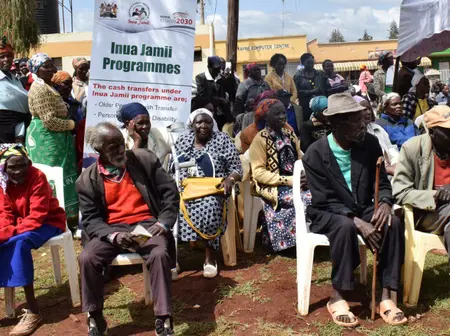
Listen to articleThe shortfall puts at risk scholarships for 4,700 learners with disabilities, start-up funding and tools of trade for vocational graduates, as well as the provision of assistive devices.Essential social protection services targeting the elderly, persons with disabilities (PWDs) and low-income households, such as Inua Jamii cash transfers, health insurance for indigent families and disability support programmes, could be disrupted due to a Sh12.97 billion budget deficit facing the State Department for Social Protection and Senior Citizen Affairs in the 2027/2028 financial year.
Category: Economy&Finance
-
Inua Jamii, SHA indigent cover at risk as Social Protection Department faces Sh12.97 billion deficit
Listen to articleThe shortfall puts at risk scholarships for 4,700 learners with disabilities, start-up funding and tools of trade for vocational graduates, as well as the provision of assistive devices.Essential social protection services targeting the elderly, persons with disabilities (PWDs) and low-income households, such as Inua Jamii cash transfers, health insurance for indigent families and disability support programmes, could be disrupted due to a Sh12.97 billion budget deficit facing the State Department for Social Protection and Senior Citizen Affairs in the 2027/2028 financial year.
-
Sugarcane farmers vote to elect five Kenya Sugar Board directors
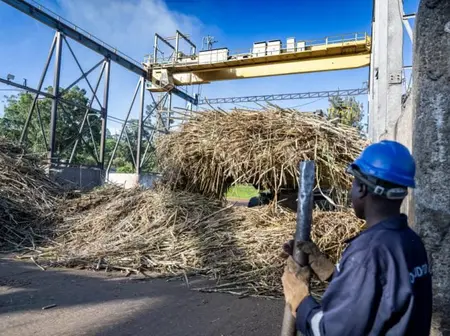
Thousands of sugarcane growers across Kenya’s sugar-producing regions are casting ballots on Tuesday, November 24, 2026 to elect five regional directors to the Kenya Sugar Board (KSB).
The poll is being conducted under the statutory framework of the Sugar Act, providing for grower representation at the national regulator.
KSB Chief Executive Officer Jude Chesire said authorities had deployed 1,400 polling clerks and 600 presiding officers across polling centres in sugar-producing regions to decentralise voting.
“We made it easy by taking the polling stations near farmers to ease their movement,” Chesire said ahead of the exercise.
Farmers are voting within their designated regional zones under guidelines enforced by the Ministry of Agriculture’s elections committee. The rules require verified grower registration and active cane delivery records.
Twenty vetted candidates are competing for five seats across the Upper Western, Lower Western, Central, Southern and Coastal catchment areas, according to the official candidate register published on the KSB website.
The elected representatives will join a restructured board tasked with enforcing the reinstated Sugar Development Levy and overseeing weighbridge standards at private and state-leased mills.
KSB Director in charge of elections Samwel Kemboi is supervising the polls, which are being overseen by an election committee commissioned by Agriculture Principal Secretary Paul Kipronoh Ronoh and Cabinet Secretary Mutahi Kagwe.
The exercise is expected to end at 5pm on Tuesday, after which KSB is expected to announce the official results for the five regional seats.
The election comes after the government released Ksh1.2 billion to fund farmer bonuses across the sugar sector.
On Monday, November 23, 2026 President William Ruto presided over the inaugural Ksh195 million bulk disbursement to outgrowers contracted to Nzoia Sugar Company in Bungoma County. Further payments were scheduled for growers supplying Mumias, Chemelil, Muhoroni and Sony Sugar factories.
The payouts are expected to provide financial relief to farmers while supporting activity in sugar-producing regions.
The incoming directors will face pressure to address challenges affecting local sugar producers, including competition from cheaper, duty-free sugar imports from the Common Market for Eastern and Southern Africa (COMESA) trading bloc.
Surges in regional imports have previously contributed to market gluts, putting pressure on farm-gate cane prices and mill margins.
Speaking during the Nzoia payout event on Monday, November 23, 2026 Agriculture Principal Secretary Paul Kipronoh Ronoh said domestic sugar production had nearly doubled to 900,000 metric tonnes this year following fertiliser subsidies, while annual imports had fallen from 608,178 tonnes to 65,000 tonnes.
The development comes as the government pursues efforts to revitalise sugar factories through long-term leasing arrangements aimed at improving their performance and profitability.
The new directors are expected to represent growers’ interests as the sector continues to address production, pricing and market challenges.
-

Vehicle Repossessions: What Kenyan Law Says About Banks’ Right to Recover Assets
Scroll through Kenyan social media on any given week, and you will find another story: a car towed from a parking lot, a pickup taken from outside a shop, a borrower insisting they were only a few days behind when the auctioneers came. More often than not, the name attached is NCBA.
-

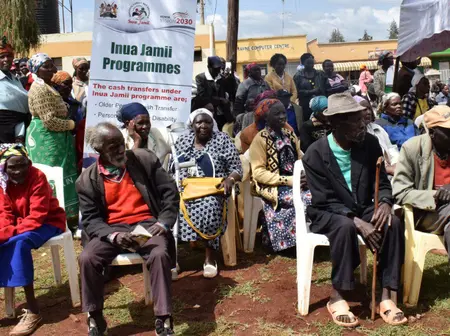
Inua Jamii beneficiaries among Kenyans affected by proposed budget funding gaps
The government’s social protection programmes could face funding pressure in the 2027/28 financial year, with the State Department for Social Protection and Senior Citizen Affairs warning of a Ksh12.97 billion budget shortfall that could affect services for vulnerable Kenyans.
In a post shared on its Facebook page on Tuesday, November 24, 2026, the department said it had been allocated Ksh36.42 billion against a total requirement of Ksh49.39 billion in the 2027 Budget Policy Statement (BPS).
Principal Secretary Joseph Motari presented the funding concerns to the National Assembly Departmental Committee on Social Protection, warning that the shortfall could undermine services for older persons, persons with disabilities and low-income households.
The department is seeking parliamentary intervention as lawmakers review the proposed budget allocations ahead of the next financial year.
The Inua Jamii programme, which provides cash transfers to older persons and people living with severe disabilities, is among the areas facing funding pressure.
The department reported a Ksh2 billion deficit in Inua Jamii operations, raising concerns about its capacity to sustain programme activities.
In August 2026, the government released Ksh2.43 billion for the June payment cycle, benefiting more than 1.2 million elderly persons and people living with severe disabilities.
Each beneficiary was scheduled to receive Ksh2,000, with payments starting on August 3, 2026 according to the Ministry of Labour and Social Protection.
The programme supports vulnerable households in meeting basic needs, including food and healthcare, making adequate and predictable funding important to beneficiaries who rely on the transfers.
However, the latest budget submission does not confirm that cash transfer payments have been stopped or that beneficiaries will miss their payments.
Health coverage for indigent households is among the department’s biggest funding concerns, with a reported Ksh5.51 billion shortfall.
“Following a government directive to onboard an additional 300,000 indigent beneficiaries, the department must cover 750,000 vulnerable citizens under the Social Health Insurance Fund (SHIF) at KSh660 per month.” the statement said.
Motari told lawmakers that the department was required to cover 750,000 vulnerable citizens under the Social Health Insurance Fund at a monthly cost of Ksh660 per beneficiary, following a government directive to enrol an additional 300,000 people.
The department said only Ksh430 million had been set aside, leaving a substantial gap that could threaten continuity of medical cover if additional funding is not secured.
The department also reported a Ksh68.66 million deficit affecting disability support, including scholarships for learners with disabilities, assistive devices and support for vocational graduates.
The State Department said it required Ksh44.97 billion for recurrent expenditure but received Ksh34.41 billion, leaving a Ksh10.56 billion gap.
Its development budget was allocated Ksh2.01 billion against a requirement of Ksh4.42 billion, resulting in a shortfall of about Ksh2.40 billion.
The department also cited funding pressures affecting adult learning and education, as well as services for people with autism and other developmental disabilities.
The parliamentary committee is expected to consider the department’s submissions as it prepares recommendations on the 2027 Budget Policy Statement before final budget ceilings are determined.
-

Inside KEBS conditions for importing used cars from January 1, 2027
Kenya is tightening the conditions for importing used motor vehicles from January 1, 2027, with the Kenya Bureau of Standards requiring all imported second-hand vehicles to be first registered no earlier than 2020.
The new requirements apply to all importers, including returning residents, diplomatic staff and members of the general public, and are anchored in the eight-year age limit prescribed under Kenya Standard KS 1515:2000.
In a public notice dated November 24, KEBS director general Esther Ngari said only right-hand-drive vehicles whose year of first registration is January 1, 2020, or later will be allowed into the country from the effective date.
The age restriction is not entirely new. Kenya has enforced an eight-year limit on used vehicle imports under KS 1515:2000, the Kenya Code of Practice for Inspection of Road Vehicles, established in 2000.
What changes annually is the qualifying year of first registration, which moves forward every January 1.
This means vehicles arriving in Kenya in 2026 must have been first registered in 2019 or later. From January 1, 2027, the qualifying year moves to 2020, effectively locking out vehicles first registered in 2019.
The distinction is important for prospective importers because the relevant date is the vehicle's first registration, not the year it was manufactured or the date it was purchased.
What happens to vehicles first registered in 2019?
KEBS has specifically warned that vehicles first registered in 2019 will no longer qualify for importation after December 31, 2026.
The agency has also clarified that Certificates of Roadworthiness (CoR) issued for such vehicles will expire on the same date and will not be valid for purposes of vehicle registration thereafter.
Importers who have already purchased vehicles first registered in 2019 in their country of origin therefore face the risk of being unable to clear and register them if they arrive after the December 31, 2026 deadline.
Which vehicles require pre-export inspection?
Beyond the age and steering-wheel requirements, used vehicles imported from five designated markets must be accompanied by a Certificate of Roadworthiness issued by Quality Inspection Services Inc. Japan (QISJ) on behalf of KEBS.
The affected markets are Japan, the United Arab Emirates, the United Kingdom, Thailand and South Africa.
The inspection is part of the verification process intended to establish whether imported vehicles comply with Kenyan standards before they are shipped.
Importers should therefore ensure that eligible vehicles undergo inspection through the KEBS-contracted agency and obtain the required certification before shipment.
Vehicles that fail to meet the applicable standards risk rejection, with the importer bearing the resulting costs.
What about Kenyans returning home from abroad?
One of the important implications of the notice is its explicit application to returning residents, a category of importers who may otherwise assume that their eligibility for tax and duty exemptions places them outside the ordinary import requirements.
Through the Kenya Revenue Authority (KRA), qualifying Kenyans permanently changing their residence back home can enjoy exemptions on customs duty and other applicable taxes on one personal motor vehicle, subject to prescribed conditions.
However, the exemption does not override KEBS requirements on the age, steering configuration and roadworthiness of imported vehicles.
In practical terms, a Kenyan returning from the United States or another country where left-hand-drive vehicles are standard cannot simply ship home the car they have been using abroad and expect it to qualify for the exemption.
The vehicle brought into Kenya must be right-hand drive, regardless of the returning resident's eligibility for tax relief.
What are the conditions for returning residents?
To qualify for the returning-resident exemption, an individual must be permanently changing their residence back to Kenya after living abroad, generally for at least two continuous years.
The individual must also demonstrate that they personally owned and used the vehicle abroad for at least 12 months before returning to Kenya.
The exemption is limited to one vehicle and can only be enjoyed once every four years.
For Kenyans returning from left-hand-drive countries, the requirements mean they must generally dispose of their left-hand-drive vehicle abroad and import a right-hand-drive replacement of equal or lesser value, subject to KRA's applicable conditions.
There is also a time restriction on bringing in the vehicle. It should generally be shipped within 90 days of the returning resident's arrival in Kenya, although extensions may be granted up to a maximum of 360 days, subject to approval.
The exemption does not cover every category of vehicle. Large passenger buses with seating capacity of 13 or more people and heavy load carriers with a payload exceeding two tonnes are excluded.
Why the January 2027 deadline matters
The new threshold means importers must pay close attention to the year of first registration when purchasing vehicles abroad, particularly those intending to ship them towards the end of 2026.
A vehicle that qualifies under the 2026 rules may become ineligible if it arrives in Kenya after December 31, 2026.
For returning residents, the implications are twofold: qualifying for tax and duty exemptions through KRA does not guarantee that a vehicle will be admitted into the country, and meeting KEBS requirements does not automatically confer tax-exempt status.
The two processes serve different purposes and must be satisfied independently.
Ultimately, importers should confirm the vehicle's first registration year, steering configuration and inspection requirements before committing to a purchase or shipment to avoid costly rejection at the port of entry.
-
Inside the Dangerous Double Trap Threatening to Wipe Out Africa’s Economic Stability
Economic assessments from the International Monetary Fund (IMF) and the United Nations Development Programme (UNDP) show that surging energy costs, disrupted maritime shipping routes, and tighter global financial conditions are reverberating sharply across the continent.
For the vast majority of African countries that are net importers of refined petroleum, spikes in global oil prices translate swiftly into higher domestic transport costs, costlier electricity generation, and renewed inflationary pressure.
Rising diesel and fertilizer expenses are simultaneously straining agricultural production and supply chains, heightening food insecurity risks for millions of households already coping with elevated living costs.
At the macroeconomic level, external shocks are widening current account and fiscal deficits across non-resource-intensive economies.
Governments attempting to cushion citizens through fuel or food subsidies face mounting budgetary strain, while weaker local currencies increase the cost of servicing foreign-denominated public debt.
Furthermore, heightened global uncertainty often prompts international investors to pull back from emerging markets, raising borrowing costs and squeezing external financing.
While a small group of net oil and gas exporters—such as Nigeria, boosted by domestic refining capacity—stand to capture short-term revenue windfalls, analysts caution that these localized gains cannot offset broader continental vulnerabilities.
Strengthening domestic resource mobilization, accelerating regional trade under the African Continental Free Trade Area, and expanding renewable energy remain critical buffers against persistent global turmoil.
What are your thoughts about this articles? Share your reactions in the comment section and don't forget to share and follow for more updates.
https://www.standardmedia.co.ke/business/business/article/2001562873/oil-prices-conflicts-put-pressure-on-africas-economic-stability
-

Gov’t Unveils 381 Housing Units in Nyeri as Blue Valley Project Nears Completion [Photos]
ProgressThe Ministry of Interior has announced progress on the Blue Valley Affordable Housing Project in Nyeri County, which is expected to deliver 381 housing units targeting different income groups.The Ministry of Interior has announced progress on the Blue Valley Affordable Housing Project in Nyeri County, which is expected to deliver 381 housing units targeting different income groups.
-

Why Grassroots Groups Struggle for Cash and How a National Fund Could Fix It
Across the world, communities are full of people who want to make a difference. Young people organise vocational training for those without jobs. Local associations support children who have dropped out of school. Community groups help vulnerable families, promote public health, protect the environment and respond to emergencies.
-

Hotel workers warn of redundancies
Sava Wycliffe, Secretary-General of the Kenya Hotels and Allied Workers Union (KHAWU), said the proposed increase in the drinking age could undermine employment opportunities in the hospitality industry and force businesses to reduce their workforce.He urged Parliament to carefully consider the implications of the proposed changes on workers before passing the legislation.