The National Land Commission (NLC) has called for the fast-tracking of community land registration to enable communities to benefit from carbon credit projects.
NLC Deputy Director and Head of Natural Resources Management Bernard Opaa said every land-based carbon credit is tied to land ownership, use and the rights of communities.
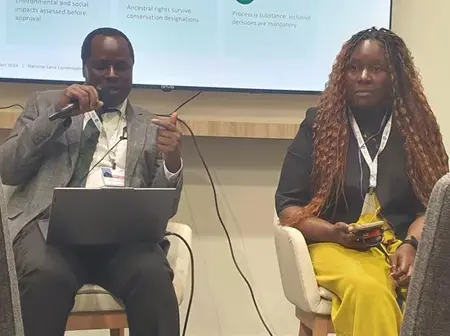
Speaking during a side event at the UN Climate Change Conference in Antalya, Türkiye, Opaa said land ownership and consent must be addressed to ensure communities benefit from carbon projects.
“The carbon is in the land. The questions are land questions: Who owns it? Who uses it? Who can consent? Who shares the benefits? Who decides when rights overlap?” he said.
Opaa made the remarks during a presentation titled ‘Land governance and carbon markets in Kenya: Experiences, lessons and navigating challenges on diverse land tenure systems.’
He cited Article 260 of the Constitution, which defines land to include the surface of the earth and subsurface rock, bodies of water, marine waters in the territorial sea and exclusive economic zone, natural resources contained on or beneath the surface, and the airspace above it.
He said almost every carbon pool falls within the constitutional definition of land, raising questions about who holds carbon rights in public forests and who has the authority to consent to projects on unregistered community land.
“Who holds the carbon right on a public forest: Kenya Forest Service, NLC, the county, or adjacent communities?” he posed.
Opaa said private land holdings in Kenya are small and fragmented, meaning aggregation of land for carbon projects could shift bargaining power to developers.
He said 69.1 per cent of Kenya's land belongs to communities, covering large parts of the arid and semi-arid north and north-east, southern rangelands, the Coast and sections of the Rift Valley.
Some of the counties hosting community land and carbon projects include Isiolo, Samburu, Marsabit, Kajiado, Taita Taveta and Kwale.
Article 63(2) of the Constitution recognises community land to include community forests, grazing areas, shrines, ancestral lands and land held in trust by county governments.
Counties hold unregistered community land in trust and cannot sell, transfer or convert it.
However, Opaa said fewer than one in five community lands had been registered, more than a decade after the Community Land Act was enacted.
He said the registration process could not begin until counties submitted inventories of unregistered community land.
This, he warned, leaves long-term carbon agreements being negotiated on land whose owners are yet to be formally registered.
“Carbon deals running 30–40 years are being negotiated on land whose owners are not yet on any register,” he said.
Opaa said Kenya's flagship carbon projects operate under different land tenure systems, each presenting distinct challenges.
He cited the Kasigau Corridor REDD+ project in Taita Taveta, which covers 200,000 hectares under group and private ranches, and has faced longstanding concerns over benefit-sharing and gender issues.
He also pointed to the Northern Kenya Rangelands Carbon Project, which covers 4.7 million hectares across Isiolo, Samburu and Marsabit and is largely based on unregistered community land and conservancies.
The project has faced controversy, with a court ruling that two conservancies were unconstitutional. An appeal is pending.
Another example is the Kenya Agricultural Carbon Project in western Kenya, which covers 45,000 hectares of privately owned smallholdings and has faced land-related conflicts and concerns over additional workloads for women.
Opaa also cited carbon projects in the Mau Forest landscape, a public forest that the Ogiek community claims as ancestral land.
He said carbon rights remained undefined, while each land tenure system presented its own risks, with the greatest challenges arising where land ownership rights were weak.
He added that although several institutions are involved in land governance, there is no single safeguard covering all land tenure systems.
Opaa called for all legitimate land rights, whether formal or customary, to be mapped before carbon projects are designed.
He urged authorities to fast-track community land registration in areas where carbon projects are proposed, saying the integrity of carbon registries begins with the integrity of land rights.
Director of Carbon Projects at Verst Carbon Charles Waweru said carbon credits offer opportunities to support climate change mitigation while creating jobs.
However, he said communities needed to be equipped with the knowledge and capacity to understand carbon projects and the benefits they stand to gain.
“The community should know what to expect, what to ask, how much money is entitled to them, what is the cost of the project,” Waweru said.
He said carbon credits could be generated once every three years, depending on the project, while the timing of revenue depended on how quickly developers sold the credits.
Waweru noted that carbon credit prices fluctuate like those of other commodities, making transparency in project agreements essential.
He urged communities to establish revenue-sharing arrangements before signing agreements with developers.
“Before they sign an agreement, they must determine the revenue sharing. There should be more transparency from developers,” he said.
Waweru added that all carbon projects must comply with carbon credit regulations and relevant industry-specific requirements, with developers required to ensure transparency in their disclosures.
Leave a Reply