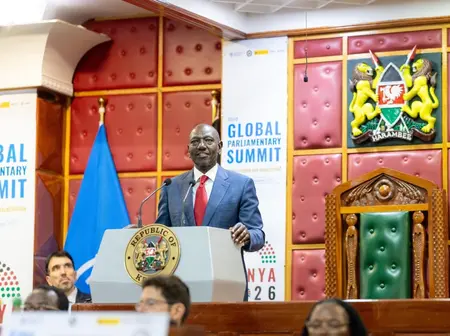
Speaking on Monday, November 16, 2026, during the opening of the Third Global Parliamentary Summit Against Hunger and Malnutrition at Parliament Buildings in Nairobi, the President acknowledged that the country was still struggling with food insecurity, particularly in arid and semi-arid regions affected by poor rainfall.
Ruto revealed that approximately 2.7 million Kenyans were facing crisis-level food insecurity, with hundreds of thousands of children, pregnant women and breastfeeding mothers requiring urgent nutritional support.
He noted that unpredictable rainfall continued to affect agricultural production and expose vulnerable communities to hunger and malnutrition. The President also said malnutrition was estimated to cost Kenya 6.9 per cent of its Gross Domestic Product (GDP), highlighting the economic consequences of the food crisis.
Despite the challenges, Ruto maintained that his administration had introduced measures aimed at increasing local food production and reducing the country's dependence on imported food.
One of the administration's key interventions has been the fertiliser subsidy programme, which seeks to reduce the cost of agricultural production and encourage farmers to increase their output.
According to the President, the government has distributed 38 million bags of subsidised fertiliser to approximately two million farmers. He added that fertiliser prices had dropped by 73 per cent since 2022.
Ruto attributed the increase in maize production partly to the government's agricultural support programmes, saying national output had risen from 34 million bags in 2022 to 71 million bags in 2025.
The increased production, he said, had helped reduce the country's reliance on maize imports.
The President maintained that the government was shifting its approach to agriculture by prioritising production rather than focusing mainly on consumption. He argued that supporting farmers with affordable inputs would strengthen the country's ability to produce enough food for its population.
Another major part of the plan involves reducing Kenya's dependence on rain-fed agriculture through investments in water storage and irrigation infrastructure.
Ruto said the government was targeting the construction of 50 mega dams, 200 medium-sized dams and thousands of micro-dams under investments linked to the proposed National Infrastructure Fund.
The projects are expected to bring an additional 2.5 million acres of land under irrigation within the next five to seven years.
The President argued that inadequate rainfall should not automatically translate into food shortages, insisting that the country could improve agricultural production by investing in water harvesting, storage and distribution.
The administration is also using school feeding programmes as part of its broader response to hunger and malnutrition.
Ruto said approximately three million learners were currently benefiting from school meals. His administration intends to expand the programme from 2027, with a target of reaching 10 million learners across all 47 counties by 2030.
The initiative is expected to support children's nutrition while encouraging school attendance, particularly in communities where food insecurity affects household incomes.
During the summit, the President called on legislators across Africa to strengthen laws, allocate adequate resources and improve oversight of public investments aimed at addressing hunger.
He argued that food security required more than government declarations, urging parliamentarians to prioritise agricultural productivity, irrigation, research, nutrition and social protection when making budgetary decisions.
Although the administration has reported progress in fertiliser distribution and maize production, the figure of 2.7 million people facing crisis-level food insecurity illustrates the scale of the remaining challenge.
Ruto's 2030 target will therefore depend on whether the proposed irrigation projects, agricultural support programmes and school feeding expansion are implemented effectively and deliver lasting improvements in food availability and affordability.
For millions of Kenyans affected by drought and rising food costs, the success of the plan will ultimately be measured by access to affordable food and more reliable agricultural production.
Leave a Reply