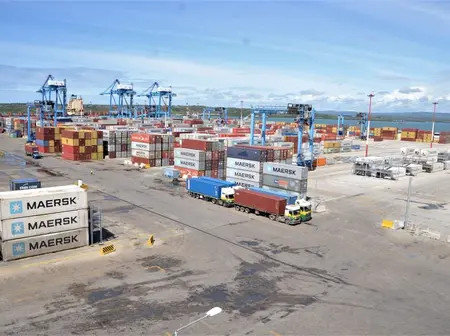
Moving a 20-foot shipping container from Mombasa to Nairobi costs up to Ksh162,425, despite the two cities being about 480 kilometres apart, according to a new World Bank report that raises fresh questions about the cost of doing business in Kenya.
The World Bank’s November 2026 Kenya Economic Update says that transporting the same container by road in Europe costs about Ksh93,557, nearly Ksh69,000 less, even though fuel and labour costs are higher there.
The comparison is particularly striking because the report notes that Europe has higher fuel and labour costs.
For Kenyan importers, manufacturers and retailers, the figures expose a costly part of the supply chain that begins after goods have already arrived at the country’s main seaport.
The expense becomes clearer when the entire journey is considered.
According to the World Bank, shipping a 20-foot container from China to Mombasa costs around US$2,000, equivalent to approximately Ksh259,880.
Moving that same container from Mombasa to Nairobi adds another Ksh110,449 to Ksh162,425.
That means the inland journey alone accounts for around one-third of the total cost of transporting the container from China to Nairobi.
The World Bank says the problem is not simply the distance or the cost of fuel.
“Logistics costs increase due to a combination of constraints,” the report states.
It identifies problems including Mombasa port management and congestion, administrative delays, and official and unofficial checkpoints affecting inland transport.
For businesses, such obstacles can create uncertainty over delivery times and add expenses to moving goods. Importers dealing in machinery, raw materials and finished products must factor these costs into their operations.
The report also raises concerns about the efficiency of the Port of Mombasa, the largest port in East Africa.
In the World Bank’s Global Container Port Performance Index, Mombasa ranked 326th out of 348 ports assessed in 2022. In the 2024 edition, it ranked 375th out of 403 ports.
The report contrasts this with Senegal’s Dakar Port, which improved from 371st to 108th place over the same two-year period.
The World Bank says businesses using Mombasa face multiple inspections, recurring system downtime, rising fees and demands for bribes, all of which increase delays and costs.
It also cites a 2025 assessment by the Shippers Council of Eastern Africa, which described logistics costs at the port as “alarmingly high”, estimating that they account for 35 to 42 per cent of the total landed cost of goods.
The report adds that the number of agencies involved in inspections keeps expanding, bringing additional fees and increasing the risk of delays.
The implications extend beyond clearing agents, shipping companies and importers.
When businesses spend more to move goods from the coast to the country’s commercial centre, they face pressure on their operating costs. Depending on the market and the product, some of those expenses may eventually be reflected in prices paid by consumers.
The World Bank warns that port congestion creates “greater uncertainty, additional costs, and foreclosed opportunities” for businesses.
It also links higher corruption levels internationally with weaker logistics performance, pointing to bribe requests and inefficient public investment as possible contributing factors. However, it cautions that this relationship shows correlation rather than proving corruption alone causes poor logistics performance.
For Kenya, the challenge is to make the journey from Mombasa to Nairobi more predictable, efficient and affordable.
The question raised by the report is difficult to ignore: why should moving a container 480 kilometres inside Kenya cost up to Ksh162,425 when an equivalent journey in Europe is estimated at Ksh93,557?
Leave a Reply