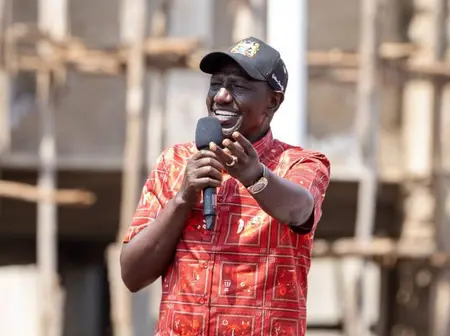
As Kenya heads towards the August 2027 General Election, President William Ruto is increasingly banking on visible development projects and an aggressive nationwide mobilisation strategy to strengthen his re-election prospects.
From rural market centres to major urban roads, Ruto’s frequent visits to counties have become a defining feature of his presidency, with the Head of State seeking to turn infrastructure development into political capital ahead of a potentially bruising election.
His approach is built around a simple political calculation: that tangible development, economic opportunities and a visible government presence across the country could prove more persuasive to voters than the opposition’s criticism of his administration.
The tours, conducted under the Bottom-Up Economic Transformation Agenda (BETA) and the administration’s ‘Usawa ni Sawa’ philosophy, are also intended to reinforce his message that every region deserves an equal share of national development regardless of its political choices.
In November 2026 alone, the President embarked on extensive development tours across Western Kenya, following similar engagements in Ukambani and the Rift Valley.
His itinerary has covered a wide range of projects, including last-mile electricity connections, street lighting, modern markets, affordable housing, road construction and major water infrastructure.
From Nyeri to Nakuru, Mombasa to Machakos, and across North Eastern, Western and Nyanza, the administration is seeking to demonstrate that its development agenda extends beyond traditional political strongholds.
The government has also prioritised the revival of struggling sugar factories, including Mumias, Muhoroni, Sony Sugar and Nzoia, while promoting investment in coffee, tea and industrial parks as part of efforts to stimulate production and create jobs.
To Ruto’s supporters, the pace of project implementation demonstrates a government determined to deliver on its promises within a single five-year term.
They argue that the President’s frequent visits to project sites and direct engagement with local communities distinguish his administration from previous governments, which they accuse of leaving development initiatives incomplete or concentrated in a few regions.
However, the strategy is not without criticism.
While the government points to infrastructure development as evidence of progress, critics argue that the number of projects launched or commissioned should not be the only measure of successful governance.
Opposition leaders, governance advocates and economic commentators have questioned the value for money of some public investments, raised concerns about the country’s debt burden and challenged the government’s approach to the proposed disposal of state assets.
There are also lingering questions about the extent to which economic growth and infrastructure investments have translated into improved living standards for ordinary Kenyans.
For many households, the immediate concerns remain the cost of food, electricity, transport, education and access to employment.
The June 2024 anti-government protests, largely driven by young Kenyans opposed to the Finance Bill and broader economic grievances, exposed the depth of public frustration and demonstrated that development announcements alone may not be enough to secure political support.
This presents Ruto with a delicate balancing act: convincing voters that his administration is delivering long-term economic transformation while addressing the immediate financial pressures affecting households.
As Ruto builds his development narrative, the opposition is attempting to consolidate a political alternative capable of challenging him in 2027.
Former Deputy President Rigathi Gachagua, now leading the Democracy for the Citizens Party (DCP), has emerged as one of the administration’s most vocal critics.
Gachagua has embarked on an aggressive grassroots recruitment campaign, attracting political defectors to DCP while accusing the government of sidelining the Mount Kenya region.
He has also raised concerns about the credibility of the electoral process, particularly the proposed mechanisms for transmitting and tallying presidential results at the Bomas of Kenya, and threatened mass action over the issue.
However, the opposition faces a challenge that goes beyond mobilising public anger against the incumbent: building a united political formation with a credible alternative programme.
Potential presidential contenders, including Wiper leader Kalonzo Musyoka, former Interior Cabinet Secretary Fred Matiang’i and Nairobi Senator Edwin Sifuna, represent different political interests and ambitions that could complicate efforts to agree on a single candidate.
Gachagua has maintained that the question of selecting a joint presidential candidate can wait, but the absence of an agreed leadership structure and common political agenda remains a potential weakness.
The findings point to a competitive political landscape in which the opposition has potential electoral support but still faces the difficult task of translating individual popularity into a cohesive political movement.
Ultimately, the 2027 contest is likely to be shaped by the intersection of economic performance and political mobilisation.
For Ruto, infrastructure development offers an opportunity to demonstrate the practical benefits of his administration and strengthen his appeal beyond traditional political constituencies.
A completed road, an operational market, a new electricity connection or an expanded water supply project provides the government with something concrete to point to when defending its record.
But the opposition will seek to shift the conversation towards the cost of living, unemployment, taxation, public debt and accountability, arguing that development projects must be measured against their actual impact on citizens.
The challenge for Ruto will be ensuring that the projects he showcases translate into tangible economic benefits before voters head to the ballot.
For the opposition, the task will be to move beyond criticism of the government and present a convincing alternative on the economy, public spending and service delivery.
The central question heading into 2027 is therefore not simply who can mobilise the biggest crowds or attract the most political defectors, but who can convince Kenyans that they have a credible plan to improve their lives.
Ruto appears determined to make development his strongest campaign argument. Whether roads, markets, dams and housing projects will be enough to secure a second term will ultimately depend on how voters assess their impact on their everyday lives.
Leave a Reply