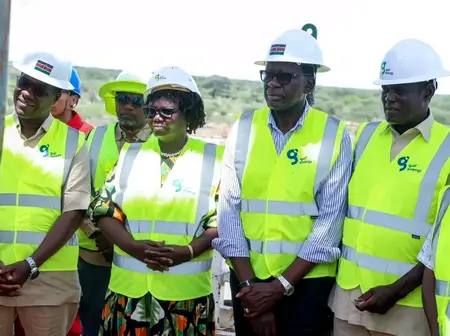
Speaking on Friday, November 20, 2026, during the landmark well-spudding ceremony at the Amosing 1 and 2 oil fields in the South Lokichar sub-basin, Chirchir emphasized that upgraded transport corridors are vital to unlocking the region's economic potential.
He noted that committing more than Ksh24 billion to quality infrastructure around the oil-producing blocks will not only support seamless petroleum logistics but also transform the socio-economic standing of local Turkana communities.
Chirchir, who previously served as Energy Cabinet Secretary before moving to the Transport docket, joined Energy and Petroleum CS Opiyo Wandayi and East African Community CS Beatrice Askul to witness the activation of the GW70 onshore drilling rig.
The Transport CS has consistently maintained that Kenya’s evacuation infrastructure is ready to move crude oil from Lokichar to the coast without operational bottlenecks.
Under the approved Field Development Plan (FDP), initial crude output from Blocks T6 and T7 will be transported by road using heavy trucks from Turkana to Mombasa for storage at the Kenya Petroleum Refineries Limited (KPRL) tank farms.
Chirchir previously explained to Parliament that Lokichar is already linked to the national trunk road network, which is undergoing continuous strengthening along the corridor to the Coast.
Looking ahead to the second development phase when daily output is projected to scale up, the Ministry of Roads and Transport plans to transition crude evacuation from highways to a rehabilitated Meter Gauge Railway (MGR) line via Eldoret.
That multimodal rail shift is designed to lower transport costs, reduce highway congestion, and enhance environmental safety once production hits peak volumes.
Meanwhile, Friday’s spudding exercise—operated by Kenyan firm Gulf Energy E&P BV SEZ under a Ksh774 billion ($6 billion) development program—marks the final countdown to December 1, 2026, when Kenya expects to record its first commercial oil output.
Gulf Energy Managing Director Paul Limoh confirmed that Phase One will target over 20,000 barrels per day from the Ngamia, Amosing, Twiga, and Ekales (NEAT) fields before expanding to 50,000 barrels daily in Phase Two.
Across the 25-year contract period, the six South Lokichar discoveries hold an estimated 326 million recoverable barrels, with the government projecting lifetime earnings exceeding Ksh371 billion.
SOURCE
Leave a Reply