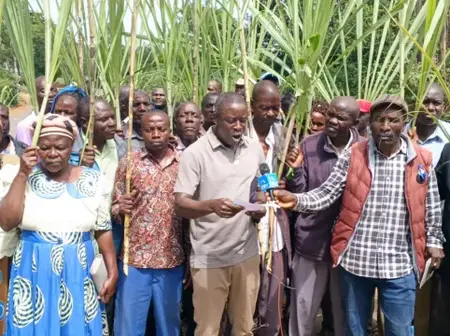
Cane farmers in Navakholo are up in arms over the Kenya Sugar Board’s decision to classify the subcounty as part of Lower Western catchment area.
They have petitioned the board to reverse the decision and place Navakholo in the Upper Western region. The farmers say they were not consulted before the decision was made.
The Sugar Act divides cane-growing areas into two catchments: Lower Western and Upper Western. Matungu, Mumias East, Navakholo, Mumias West, Busia and Siaya are classified as part of Lower Western.
Bungoma, Trans Nzoia, Vihiga, Nandi, West Pokot and the upper part of Kakamega fall within the Upper Western catchment.
The law restricts the movement of sugarcane between catchment areas. Navakholo farmers say they fear being confined to Lower Western will disadvantage them and the millers in Upper Western.
Farmers from Navakholo’s five wards Bunyala Central, Shinoyi-Shikomari-Esumeya, Bunyala East, Bunyala West and Ingotse-Matiha met at Navakholo Social Hall over the weekend to express their dissatisfaction with the board’s decision.
Their concerns come days before the much-anticipated election for the Kenya Sugar Board director position, scheduled for November 24, 2026.
“We acknowledge that the reallocation of Navakholo farmers to the Lower Western catchment was an administrative step to allow the elections to take place. It was not, and must not be treated as, a permanent decision on catchment boundaries,” Moses Nyongesa said.
“We were not consulted before Navakholo was moved to the Lower Western side. We were not asked whether we agreed to a permanent change. We still do not know the exact legal basis, how long the arrangement is meant to last, or whether any formal instrument was issued.”
Nyongesa said the farmers were not opposed to the upcoming directors’ election, but wanted to advocate for what they considered to be in their best interests.
“Our intention is not to obstruct the Kenya Sugar Board’s electoral process because we understand the need for the elections to proceed. We just want Navakholo taken back to Upper Western because we are all aligned with millers in that region,” he said.
Roselyne Owalo claimed that placing Navakholo in Lower Western was intended to disadvantage millers in Upper Western.
She said cane production in Navakholo had grown as a result of development programmes run by Upper Western millers, including Butali Sugar, Kabras Sugar and Nzoia Sugar.
“Taking Navakholo, which is known for producing a lot of cane, to Lower Western is a strategic move to deprive Upper Western millers of raw materials they helped develop,” Owalo said.
Her concerns were echoed by Stanley Kusimba, who said farmers in Navakholo could access Upper Western millers more easily than those in Lower Western.
“The three millers in Upper Western are nearer than those in Lower Western. We will be charged exorbitantly to transport cane to millers in the Lower region. We don’t want that to happen,” Kusimba said.
“They are forcing us to supply cane to Mumias Sugar. What happens if the miller shuts down or suffers a breakdown?”
The farmers warned that they could abandon cane farming if the board failed to address their concerns and return Navakholo to the Upper Western catchment.
They also criticised the criteria used to classify the region, arguing that the lack of a clearly defined physical boundary between Lower and Upper Western was deliberate.
Leave a Reply