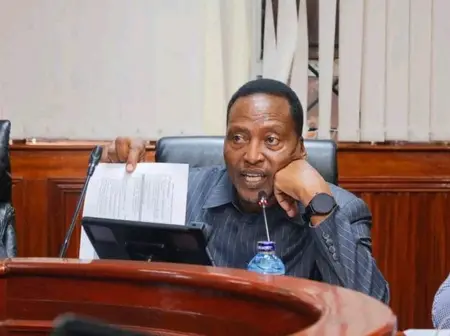
Speaking on Thursday, November 26, 2026, Onyonka alleged that legislative changes backed by the executive removed critical safeguards requiring borrowed funds to be channeled through the Consolidated Fund before drawdowns by the Controller of Budget and the Auditor-General.
"Ruto made MPs to remove a clause that demanded that when a President borrows money, that money should go to the Consolidated Fund. After that, the drawdowns should be done by CoB and the Auditor-General," Onyonka said.
He argued that granting the executive wider discretion over loan proceeds undermines transparency and accountability in public expenditure.
"Now, the President can borrow any money he wants and take wherever he wants. Most of the loans do not come back to Kenya," Onyonka added.
The Kisii lawmaker also questioned government spending priorities, pointing to major infrastructure undertakings such as the construction of Talanta Stadium in Nairobi as projects requiring tighter cost scrutiny.
According to National Treasury disclosures, Kenya’s outstanding public debt stood at approximately Ksh13.53 trillion at the end of September 2026, with the Treasury acknowledging that the country remains at high risk of debt distress even as it maintains the debt load is sustainable.
Onyonka’s projection contrasts sharply with recent remarks by National Treasury Cabinet Secretary John Mbadi, who defended the government’s borrowing pace and estimated that public debt would reach roughly Ksh19 trillion by 2032.
With interest payments consuming a growing share of ordinary revenue and fiscal policy emerging as a central issue ahead of the August 10, 2027, General Election, battles over borrowing limits, project transparency, and debt sustainability continue to dominate national debate.
https://peopledaily.digital/inside-politics/onyonka-warns-kenyas-public-debt-could-hit-ksh17-trillion-by-end-of-2027
Leave a Reply