Nearly 300 traders, employees and small-scale vendors who depended on businesses at Kenya’s Great Rift Valley Viewpoint face an uncertain future following demolitions linked to the ongoing Rironi-Mau Summit highway expansion.
The demolitions have affected roadside curio shops where traders sold Maasai shukas, soapstone carvings, beads, bangles, necklaces and other souvenirs to motorists and tourists travelling between Nairobi and Nakuru.
Some businesses have already been brought down, while traders who were still operating expressed concern over eviction notices and the possibility of losing access to the location permanently.
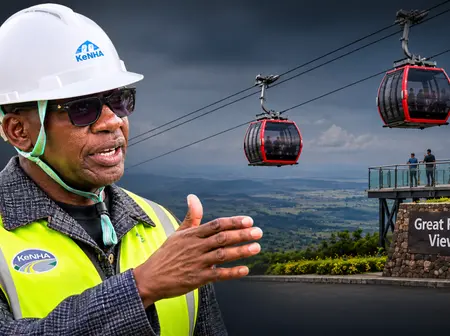
The uncertainty comes as the government announces plans to transform the famous viewpoint through cable cars, redesigned curio shops and hotels.
Roads and Transport Cabinet Secretary Davis Chirchir announced the proposed developments on November 10, 2026, during an inspection tour of the ongoing highway construction.
However, he did not provide details on how traders affected by the road expansion would be accommodated in the proposed redevelopment.
The traders’ concerns extend beyond the demolition of individual business premises.
Bernard Kihiu Njoka, secretary of the Kwa Mathore Viewpoint Community Based Organisation, told the Daily Nation that the group had 50 kiosks selling different products at the attraction.
According to Njoka, each kiosk employed four additional people, translating to approximately 200 workers associated with the businesses.
He said the traders received a notice of intended demolition from the Kenya National Highways Authority (KeNHA) on March 24, giving them 30 days to demolish their structures and vacate.
Some premises have since been demolished, leaving other traders uncertain about when they will be required to leave.
A separate estimate from traders puts the number of people who depended on commercial activities around the viewpoint at close to 300, including business owners, employees and small-scale vendors.
The figures represent estimates of people involved in the trading economy rather than a confirmed register of 300 individual shop owners.
The planned redevelopment could change the commercial arrangement at the Great Rift Valley Viewpoint.
Chirchir said the government intends to introduce cable cars connecting the A8 highway corridor to the A8 South escarpment corridor.
The proposed system would allow visitors to travel in suspended passenger cabins while viewing the Great Rift Valley.
“It will be world-class, with cable cars connecting the A8, the corridor which we are in now, to the A8 South, the escarpment corridor. It will be a magnificent tourism site,” Chirchir said.
The Cabinet Secretary also announced plans to establish modern curio shops and attract private investors to put up hotels.
“We are going to do curio shops that will encourage tourists to stop and want to spend time. We will probably get investors putting up hotels,” he said.
Chirchir added that the existing viewpoint required redesigning because its current layout did not adequately address visitor safety.
The announcement did not specify the cost of the cable car system, its construction timeline or the proposed arrangements for the new commercial facilities.
The proposed modern curio shops raise an immediate question for traders whose businesses have already been disrupted by the highway expansion.
The government has not publicly outlined whether affected traders will receive priority when the new commercial spaces become available.
It has also not provided details on the number of shops to be constructed, their ownership structure, rental charges or the criteria for allocating business premises.
These details will determine whether existing small-scale traders can return to the viewpoint or whether the new commercial facilities will operate under a different business arrangement.
Traders have previously asked the government to relocate them rather than permanently remove their businesses from the attraction.
Their concern is that losing access to the viewpoint also means losing access to the motorists and tourists who provided their main customer base.
The Great Rift Valley Viewpoint redevelopment is being proposed alongside the wider Rironi-Mau Summit highway expansion, which President William Ruto launched on November 28, 2025.
The highway project covers the Nairobi-Nakuru-Mau Summit route and the Nairobi-Mai Mahiu-Naivasha corridor.
While Chirchir has outlined the government’s tourism vision for the viewpoint, the implementation details of the proposed cable cars, hotels and commercial facilities remain unclear.
For the affected traders, the immediate issues are relocation, access to alternative business premises and whether they will be considered for the new curio shops.
Until the government clarifies these arrangements, nearly 300 people reportedly dependent on the viewpoint’s trading activities remain uncertain about the future of their businesses and employment.
Leave a Reply