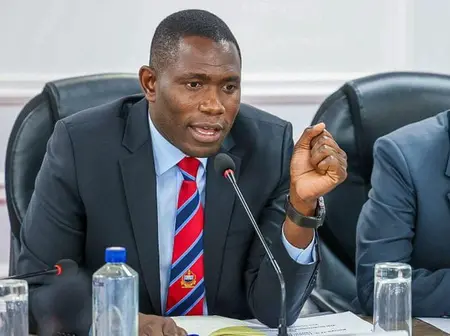
Principal Secretary for the State Department for Medical Services at Kenya’s Ministry of Health, Ouma Oluga, has explained why public hospitals must remove payment paybills, warning that demanding money from patients seeking treatment could push struggling households deeper into poverty.
Oluga said hospitals should provide quality healthcare without creating additional financial pressure on patients, particularly low-income earners whose daily survival depends on small businesses and limited household incomes.
He said some of the traders operate with working capital of less than Ksh30,000, questioning how they would cope if a hospital demanded Ksh50,000 before providing treatment.
According to Oluga, such a payment could consume the money a trader needs to restock her business, leaving her and her family in an even more difficult financial position.
He challenged health facilities to consider the wider economic consequences of imposing such costs on patients.
“So the hospital then is now contributing to poverty in the society,” he said.
Oluga further questioned how many residents of Vihiga County could afford a hospital bill of Ksh200,000, with the SHA compliance officer responding that very few people could manage such an expense.
He argued that the purpose of public healthcare should be to improve people’s welfare, not expose them to financial hardship when they fall ill.
He illustrated this by comparing a patient’s hypothetical contribution of Ksh10,000 or Ksh20,000 with a hospital payment of Ksh200,000 from SHA.
The figures were examples used in his explanation and were not presented as standard contribution rates or reimbursement tariffs.
Oluga maintained that patients should not be asked to raise additional money at hospitals for services covered under the scheme.
Following his explanation, Oluga instructed SHA compliance officers to identify public hospitals operating payment paybills and remove them.
“Na uangalie kama wameweka paybill kwa hiyo hospitali. Na ung’oe hiyo paybill. Nimekupatia ruhusa ya kung’oa paybill,” he told an officer.
He subsequently authorised the exercise across Vihiga County, saying:
“Eh, nimekupatia ruhusa ya kung’oa paybills kwa the entire county.”
In a further instruction, he told compliance officers to visit public hospitals and remove the payment channels, assuring them that security support would be provided.
He also said County Commissioners had been informed and would accompany the enforcement teams.
The State Department for Medical Services shared the video on Sunday, November 22, 2026. It did not specify a nationwide implementation timetable or clarify how facilities should handle payments for services not covered by SHA.
Leave a Reply