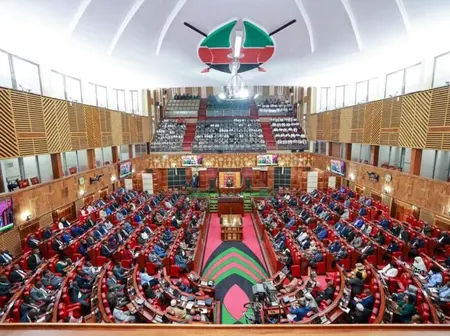
The disappearance of nominated MP Sabina Chege’s mobile phone inside Parliament dates back to June 8, 2023, when the National Assembly descended into chaos over her position as Deputy Minority Whip.
The incident resurfaced in November 2026 after Speaker Moses Wetang’ula disclosed that CCTV footage captured a lawmaker picking up a colleague’s phone. The disclosure has raised questions about the three-year delay.
“We actually saw a member pocket the phone of another member, and we called him, and he denied it completely even as he could see himself pocketing the phone on CCTV,” Wetang’ula said.
“I told him to go and wrestle with his conscience for the rest of this term because there are certain things that are not expected of us,” he added.
The incident occurred during a sitting in which Wetang’ula addressed competing communications concerning Chege’s removal as Deputy Minority Whip and her proposed replacement by Embakasi West MP Mark Mwenje.
The dispute followed disagreements within the Jubilee Party and Azimio over parliamentary leadership.
On April 6, 2023, Minority leadership communicated changes involving Chege’s position. On May 4, Wetang’ula said the communication was incomplete under Standing Order 20A and gave the Minority Party 30 days to submit the required documentation.
On June 2, the Jubilee Party and the Azimio coalition wrote to parliamentary Speakers asking them to suspend changes to leadership and committee membership until their internal disagreement was resolved.
Meanwhile, Minority Leader James Opiyo Wandayi informed the Speaker on May 31 that Mwenje had been elected Deputy Minority Whip during a meeting held on May 30.
When the House resumed on June 8, Wetang’ula updated lawmakers on the proposed replacement. His communication reignited disagreements over whether Chege should retain her position or be replaced by Mwenje.
Tensions escalated as lawmakers confronted Chege, and the disagreement turned physical. She sustained injuries to her hand and required medical attention as security officers intervened.
“For the benefit of this House, the phone that was taken was my phone. It was 2023, 8th of June; we were seated there,” Sabina said.
She told Parliament that she was seated on the Minority side when lawmakers approached her. According to her account, a colleague picked up her handbag during the commotion, while she struggled with her injured hand.
She later discovered that her phone was missing and reported the matter to parliamentary security officers.
After being taken to Nairobi Hospital, she activated the phone-tracking feature. She claimed the device was first detected within Parliament before moving towards Protection House and Bunge Towers. It was later traced to Donholm, Nairobi, before she lost track of it.
“Mr Speaker, later when we tracked it, it was tracked somewhere in Donholm, and from that point, Mr Speaker, I did not get my phone,” she added.
On November 24, 2026, Wetang’ula told lawmakers that CCTV footage captured a male legislator picking up a colleague’s phone. He said the recording had been reviewed in his office alongside Majority Leader Kimani Ichung’wah and other officials.
According to the Speaker, the lawmaker was summoned and confronted with the recording but denied taking the device.
On November 25, Wetang’ula directed that the footage be submitted to the House Powers and Privileges Committee. He said he would recuse himself from chairing the proceedings and appoint another legislator to oversee the review.
If the footage had already been reviewed and a lawmaker confronted, what prevented the institution from completing the investigation? Why did it take a public disclosure by the Speaker for the alleged victim to receive another opportunity to seek answers?
The correspondence exposed divisions over the authority of party organs to make changes affecting parliamentary offices. The Speaker was left to consider competing claims as Jubilee’s dispute split into the opposition coalition.
The delay matters because CCTV evidence alone does not explain what investigators did with it. Parliament should disclose when the footage was reviewed, whether it was shared with investigators and what steps were taken to trace the device. This would establish how the complaint was properly handled.
The controversy raises wider questions about parliamentary security and accountability. Parliament must explain whether police conducted a formal investigation, when the CCTV footage was first retrieved and whether it was preserved immediately after the incident.
For an institution expected to uphold the rule of law and hold public officials accountable, the three-year delay requires a transparent explanation.
The Committee on Powers and Privileges must establish what happened on June 8, 2023, determine whether the evidence supports a finding of misconduct and explain why the matter remained unresolved.
Leave a Reply