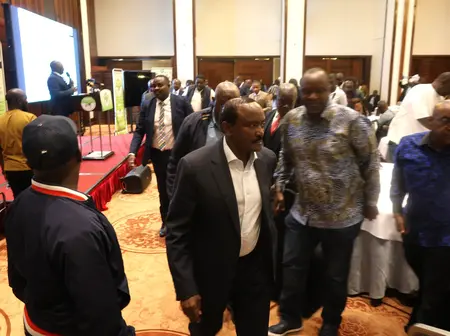
The opposition has once again distanced itself from the electoral commission, announcing in Nairobi that it will not take part in an evening meeting that the Independent Electoral and Boundaries Commission (IEBC) has convened.
Reports from K24 TV and A.M Media indicate that the decision was made public at a press briefing by the united opposition, held shortly after the principals had met to agree on their position.
Speaking on behalf of the group, former Deputy President Rigathi Gachagua explained that the leaders had concluded the commission was not acting independently.
He claimed that the IEBC has been taking instructions from President William Ruto and Interior Cabinet Secretary Kipchumba Murkomen, and said the opposition saw no point in sitting at a table where the outcome appeared to have been decided elsewhere.
The government has not yet responded to those claims.
The briefing followed a closed-door gathering earlier in the day, where the principals had discussed how to strengthen electoral reforms and safeguard the integrity of the process.
K24 TV reported that the meeting had been intended as preparation for planned talks on the same subject, and the leaders had stood together afterwards to present a common front.
Gachagua also used the occasion to react to the commission's recent clearance of his name to contest the presidency in 2027, which has drawn wide attention.
Rather than welcoming it as a concession, he has treated it as a reason to press harder for reforms.
According to A.M Media, he warned that Gen Z supporters could be mobilised to occupy IEBC offices in January if the commission has not engaged opposition leaders properly in December.
The warning has added a sharper edge to an already tense standoff.The walkout is not the first of its kind.
The opposition has stayed away from commission engagements before, arguing that such meetings have produced little beyond photo opportunities.
Commission officials, for their part, have often maintained that their doors remain open to all political players, and that consultation is a standing practice rather than a favour.
What happens next will depend on whether either side is willing to shift. Without the opposition in the room, any agreement reached in the evening session will carry limited weight with its supporters.
If talks do resume in December, the commission will have had time to reconsider its approach, and the opposition will have had time to decide whether its threat was a bargaining tool or a firm plan.
https://www.facebook.com/share/v/1E8cvPmKuS/
Leave a Reply