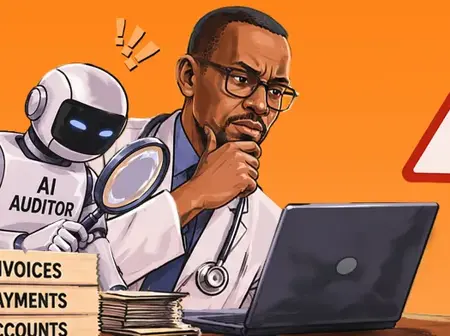
On one of my WhatsApp groups last week, I spun out a scenario that drew a string of laughing emojis. Suppose my accountant were an AI agent. It has no cousin on the payroll, no school fees to worry about and no reason to look away.
If I dipped into my own business, it would flag the gap. Given the power, it would tell my board. And if my board were also made of agents, the file could reach the police and the ODPP before I had even planned the cover up.
We laughed. That world is closer than the joke suggests, and I welcome it on one condition: the machine may find, but only people may judge.
The firms building artificial intelligence already use it to build their next models. On October 16, an Anthropic executive told an IMF and World Bank panel that its model, Claude, led about a quarter of the work on the company's next generation of models in August, up from zero at the start of the year. Humans still supervise, the company says. The direction of travel is less supervision, not more.
Accounting will not be spared, nor should it be. Fraud examiners estimate that the typical organisation loses five per cent of its revenue to fraud every year. Most audits still check a sample and infer the rest. An agent reads every invoice, every payment and every journal entry, every day. It does not tire in March, and nobody can take it to lunch.
My surgical training makes me cautious here. In my clinic, a shadow on an MRI is not a sarcoma. It is a finding. Before major surgery, we take a biopsy, a pathologist examines the tissue and a team discusses the case. We never amputate on a scan. The scan tells us where to look. It is not allowed to decide.
An AI accountant is a scanner. Picture a hospital cashier whose ledger shows the same supplier paid twice in one week. The machine flags it, correctly, as unusual. A person who walks down the corridor learns that the first payment bounced. Unusual is not criminal.
A system that can go straight from unusual to the police has skipped the biopsy, and the cashier pays for its mistake in reputation long before any court rules.
Three questions should be answered before any business, board or public body hands this job to a machine.
Who holds the leash? The person best placed to steal is often the person who sets up the system and writes its instructions. An agent that answers to the chief executive can be quietly reconfigured by the chief executive. It should report to the audit committee, and only the audit committee should change what it watches.
Who confirms the finding? Any alert that could end in a report to an outside authority should pass through a qualified person who examines the evidence and the context before anything leaves the building. That is the biopsy.
Who answers when it is wrong? A wrongly accused clerk must be able to see the evidence and challenge it, and someone with a name must own the decision. Nobody can cross-examine an algorithm.
Kenya has laid good foundations. The Data Protection Act already gives people the right to object to decisions made about them by automated means. The Office of the Auditor General has for some time described AI in fraud detection as inevitable, while committing to adopt it within professional and ethical standards.
The Artificial Intelligence Bill, 2026 treats finance as a high risk sector and requires human oversight of critical decisions, with a qualified person able to override the system.
What is missing is a rulebook for the people who switch these tools on. The Bill leaves the Cabinet Secretary to list which decisions count as critical.
That list should say plainly that any automated finding that could lead to a referral to the police, ODPP or EACC is one of them, with a named person signing off and the accused told why.
ICPAK, working with the Capital Markets Authority for listed companies and the Treasury for public audit committees, could issue simple guidance on who an audit agent reports to, which findings need human review and how an accused person is heard.
The tireless machine is coming, and it will find what we miss. Let it scan. Keep the biopsy in human hands.
Leave a Reply