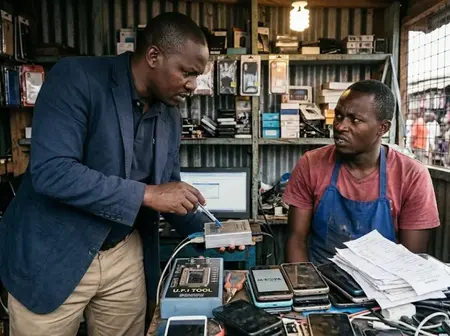
Kenyans who modify financed smartphones to bypass security restrictions could face criminal investigations if their actions involve knowingly handling suspected stolen property or participating in unlawful activities.
The issue has come under scrutiny following a police investigation at a phone repair workshop in Mathare, Nairobi, where officers reported to have recovered 71 mobile phones and specialised electronic equipment linked to alleged attempts to bypass M-Kopa’s security systems.
The case highlights the legal risks surrounding the unlocking of smartphones acquired through instalment financing, particularly where customers have outstanding payments.
Investigators are said to have established that approximately 365 phones had passed through equipment recovered during the operation. M-Kopa identified 24 of 29 examined handsets as its devices, with 23 allegedly showing signs of interference with security software.
A further 18 phones associated with the company’s financing arrangements were reportedly identified, with a combined value of Ksh303,487.
The investigation centres partly on Section 323 of Kenya’s Penal Code, which deals with possession of suspected stolen property.
The provision allows prosecution where a person is found possessing property reasonably suspected to have been stolen or unlawfully obtained and cannot satisfactorily account for its possession.
A person convicted under this provision faces imprisonment of up to one year.
However, this does not mean every customer who defaults on M-Kopa instalments or every technician who unlocks or repairs a financed phone automatically commits a criminal offence.
The prosecution must establish the elements of the offence using evidence. The circumstances surrounding possession and the explanation given by the accused are important considerations.
There is also a distinction between breaching a financing agreement and possessing suspected stolen property.
Missing instalments can trigger contractual consequences, including restrictions on the financed device. However, default alone does not establish criminal guilt.
Similarly, modifying a smartphone’s software does not automatically prove that the device is stolen or that the technician knows it was unlawfully obtained.
The investigation followed complaints received by M-Kopa in February 2025 concerning phones reported stolen or lost. The company formally reported the matter to police on July 10, 2025.
Investigators subsequently searched a repair workshop in the Mradi area of Mathare, Nairobi.
During the operation, officers are reported to have recovered 71 handsets, computers, laptops, external storage devices and specialised flashing equipment, including Pandora, Chimaera and U.F.I tools.
Forensic examination indicated that approximately 365 phones had passed through the equipment.
M-Kopa identified 24 of 29 examined handsets as belonging to the company, with 23 claimed to be showing signs of security software interference.
Investigators also identified 18 additional financed devices valued at approximately Ksh303,487. Seventeen were reportedly active on loan records but appeared inactive on the company’s device management system.
The technician associated with the workshop denied knowingly handling stolen property, maintaining that customers brought phones to his business for ordinary repairs, software diagnosis and replacement of damaged components.
He also challenged the police search and seizure of equipment he valued at approximately Ksh555,000.
The dispute reached the High Court after the technician challenged Section 323, arguing that its application violated constitutional protections, including the presumption of innocence.
On November 5, 2026, the High Court dismissed his constitutional petition, allowing the criminal proceedings at Makadara Law Courts to continue.
The court clarified that reasonable suspicion must be based on ascertainable facts. It also noted that operating a repair shop or possessing phones and diagnostic equipment does not, by itself, establish criminal wrongdoing.
The ruling did not amount to a conviction. Prosecutors must still prove the allegations in the criminal trial.
M-Kopa allows eligible Kenyans to acquire smartphones through an initial payment followed by scheduled instalments. Its remote-management system can restrict or deactivate financed devices when customers fall behind on repayments, subject to the applicable agreement.
The company’s SIM security features also restrict certain devices to registered SIM cards, meaning unauthorised SIM changes can trigger restrictions.
Some customers may consider taking their phones to technicians to remove security applications or bypass remote controls. However, modifying a phone does not automatically clear outstanding instalments or remove contractual obligations.
For repair technicians, the Mathare case highlights the importance of maintaining customer records, job cards and receipts, and establishing the nature of requested software modifications.
For customers, the safest option when a financed phone is locked is to contact M-Kopa through official support channels and retain repayment confirmations.
The case raises wider questions about digital security, consumer rights and the responsibilities of independent repair businesses as smartphone financing expands in Kenya.
Ultimately, criminal liability depends on the evidence and the specific offence charged, not simply on whether a phone has been unlocked.
Leave a Reply