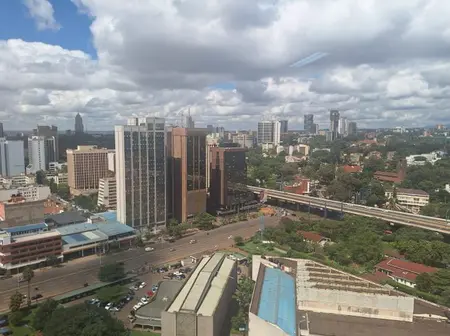
Kenya is projected to record slower economic growth than Tanzania and Uganda over the next two years, despite remaining East Africa’s largest economy by nominal gross domestic product (GDP).
Data from the International Monetary Fund’s (IMF) October 2026 World Economic Outlook show that Kenya’s economy is forecast to grow by 4.5 per cent in 2026, before improving slightly to 4.7 per cent in 2027.
The projections place Kenya behind Tanzania, whose economy is expected to expand by 6.0 per cent in 2026 and 5.9 per cent in 2027.
Uganda is also projected to outperform Kenya, with its real GDP growth forecast at 6.2 per cent in 2026 before accelerating to 9.9 per cent in 2027.
The figures highlight the different growth trajectories of the three neighbouring economies, with Uganda expected to record the strongest expansion, particularly in 2027.
The IMF cautioned that the regional growth figures concealed significant differences in individual countries’ economic performance.
“But steady regional growth masks different country experiences with slowing growth in non-resource-intensive economies and continued resilience in resource-intensive ones,” the Fund stated.
The IMF’s estimates show that Kenya’s growth rate has remained relatively stable, moving from 4.6 per cent in 2025 to a projected 4.5 per cent in 2026.
The Fund expects a modest recovery in 2027, when the economy is forecast to expand by 4.7 per cent.
However, Tanzania is projected to maintain growth above 5 per cent throughout the period, while Uganda is expected to experience a significant acceleration in 2027.
The projections also show that Kenya is broadly in line with the wider regional outlook.
The IMF expects sub-Saharan Africa to record economic growth of 4.5 per cent in both 2026 and 2027, meaning Kenya matches the regional average in 2026 and exceeds it slightly the following year.
IMF Managing Director Kristalina Georgieva said sub-Saharan Africa’s economic growth remained resilient but warned of risks to the region’s outlook.
“Sub-Saharan Africa’s growth remains resilient, with output projected at 4.5% in both 2026 & 2027. But the outlook is clouded by rising inflation, thin buffers, & downside risks. Policies should rebuild buffers, support growth, and protect the vulnerable,” she stated.
Uganda’s projected 9.9 per cent growth in 2027 is particularly notable because it represents a substantial increase from the 6.2 per cent forecast for 2026.
The country’s expected transition into commercial oil production is among the factors underpinning its stronger medium-term economic outlook.
In its July 2026 assessment, the IMF said Uganda’s economic outlook would strengthen with the expected start of oil production in late 2026.
The Fund noted that oil production could improve the country’s fiscal and external balances over the medium term, although delays in the start of production remained a downside risk.
Uganda’s government has also identified oil and gas production, alongside agriculture, tourism and mineral development, as important drivers of its economic expansion.
Tanzania, meanwhile, has maintained a relatively strong growth outlook, supported by mining, agriculture and tourism.
In its July 2026 assessment, the IMF projected Tanzania’s medium-term real GDP growth at approximately 6.2 per cent, citing the favourable outlook for the three sectors.
Although Kenya’s economy remains larger than those of its two neighbours in nominal US dollar terms, its growth outlook faces several constraints.
The World Bank’s October 2026 assessment projected that Kenya’s economy would expand by 4.6 per cent in 2026, with modest growth expected over 2026–2027.
The institution noted that the conflict in the Middle East and unpredictable El Niño rainfall could weigh on economic activity.
It also identified elevated public debt, risks of fiscal slippage and corruption as challenges affecting economic growth and job creation.
The World Bank further observed that interest payments absorb about one-third of government revenue, limiting the resources available for development spending and investment.
Household consumption is also expected to face pressure from higher energy and transport costs, although recovering credit and stronger foreign investment could support investment activity.
The slower growth projection does not mean Kenya has lost its position as the region’s largest economy.
According to the IMF’s October 2026 estimates, Kenya’s nominal GDP stood at approximately $151.15 billion (Ksh19.6 trillion), compared with Tanzania’s $96 billion (Ksh12.4 trillion) and Uganda’s $72 billion (Ksh9.3 trillion).
This means Kenya still has a substantially larger economic base, even though its neighbours are projected to grow faster.
GDP growth measures how quickly an economy expands after adjusting for inflation, while nominal GDP measures the overall value of economic output at current prices.
Consequently, a country with a smaller economy can record a higher growth rate without immediately overtaking a larger economy.
The IMF expects sub-Saharan Africa’s economy to grow by 4.5 per cent in both 2026 and 2027, although individual countries face different economic conditions and risks.
Leave a Reply