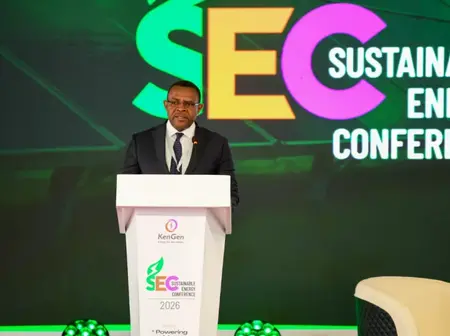
Kenya is seeking to attract more private investment into electricity transmission, battery storage and power generation as rising demand threatens to outpace the infrastructure needed to support the country's industrial expansion.
Energy Cabinet Secretary James Opiyo Wandayi said the government was opening up electricity transmission to private investors through public-private partnerships (PPPs), while encouraging investment in battery energy storage systems to strengthen grid reliability and accommodate more renewable energy.
The move comes as Kenya's peak electricity demand reached a record 2,550 megawatts in July, reflecting growing consumption by households, businesses and industries.
Speaking during the opening of the 2026 Sustainable Energy Conference at KenGen's Geothermal Spa in Olkaria, Naivasha, on Thursday, Wandayi said the country must expand generation and transmission infrastructure simultaneously to sustain economic growth and attract industrial investment.
"Generation and transmission must grow together. A power plant without adequate transmission infrastructure is constrained in delivering its full generation capacity, while a transmission line with insufficient generation remains underutilised," he said.
The government is therefore looking to unlock private capital to finance critical electricity infrastructure, as it seeks to meet rising demand and position Kenya as a regional manufacturing and investment destination.
The push for private investment comes as Kenya seeks to leverage its renewable energy advantage to attract energy-intensive industries, reduce dependence on imported fossil fuels and strengthen its competitiveness in regional markets.
The country generates approximately 90 per cent of its electricity from renewable sources, including geothermal, hydro, wind and solar, making it one of the world's leading clean electricity producers.
Geothermal remains the backbone of this energy mix, providing reliable baseload electricity that is not dependent on weather conditions and supporting the integration of other renewable sources into the national grid.
Renewable energy makes up 81.13 per cent of Kenya's generated electricity (and 91.65% of supply when counting cross-border renewable imports), led by geothermal power at 40.91 per cent.
Hydropower accounts for 22.65 per cent, wind: 12.31 per cent, electricity imports 12.19 per cent, thermal 8.34 per cent while utility-scale solar accounts for three per cent.
KenGen, the Geothermal Development Company (GDC) and independent power producers have played a central role in developing the country's geothermal capacity.
However, Wandayi said Kenya's next challenge was moving beyond electricity generation to translating its clean energy advantage into manufacturing expansion, employment and economic prosperity.
"A green grid is not the finish line. It is the starting point. The question before us now is how we turn clean power into factories, jobs and prosperity," he said.
The Government's investment agenda also targets a more predictable regulatory environment, with Wandayi saying the Ministry of Energy and Petroleum was working with the Energy and Petroleum Regulatory Authority (EPRA) to strengthen frameworks governing power purchase agreements, licensing and electricity tariffs.
He said investors required clear, consistent and fair rules before committing capital to long-term energy projects, while consumers needed protection against unreasonable electricity costs.
"Capital goes where it is welcome and stays where it is respected. Investors want three things from any government: clear rules, consistent rules and fair rules. The Ministry is committed to all three," he said.
The four-day gathering, themed Powering Africa’s Green Industrial Revolution has attracted over 1,500 delegates from more than 80 countries, including 200 investors and 40 financiers.
KenGen managing director and chief executive Peter Njenga said the growing private-sector participation reflects increasing confidence in the opportunities presented by Africa’s clean energy transition.
“We are at a very crucial juncture in the energy sector where we are expanding to cleaner energy against growing demand. These partnerships bring together complementary expertise, capital and technology that are essential to accelerating geothermal development and strengthening Africa’s energy future,” he said.
Njenga said the conference provides a platform for industry players to exchange knowledge, explore investment opportunities and develop partnerships to turn Africa’s renewable energy potential into economic gains.
The partnerships cut across geothermal development, financial services, energy regulation, industrial investment, energy access and technical expertise, highlighting the growing role of private capital in financing the continent’s energy transition.
Among key investment projects is the approximately $800 million (Sh103.6 billion) green fertiliser plant being developed by Kaishan Group at KenGen’s Olkaria Green Energy Park.
The facility will be powered by 165 megawatts of geothermal energy and is expected to create more than 2,000 jobs, underscoring the potential of renewable energy to support industrialisation beyond electricity generation.
KenGen is keen on expanding renewable energy investment pipeline, with a target of adding 5,540 megawatts of renewable energy capacity by 2034.
Its immediate development programme includes approximately 250 megawatts expected to be connected to the national grid by 2027, incorporating a 100-megawatt battery energy storage system.
Meanwhile, Njenga has noted that Olkaria offers expertise.
"The skills our teams have built in exploration, drilling, reservoir management and plant operation are now sought across Africa and beyond, and KenGen's drilling and technical capabilities are an asset to the region," he said.
Olkaria is also a hub of innovation where KenGen is exploring direct use of geothermal and green hydrogen and the use of geothermal energy for industrial parks and agriculture.
It also offers a unique model of co-existence that integrates power generation, tourism, wildlife, and local communities sharing the same landscape within Hell’s Gate National Park.
Leave a Reply