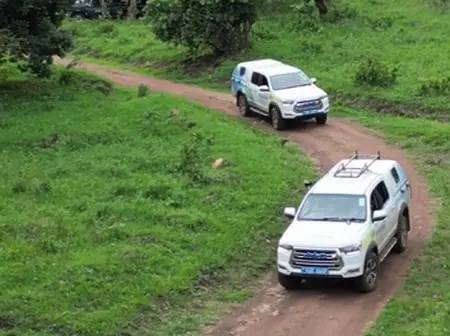
Kenya Power has taken two electric double-cab pickups to the Maasai Mara as part of an expedition testing how the vehicles perform on long-distance journeys and whether charging infrastructure can support electric tourism in Kenya.
The company said on Tuesday, November 24, 2026, that the vehicles had completed a game drive across the Mara Triangle after travelling from Nairobi, with the expedition focusing on range anxiety, one of the main concerns among potential electric vehicle (EV) buyers.
Each pickup has a 65kWh battery and a stated driving range of 300 kilometres on a full charge.
Kenya Power said it first charged both vehicles overnight in Nairobi before covering approximately 250 kilometres to the Maasai Mara, where they received additional charging on Sunday night, November 22, 2026.
One vehicle was charged at Sekenani Gate while the other used charging facilities at Camp Entumoto.
The company subsequently drove the two pickups across the Mara Triangle on Monday, starting at Sekenani Gate before proceeding to Pristine Mara Bay Lodge, Karen Blixen Camp and Tipilikwani Mara Camp.
By the time they reached Tipilikwani, one vehicle had 30 per cent battery charge remaining, while the other had 20 per cent.
Their average speed was 50 kilometres per hour, in line with park regulations.
“Range anxiety perhaps tops the list of concerns for any e-mobility enthusiast,” Kenya Power said.
The company said the expedition was designed to establish how far the vehicles could travel and assess their performance in different driving conditions.
On Tuesday, November 24, 2026, the team planned to enter the reserve through Talek Gate before exiting through Sekenani Gate. Kenya Power said it could recharge at Sekenani or proceed to Narok Town for another charging session.
The expedition comes as Kenya attracts more investment in electric vehicle distribution, assembly and charging infrastructure.
In November 2026, Simba Corporation introduced British-origin automotive brand MG into the Kenyan market, adding electric passenger cars and SUVs to the growing range of vehicles available to local buyers.
The company plans to assemble MG vehicles at Associated Vehicle Assemblers (AVA) in Mombasa, building on its Ksh1 billion investment in a dedicated electric vehicle assembly line.
Simba Corporation told a local newspaper that it planned to assemble both electric and petrol-powered MG vehicles once sales volumes reached the required levels.
“The plan is to locally assemble both electric and petrol MG cars once we reach the right sales volumes in the market. When we do, prices could come down by up to 20 percent,” the company said.
The assembly investment is expected to support the production of passenger vehicles initially, with electric trucks and buses also forming part of the longer-term plans.
AVA says its dedicated assembly line will employ 60 technicians trained in battery handling and electrical systems. The facility already assembles electric hatchbacks and minibuses for companies operating in Kenya’s public transport and mobility sectors.
The expansion comes as the government pushes to increase electric vehicle adoption through tax incentives, local assembly and investment in charging infrastructure.
The Ministry of Roads and Transport reported that Kenya had registered more than 50,000 electric vehicles by June 2026, with electric motorcycles accounting for the majority.
The government launched its National Electric Mobility Policy in February 2026, setting out plans to develop charging infrastructure, promote local manufacturing and support the adoption of electric vehicles in public and private transport.
However, charging availability remains an important consideration for motorists contemplating the switch from petrol and diesel vehicles.
Kenya Power’s Maasai Mara expedition is therefore an opportunity to demonstrate how electric vehicles can operate beyond urban areas and whether charging facilities can support longer journeys.
The company’s findings could provide useful insights for tourism operators, fleet owners and motorists considering electric vehicles for journeys outside major towns.
Leave a Reply