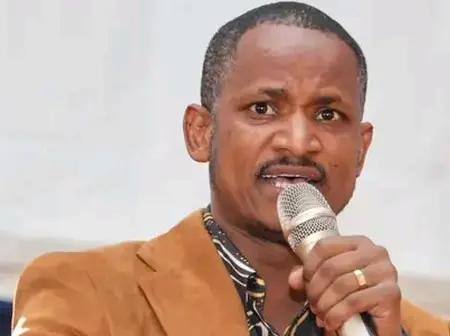
Embakasi East Member of Parliament Babu Owino has raised fresh concerns over Kenya's rising public debt, questioning why the country continues borrowing heavily without experiencing proportional economic growth.
The Orange Democratic Movement (ODM) legislator argued that borrowing alone does not necessarily indicate economic failure, but warned that the real danger emerges when borrowed money fails to generate meaningful economic returns.
Speaking about the country's economic situation, Babu described Kenya as being trapped in a Malthusian economic situation, where population and economic pressures continue growing while the country's productive capacity struggles to keep pace.
"Our country is borrowing so much, yet it is not growing proportionately. We are in a Malthusian trap. Having a debt is not a problem, but what you do with that debt is what determines whether it becomes a blessing or a curse," Babu Owino stated.
His remarks come amid growing public debate over the national government's borrowing decisions, the cost of living and the sustainability of Kenya's public finances.
Babu's argument centres on the importance of productive borrowing, insisting that loans should finance investments capable of expanding the economy, creating employment opportunities and improving the livelihoods of ordinary citizens.
He suggested that borrowing becomes beneficial when resources are directed towards infrastructure, industries, agriculture, education and other sectors capable of generating long-term economic returns.
However, when borrowed funds fail to translate into economic expansion, the country risks accumulating financial obligations without developing sufficient capacity to repay them.
The legislator's comments also place economic management at the centre of the political debate ahead of the 2027 General Election.
President William Ruto's administration has repeatedly defended its economic policies, arguing that government investments and fiscal reforms are necessary to strengthen the country's long-term economic prospects.
Nevertheless, opposition politicians have continued questioning the government's borrowing strategy and its impact on ordinary Kenyans.
Babu's latest intervention could further intensify scrutiny of the administration's economic record as political leaders prepare to present competing development agendas to voters.
With 2027 approaching, public debt, economic growth, taxation and employment are expected to remain major campaign issues.
Link:
https://www.facebook.com/share/1FDDeWNNxy/
Leave a Reply