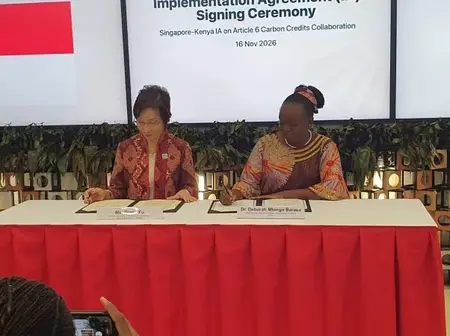
Kenya has entered into an agreement with Singapore with a view of exploring opportunities offered by carbon trade.
Article 6.2 of the Paris Agreement enables countries to cooperate voluntarily through bilateral or multilateral agreements to trade greenhouse gas emission reductions.
To advance this opportunity, Environment CS Dr Deborah Barasa and Singapore Minister for Sustainability and the Environment and the Minister-in-charge of Trade Relations Grace Fu presided over the signing ceremony at Singapore Pavilion on Monday.
Barasa said the signing ceremony marks an important milestone in our bilateral partnership and demonstrates our shared commitment to advancing practical solutions to the global climate challenge.
“Climate change is not merely an environmental challenge; it is an economic, social and development challenge that demands innovative financing, strong partnerships and collective action,” Barasa said.
The CS said Kenya recognises that carbon markets provide an important opportunity to mobilise climate finance, attract investment and accelerate the implementation of our Nationally Determined Contribution.
She said through the Climate Change (Amendment) Act, 2023, and the Climate Change (Carbon Markets) Regulations, 2024, the country has established a legal and institutional framework to ensure that carbon market activities in Kenya are transparent, accountable and anchored in environmental integrity.
“Our partnership with Singapore builds on the Memorandum of Understanding signed on 18 May 2023 in Nairobi. Today's Agreement takes that commitment a step further by establishing an operational framework for cooperation under Article 6.2 of the Paris Agreement,” she said.
Barasa said the significance of the agreement lies in its ability to translate climate commitments into tangible opportunities.
“It establishes a framework for the approval of mitigation activities and the authorization and transfer of Internationally Transferred Mitigation Outcomes.”
The CS said the agreement also provides for corresponding adjustments, joint institutional oversight, transparent reporting and registry arrangements to ensure that every authorized transfer is properly accounted for and that double counting is avoided.
“Through these arrangements, we are strengthening confidence in Kenya's carbon market framework and creating an enabling environment for responsible international investment.”
Barasa emphasised that Kenya's participation in international carbon markets will always be guided by the protection of our national climate ambitions, our environmental integrity and the interests of our people.
“We must ensure that carbon market investments do more than generate carbon credits. They must create jobs, support local communities, protect biodiversity, improve livelihoods and contribute to our broader national development priorities,” Barasa said.
The CS said Kenya is endowed with significant natural capital, including our forests, wetlands, grasslands, mangroves and renewable energy resources.
“These are not merely environmental assets; they represent opportunities for climate action, investment and sustainable economic growth.”
Barasa said through high-integrity carbon markets, the country can unlock the value of these resources while ensuring that the benefits of climate action reach the communities that are central to their protection and sustainable management.
She said the agreement with Singapore provides an important platform for mobilising international investment and encouraging greater private-sector participation in eligible mitigation activities.
Barasa said the opportunity must however go hand in hand with accountability.
“We must maintain robust carbon accounting systems, effective monitoring and reporting, strong regulatory oversight and appropriate environmental and social safeguards. Our commitment is clear: Kenya welcomes climate investment, but such investment must operate within our laws, respect our national priorities and deliver credible and measurable outcomes,” Barasa said.
The CS said the signing of the agreement is the beginning but its success will depend on how effectively we translate its provisions into action.
Barasa said the immediate priorities following the entry into the force of the agreement will include operationalising the Joint Committee, developing common procedures for project approval and authorization, establishing the eligible crediting programs and methodologies, and strengthening registry and reporting arrangements.
The CS encouraged the technical teams, project developers, investors and other stakeholders to work together in identifying opportunities that can translate this partnership into tangible climate and economic benefits.
Grace Fu said no country can tackle the impacts of climate change such as rising sea level alone.
The Singapore official said countries are facing more frequent and severe droughts and floods.
Grace Fu lauded countries such as Kenya for recognising that they must lead the course on international climate cooperation.
“Kenya has demonstrated considerable leadership in the green transition. In 2024, over 90 per cent of Kenya's electricity was generated from renewable sources, an impressive achievement that places Kenya among the leaders in green energy development,” she said.
Grace Fu said Kenya is also a significant player in Africa's carbon markets.
“In 2024, Kenya's projects accounted for about one-fifth of all energy carbon market revenues across Africa. These achievements speak to Kenya's tremendous potential to contribute to global decarbonisation.”
Grace Fu said realising the potential requires investment.
“This is where international cooperation such as Article 6 can make a difference.”
Leave a Reply