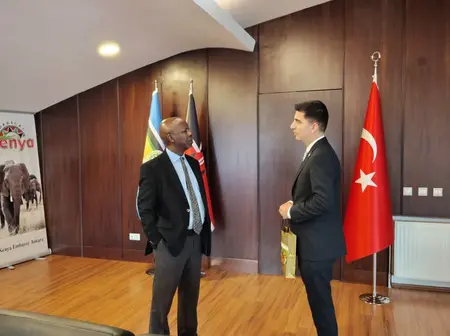
Kenya is stepping up efforts to attract Turkish investment and technology, with its embassy in Ankara engaging business leaders, industrial players and healthcare providers in a push to deepen economic ties.
A series of engagements by Kenya Ambassador to Türkiye Anthony Muchiri points to an expanding economic diplomacy agenda targeting agriculture, construction, irrigation, healthcare and technology.
In the latest engagement on November 19, Amb Muchiri met Kerem Ilengir, founder and chairman of Ilengir Group of Companies, and head of the World Turkish Business Council, Qatar, to explore investment opportunities in Kenya.
The embassy said the two “explored high-potential investment opportunities in Kenya and exchanged insights on future strategic partnerships”.
While the mission did not give more details, the dispatch signals Nairobi's interest in attracting Turkish capital through business networks that extend beyond Türkiye into the Gulf.
The meeting followed a series of engagements in October, including discussions with the DEİK Kenya-Türkiye Business Council.
The meeting brought together Turkish business interests to explore ways of increasing trade between the two states.
“Amb Muchiri and Abdullah Yeşil, chair of the DEİK Kenya-Türkiye Business Council, co-chaired a strategic meeting focused on boosting trade volumes between Kenya and Türkiye.
“DEİK (Foreign Economic Relations Board of Türkiye), one of Türkiye’s largest and most inclusive business platforms, brings together premier industries, chambers of commerce and international businesses,” the embassy said.
The meeting covered key sectors, among them agriculture and irrigation, as well as construction, sectors central to Kenya's ambitions to expand food production, improve infrastructure and attract private investment.
Kenya's outreach has also extended beyond Ankara to regional commercial centres. On October 12, Muchiri met the Aegean Region Chamber of Commerce in İzmir, where discussions focused on expanding bilateral trade and strengthening commercial relations.
The embassy said the two sides held an "insightful discussion on enhancing economic cooperation, boosting bilateral trade and deepening commercial ties between our nations".
The focus on Turkish industrial expertise was also evident during Muchiri's visit to Turka, a vehicle inspection company that demonstrated its technology-driven inspection systems.
According to the embassy, the company uses "AI-driven imaging, robotic under-carriage scanners and automated laser testing" to eliminate human bias from vehicle inspections.
The demonstration could be relevant to Kenya's efforts to modernise vehicle inspection, improve road safety and reduce opportunities for human interference in regulatory processes.
Healthcare is another emerging area of engagement. Muchiri also met representatives of Ankara Güven Hospital to discuss possible collaboration with Kenya's Social Health Authority, although the embassy did not disclose the specific areas of cooperation.
Muchiri and an embassy delegation also visited and engaged the Konya Chamber of Commerce to explore commercial and economic cooperation between Kenya and the central Turkish region.
Chamber president Selçuk Öztürk said the visit provided an opportunity to assess "the possibilities for commercial and economic cooperation between Konya and Kenya.
They also exchange views on strengthening relations between the business communities of the two countries.
The expanding engagements come as Kenya seeks to diversify its sources of investment, technology and industrial partnerships, amid intensifying competition among global and emerging economic powers for access to African markets.
Türkiye has increasingly positioned itself as an important economic and diplomatic partner for African countries, pursuing opportunities in infrastructure, manufacturing, agriculture, healthcare and trade.
Stronger trade relations could provide Kenya more access to Turkish industrial expertise, investment capital and business networks, while creating additional markets for Kenyan products.
The strategy also offers Nairobi another avenue for diversifying its international economic partnerships rather than relying heavily on traditional Western partners and established Asian investors.
Leave a Reply