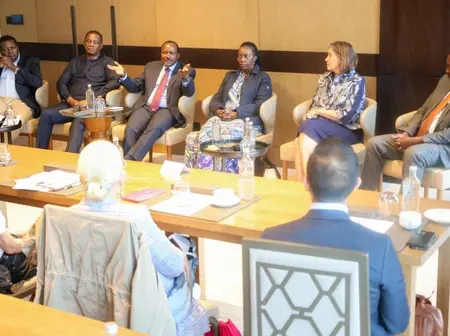
Wiper Patriotic Front Party leader Kalonzo Musyoka has led a delegation of opposition leaders in a high-level meeting with the United States-based Council on Foreign Relations (CFR), where they raised concerns over the independence of Kenya’s electoral commission and the country’s preparedness for the 2027 General Election.
The delegation, which included former Justice Minister Martha Karua, former Attorney General Justin Muturi, Democratic Action Party-Kenya (DAP-K) leader Eugene Wamalwa and National Assembly Deputy Minority Leader Robert Mbui, met the Council’s leadership led by its President, Michael Froman.
In a statement issued on Monday, November 16, 2026, following the meeting, Kalonzo said the opposition leaders presented their concerns about the Independent Electoral and Boundaries Commission (IEBC), arguing that its impartiality would be central to determining whether the next General Election would be free and fair.
“There can be no free and fair election when the Independent Electoral and Boundaries Commission is not independent,” Kalonzo stated.
He accused President William Ruto’s administration of using public resources and civil servants for political campaigning ahead of the polls.
He also claimed that the government was engaging in open bribery, claims that were part of the delegation’s presentation to the American foreign-policy organisation.
Kalonzo said the delegation also briefed the Council on what it described as organised attacks against opposition gatherings and supporters.
He claimed that opposition events had repeatedly come under attack, with leaders and supporters being stoned and tear-gassed, vehicles targeted and staff members seriously injured.
The Wiper leader further alleged that police officers had fired live bullets at opposition members during political activities.
“A regime that turns violence on citizens exercising their democratic rights has no business talking about peaceful elections,” he said.
The allegations come amid wider concerns about political violence ahead of the 2027 polls.
In September 2026, Human Rights Watch reported that organised gangs had attacked civil society and opposition gatherings in different parts of Kenya. The organisation said the violence had reportedly killed at least six people and injured dozens more, calling on authorities to investigate the incidents and protect citizens exercising their political rights.
One of the incidents highlighted by the organisation was the August 16 attack on a convoy transporting Linda Mwananchi supporters and politicians to a planned rally in Homa Bay. Human Rights Watch reported that at least three people were killed during the attack.
The report also documented attacks on journalists and vehicles, as well as incidents involving tear gas during opposition events.
The developments have intensified scrutiny of the security environment in which political parties and candidates will operate as the country approaches the next General Election.
The opposition delegation also raised concerns about the functioning of Parliament, with Kalonzo accusing the Executive of exercising excessive influence over the legislature.
He claimed that Parliament had been reduced to an extension of the Executive and was no longer adequately performing its constitutional oversight role.
The opposition leaders also criticised the government’s foreign policy, particularly its handling of the conflict in Sudan.
Kalonzo claimed that President Ruto’s interests in the Rapid Support Forces (RSF) had compromised Kenya’s neutrality and standing in the region.
The Sudan conflict has been a subject of diplomatic concern, with Kenya’s engagement with Sudanese political and military actors attracting criticism from different sides.
The delegation also raised corruption and the rule of law, accusing the government of presiding over escalating corruption and failing to respect constitutional accountability mechanisms.
Kalonzo said the leaders had made it clear to the Council that the situation needed to change, insisting that Kenyans would seek political change through the ballot.
The meeting comes as the IEBC faces growing pressure to demonstrate its institutional and operational readiness for the August 10, 2027 General Election.
The commission has projected a voter register of approximately 28.5 million, compared with about 22.1 million registered voters in the 2022 General Election.
It is also pursuing expanded voter registration for Kenyans living abroad, with plans to increase the number of countries participating in diaspora voting from 12 to 26.
However, financial constraints have emerged as a major challenge.
The commission is also facing a funding shortfall of approximately Ksh34 billion after the National Treasury committed about Ksh41 billion against an election budget requirement of Ksh74.4 billion.
The commission requires the funds for activities including election technology, voter registration, voter education, logistics and procurement of election materials.
In its annual report presented to Parliament in November, the IEBC also identified public scepticism, delayed Treasury disbursements, outstanding bills from previous election cycles and staffing shortages among the challenges affecting its preparations.
The commission said rebuilding public confidence was a priority following its reconstitution in July 2025.
Despite the concerns, the IEBC has continued implementing its election preparations. On November 11, it announced that 105 fully registered political parties had submitted their certified nomination rules for the 2027 General Election.
The commission has maintained that it is committed to conducting elections that are free, fair, transparent, inclusive and credible.
The meeting with the Council on Foreign Relations comes at a time when opposition leaders are stepping up engagements within Kenya and internationally ahead of the next General Election.
Kalonzo is preparing to lead a nine-member delegation on a seven-day tour of the United States from November 18 to 24.
The planned visit includes engagements with American lawmakers at Capitol Hill, a meeting with technology and investment stakeholders at the Massachusetts Institute of Technology (MIT), and town halls with Kenyans living in different American cities.
The programme is expected to take the delegation to Washington, Boston, Germantown, Baltimore, Minneapolis and Cleveland.
The latest meeting with the Council on Foreign Relations therefore forms part of a wider series of engagements through which opposition leaders are presenting their concerns and political agenda to international audiences.
Leave a Reply