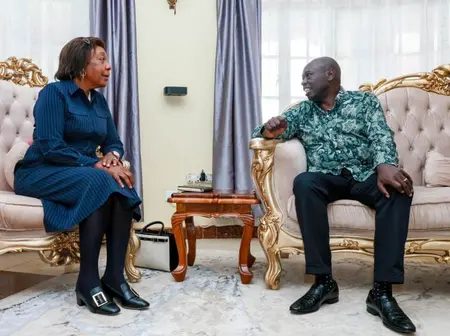
Former Deputy President Rigathi Gachagua has turned to veteran politician Charity Ngilu for lessons from Kenya’s historic 2002 opposition alliance, signalling his intention to borrow from the political strategy that ended KANU’s decades-long hold on power.
In a statement following their meeting at his Wamunyoro residence on Tuesday, November 3, 2026, Gachagua described Ngilu as the “Iron Lady of Kenyan politics” and credited her with playing a central role in the formation of the National Rainbow Coalition (NARC), which swept former President Mwai Kibaki to power in the 2002 General Election.
Gachagua said he had benefited from Ngilu’s experience as she took him through how the coalition was crafted and implemented, including the negotiations, strategy and political calculations that brought different opposition groups together.
He said the former Kitui Governor also shared lessons on what opposition leaders needed to do to challenge corruption and impunity and steer the country towards prosperity.
“Today at our Wamunyoro residence, I met the Iron Lady of Kenyan politics, Hon. Charity Ngilu. Hon. Ngilu was the architect of the NARC dream and, together with the late President Mwai Kibaki and Kijana Wamalwa, crafted a winning strategy that brought the KANU era to an end,” Gachagua stated.
“This morning, I benefited greatly from Hon. Ngilu’s wisdom as she took me through how NARC was crafted and implemented. The lessons I have learnt will be very instrumental. I assure the Kenyan people that I am more knowledgeable, and I can clearly see light at the end of the tunnel.”
The former Deputy President framed the discussions around the possibility of a repeat of the political realignment that preceded the 2002 elections, declaring that Kenya was approaching another defining political moment.
“We have a 2002 moment, and our promise is that we shall identify one presidential candidate who will win by a landslide,” he added.
Gachagua’s reference to 2002 recalls one of the most consequential political moments in Kenya’s multiparty history.
After years of opposition fragmentation, several political formations began negotiations to consolidate their support ahead of the December 2002 General Election.
In September 2002, Kibaki’s Democratic Party joined Kijana Wamalwa’s FORD-Kenya and Ngilu’s Social Democratic Party to form the National Alliance of Kenya (NAK), with Kibaki selected as its presidential candidate.
The alliance later joined forces with Raila Odinga’s Liberal Democratic Party (LDP), which had broken away from KANU following divisions over former President Daniel Arap Moi’s preferred successor, Uhuru Kenyatta.
The expanded coalition became the National Rainbow Coalition (NARC), bringing together politicians who had previously competed against one another.
At a major rally at Nairobi’s Uhuru Park, Raila famously declared “Kibaki Tosha”, endorsing Kibaki as the opposition’s joint presidential candidate.
The strategy delivered a decisive result in the December 2002 elections. Kibaki won approximately 62 per cent of the presidential vote against Kenyatta’s 31 per cent, while NARC secured 125 of the 210 elected parliamentary seats.
The victory ended KANU’s 24-year rule under Moi and ushered in a new administration led by Kibaki.
However, the coalition’s unity would later come under strain. Disagreements over the implementation of pre-election power-sharing arrangements, Cabinet appointments and constitutional reforms exposed divisions between its constituent groups.
The death of Wamalwa in 2003 further weakened the alliance, while political disagreements eventually contributed to the breakdown of the NARC arrangement.
Gachagua’s meeting with Ngilu comes as opposition leaders intensify consultations on how to challenge President William Ruto in the August 10, 2027 General Election.
The former Deputy President has repeatedly called for opposition parties and leaders to agree on one presidential candidate rather than split their support among competing aspirants.
He has been involved in a series of high-profile consultations at his Wamunyoro residence, including meetings with Nairobi Senator Edwin Sifuna and Wiper Patriotic Front leader Kalonzo Musyoka.
During a meeting with Sifuna and leaders associated with the Linda Mwananchi movement on October 20, Gachagua said the discussions were aimed at building cooperation between the two political formations.
The talks explored the possibility of a joint presidential ticket and an agreement to support whoever eventually emerges as the opposition’s flagbearer.
Gachagua has also indicated that he would be willing to support Sifuna, including deputising him, if political calculations establish that the Nairobi Senator is best placed to lead the opposition into the election.
On October 26, Kalonzo also visited Gachagua at Wamunyoro, with the two leaders reiterating the need for opposition unity and a single presidential candidate.
Despite the public calls for unity, the opposition continues to grapple with competing political ambitions and disagreements over how the coalition should be structured.
On Monday, November 2, Democratic Party leader Justin Muturi criticised Gachagua, accusing him of political bullying and double-speak that could undermine efforts to build a united opposition.
Muturi questioned whether some of the political negotiations were prioritising control of parliamentary and county seats over the broader objective of agreeing on a presidential candidate.
He argued that no individual or political community could claim ownership of the opposition, warning that a national presidential campaign required consensus and cooperation across regional and political boundaries.
Other opposition figures have also floated possible presidential contenders. DCP Deputy Party Leader Cleophas Malala, for instance, recently suggested that Sifuna could fly the opposition’s presidential flag, with an experienced politician serving as his running mate.
Ngilu is among the veteran politicians who played prominent roles in Kenya’s multiparty political era.
She contested the presidency in the 1997 General Election on a Social Democratic Party ticket, becoming one of the first women to run for the country’s highest office.
Her political experience also includes serving as Kitui Central MP, Cabinet Secretary for Water and Irrigation, and later Governor of Kitui County.
Her involvement in the political realignments that produced NARC gives her first-hand experience of the negotiations and compromises required to unite parties behind a common presidential candidate.
For Gachagua, the engagement appears to be part of a broader effort to understand how the opposition can turn its current consultations into a coordinated political movement ahead of 2027.
Leave a Reply