Kenyan banks have quietly built one of Africa’s most influential regional banking networks, extending their reach beyond Nairobi to become major players in the financial systems of neighbouring countries.
A new International Monetary Fund (IMF) working paper has revealed the extent of that influence, showing that Kenyan-controlled lenders account for approximately 65 per cent of Rwanda’s banking assets and 48 per cent of assets in the Democratic Republic of Congo (DRC).
The banks also control 29 per cent of Uganda’s banking assets, highlighting Kenya’s growing influence over financial services in East and Central Africa.
The findings are contained in a paper titled Cross-Border Banking Exposures and Macroeconomic Spillover Effects: The Case of Kenya, authored by IMF researchers Zhongxia Zhang and Francine Nyankiye.
But the dominance did not happen overnight. It is the result of years of strategic acquisitions, investments in established local lenders, expansion of branch networks and a search for new markets beyond Kenya’s increasingly competitive banking sector.
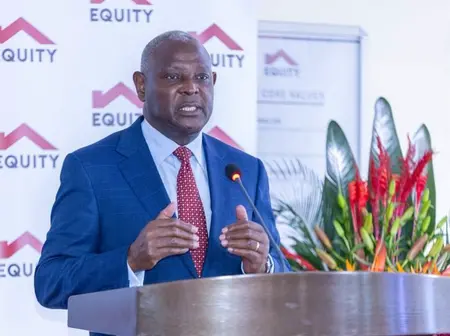
Two institutions, Equity Group and KCB Group, have been particularly instrumental in this expansion.
One of the biggest moves was made by KCB Group, which used acquisitions to establish a much stronger position in Rwanda.
In 2021, KCB acquired a 62.06 per cent stake in Banque Populaire du Rwanda (BPR) from London-listed financial services company Atlas Mara.
The transaction cost approximately Ksh4.8 billion. KCB subsequently increased its shareholding to 76.67 per cent by purchasing additional shares from minority shareholders.
The bank then merged BPR with its existing KCB Bank Rwanda operations in 2022, creating BPR Bank Rwanda Plc.
The consolidation increased KCB’s ownership to approximately 87 per cent and gave it access to an established customer base, existing branches and a recognised banking brand.
Rather than building a banking business from scratch, KCB acquired an institution that already had roots in the Rwandan economy.
The strategy also allowed it to expand its retail, corporate and small-business banking operations.
Equity Group has also established a presence in Rwanda, where it operates Equity Bank Rwanda.
Together with other Kenyan-linked financial institutions, these investments help explain the IMF’s finding that Kenyan banks account for nearly two-thirds of Rwanda’s banking assets.
The Democratic Republic of Congo has become an even bigger strategic prize for Kenyan lenders.
With a population exceeding 100 million people, substantial mineral resources and significant demand for financial services, the country offers opportunities that are difficult to find in smaller banking markets.
Equity Group was among the first Kenyan institutions to make a major move into the market.
Its expansion happened in two major stages:
The merger brought together an existing customer base, infrastructure and banking expertise, positioning Equity BCDC among the largest financial institutions in the DRC.
KCB Group subsequently entered the market through another major acquisition.
In December 2022, KCB completed the acquisition of an 85 per cent stake in Trust Merchant Bank (TMB), one of the DRC’s established financial institutions.
TMB already had an extensive network, including more than 100 branches, agency banking outlets and services targeting individuals, businesses and large corporations.
The acquisition allowed KCB to enter the Congolese market with an established operation instead of spending years developing one from the ground up.
These two investments have been central to the growth of Kenyan banking assets in the DRC.
The scale of the expansion is particularly evident in the amount of assets Kenyan banking groups have accumulated outside the country.
According to the IMF research, Kenyan banks held approximately Ksh2.147 trillion in assets across other East African Community markets by the end of 2024.
This was nearly 3.7 times the amount recorded in 2018.
The DRC accounted for approximately 43.5 per cent of those assets, up from around 10 per cent in 2018.
Rwanda, Tanzania and Uganda each accounted for approximately 15 per cent.
The Central Bank of Kenya’s 2024 Bank Supervision Annual Report provides further insight into the figures.
The figures demonstrate how the DRC has overtaken other regional markets as the largest destination for Kenyan banking investments.
More recent figures published in September 2026, based on the CBK’s 2025 supervision report, showed that Kenyan banks’ assets in the DRC had crossed the Ksh1 trillion mark.
They stood at approximately Ksh1 trillion, compared with Ksh933.4 billion in 2024.
This represents a substantial concentration of Kenyan banking investments in the Congolese economy.
The acquisitions are not simply about geographical expansion. They reflect a deliberate search for growth opportunities.
Kenya has one of the region’s most developed banking industries, with established institutions competing for customers, deposits, businesses and lending opportunities.
For major lenders, expanding into neighbouring economies provides access to new customers and revenue streams.
The DRC is particularly attractive because of its large population, mining industry, cross-border trade and demand for financial services.
Rwanda, on the other hand, offers a relatively organised financial environment and opportunities in retail banking, corporate finance and small-business lending.
There is also a regional integration dimension.
The East African Community has promoted the movement of capital, services and investment across member states, creating opportunities for financial institutions to establish operations beyond their home markets.
The DRC’s admission into the EAC in 2022 further strengthened the strategic importance of the market.
Kenyan banks have also benefited from existing commercial relationships, regional trade and familiarity with neighbouring economies.
Importantly, the expansion has not been driven exclusively by Equity and KCB.
Other Kenyan-linked banking institutions operating across regional markets include Co-operative Bank, NCBA, I&M Bank, Diamond Trust Bank and Guaranty Trust Bank.
Their presence has helped establish Kenya as an important source of banking capital and expertise across the region.
One of the more interesting findings in the IMF paper concerns how Kenyan banks finance their operations outside Kenya.
A large proportion of the subsidiaries’ activities is funded through deposits collected from customers in the host countries rather than relying primarily on money transferred from their parent institutions in Nairobi.
This means that when customers in Rwanda or the DRC deposit money with a Kenyan-owned bank, those funds can help finance lending and other banking activities within the local economy.
The arrangement is significant because it reduces dependence on cross-border funding and limits the extent to which financial difficulties at a parent institution automatically translate into immediate funding problems for its subsidiaries.
The IMF considers the locally funded structure an important factor when assessing financial stability.
However, it does not eliminate the risks associated with foreign ownership.
Decisions on capital allocation, risk appetite, corporate strategy and group liquidity can still be influenced by parent institutions in Kenya.
The growing influence of Kenyan banks has also created a new regulatory challenge.
The IMF warns that the expansion has made Kenyan banking groups increasingly important to the financial stability of countries where they operate.
One concern involves non-performing loans (NPLs).
The working paper identifies instances where Equity and KCB subsidiaries have recorded non-performing loan ratios above the averages in some of their host markets.
In Uganda, for example, Equity’s reported NPL ratio stood at 14.5 per cent against a banking-sector average of 3.98 per cent.
This is particularly important because a bank with a substantial market share and deteriorating loan quality can pose risks beyond its own balance sheet.
The IMF also identifies gaps in cooperation between financial regulators.
The Central Bank of Kenya has signed memoranda of understanding with 13 central banks, largely in countries where Kenyan banks operate.
However, the researchers found that most bank-country pairs had not conducted joint inspections during the preceding decade.
Only one joint inspection was scheduled for KCB’s Rwandan subsidiary in 2026, according to the paper.
Differences in accounting standards, capital requirements and deposit insurance arrangements also complicate the management of cross-border banking risks.
The challenge is therefore ensuring that regulators in Nairobi, Kigali and Kinshasa can coordinate effectively when a financial institution experiences difficulties.
Leave a Reply