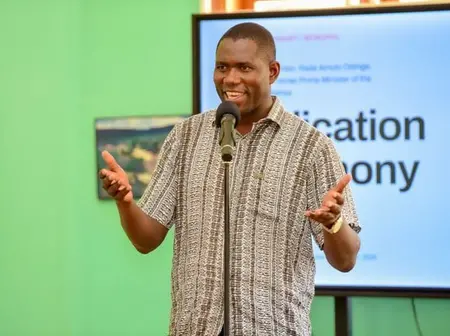
The Government has directed compliance officers to remove payment paybills from public hospitals across Kenya, warning health facilities against demanding additional payments from patients whose treatment is covered under the Social Health Authority (SHA).
The directive was issued by the Principal Secretary for Health Dr. Ouma Oluga, during an engagement with health officials in Vihiga County, where he instructed SHA compliance officers to inspect public hospitals and ensure that payment paybills were removed.
In a video shared by the State Department for Medical Services on Saturday, November 21, 2026, the PS authorised the officers to undertake the exercise across the county, assuring them of security support during enforcement.
“Na uangalie kama wameweka paybill kwa hiyo hospitali. Na ung’oe hiyo paybill. Nimekupatia ruhusa ya kung’oa paybill,” the PS told a SHA compliance officer in Vihiga.
“Eh, nimekupatia ruhusa ya kung’oa paybills kwa the entire county,”He subsequently extended the instruction beyond the individual facility, telling the officer.
In a separate exchange, he directed compliance officers to inspect every public hospital and remove the payment channels.
“Remove those things called paybills,” he instructed, adding that the officers would receive security support to carry out the exercise.
The PS said requiring patients to make substantial out-of-pocket payments could undermine the purpose of SHA, particularly for low-income households that depend on small businesses for their livelihoods.
Using the example of women operating small food businesses in Vihiga markets, he explained that some traders have very limited working capital and could lose their businesses if required to pay large hospital bills.
He illustrated the situation using a trader whose entire business capital was less than Ksh30,000.
“Now you can imagine when that woman comes to the hospital, you want to put for her a paybill to pay 50,000. You are closing the business,” he said.
He argued that hospitals should contribute to improving people’s economic and social wellbeing rather than pushing households further into poverty.
“So the hospital then is now contributing to poverty in the society,” he said.
The PS urged hospitals to encourage members to maintain their SHA contributions so that the authority could meet the cost of eligible healthcare services.
“Please, the little money that woman is getting, she’d rather pay 10,000 or 20,000 to SHA and come here and SHA pays you the 200,000,” he said.
He also outlined three important responsibilities of hospitals: providing quality healthcare, supporting training and research, and improving population health.
The PS said county commissioners had been informed about the exercise and would accompany enforcement officers during inspections.
He maintained that patients should receive covered services without being asked to make additional payments.
The directive places public hospitals and SHA compliance teams at the centre of efforts to strengthen implementation of the new health financing system.
However, the video did not provide a nationwide implementation timetable, specify penalties for hospitals that retain paybills or clarify how the directive will address services and charges not covered by SHA.
Leave a Reply