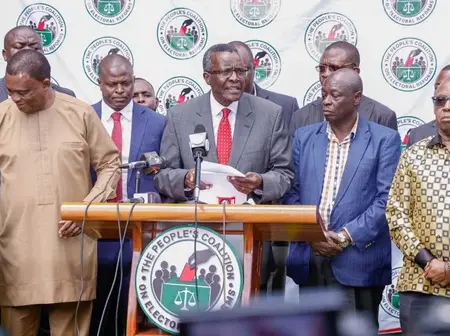
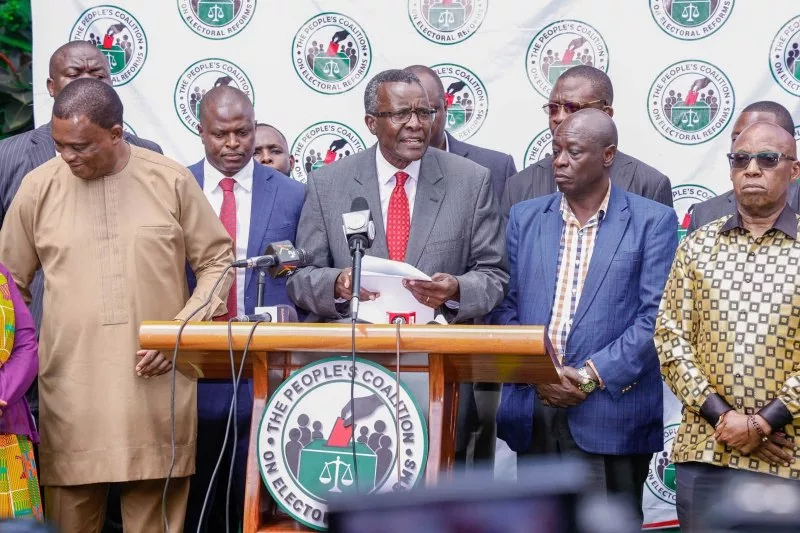
The united opposition has threatened to mobilise Kenyans for street demonstrations against the Independent Electoral and Boundaries Commission (IEBC) if it fails to address its demands for electoral reforms.
The team, led by DCP leader Rigathi Gachagua, threatened to take its grievances directly to the commission's offices from January. It accused the IEBC of failing to address concerns over the credibility and transparency of the 2027 General Election.
The former Deputy President gave IEBC until December to have its concerns addressed, warning that failure to do so would prompt countrywide demonstrations.
“We are asking IEBC to listen to us this month if possible. If not, next month in January we will mobilise Kenyans to talk to IEBC directly because I think they will understand that language,” Gachagua said.
“Let IEBC listen to leaders, if they are not ready then let them listen to Kenyans.”
He was speaking after a consultative meeting held under the People’s Coalition on Electoral Reforms umbrella, which brings together opposition leaders.
Those present included David Maraga (UGM), Martha Karua (LPP), Fred Matiang’i (Jubilee), Ndindi Nyoro (PPL), Jimmy Wanjigi (Safina) and Justin Muturi (DP).
Gachagua also dismissed recent threats by President William Ruto against planned demonstrations targeting the electoral agency, saying Kenyans had the right to ‘talk to IEBC’.
“You cannot stop Kenyans from talking to IEBC. Kenyans will talk to IEBC and nothing he (Ruto) can do,” he said.
President Ruto had warned political leaders against threatening the commission or mobilising demonstrations ahead of the 2027 General Election.
Some of the opposition's demands include an independent audit of the voters' register to eliminate duplicate and deceased voters, reforms to election technology, mandatory electronic transmission and livestreaming of results, and a framework guaranteeing the declaration of presidential results at constituency level.
Gachagua questioned the commission's preparedness for the August 2027 elections, warning that unresolved concerns could undermine public confidence in the electoral process.
The united opposition has also snubbed a meeting scheduled for Wednesday with the IEBC, accusing the agency of failing to demonstrate its commitment to their demands.
The team insisted that far-reaching electoral reforms must be implemented before the country heads into the 2027 General Election.
It described the reforms as minimum and non-negotiable conditions for an electoral process that is free, fair, transparent and credible.
“We are unwilling to participate in a charade. The meeting called this afternoon is organised by the State Department of Interior with briefcase parties to sanitise what IEBC is doing,” Gachagua said early on Wednesday.
According to United Green Movement Party leader David Maraga, the IEBC had invited them to a meeting on Wednesday as part of ongoing consultations with election stakeholders.
“We are not going to be rubber stamps for IEBC, we can see clearly that IEBC has been captured,” Maraga said.
In its list of demands, the opposition has called for mandatory electronic transmission and livestreaming of election results, arguing that the measures would enhance transparency and seal loopholes that could facilitate manipulation.
The team is also demanding strict enforcement of constitutional provisions requiring presidential election results to be declared at polling stations and collated at constituency level. It insists that results announced at polling stations must remain final.
“Decentralised Results Transmission System (RTS) and online public portal with read-only media APIs to the media, candidates, agents and election observers to enable electronic transmission and livestreaming of results forms and voter-turnout,” Maraga said.
“Our new Section 39 and related regulations deliver a non-partisan solution that is good for the country. It is disturbing that in Isiolo South, West Kabras, Muminji, and Evuroe by-elections, 27.3 per cent of polling stations failed to publicly post results forms, which is a crucial accountability mechanism as guided by the Maina Kiai decision.”
On the voters' register, the opposition wants a clean, verified and independently audited database to eliminate irregularities and ensure all eligible voters are properly captured ahead of the elections.
The team has also demanded transparency in the recruitment and deployment of electoral officials, particularly Returning Officers, through a competitive and merit-based process to restore public confidence in the commission.
“The recruitment of personnel including Returning Officers and even CEO is being done in opaque manner. In fact RO should come from the 290 constituencies not that most of them are coming from one area,” Maraga demanded.
The opposition also raised concerns over election technology, calling for an open, modular and escrowed system subject to independent verification and clear accountability mechanisms.
The demand comes against the backdrop of reported failures of Kenya Integrated Election Management System (KIEMS) kits in approximately 30 per cent of polling stations during recent by-elections. This has raised questions about the preparedness and reliability of the technology ahead of the high-stakes 2027 elections.
The opposition argues that the failures underscore the urgency of addressing technological weaknesses before the next General Election rather than waiting until polling day.
"These, alongside other proposed amendments to the electoral laws and regulations, constitute our mandatory and non-negotiable demands for a free, fair, transparent and credible election in 2027," the team said.
Leave a Reply