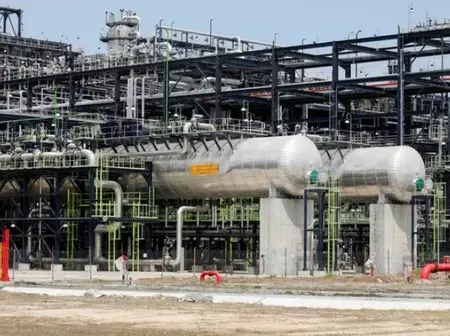
Kenya’s decision to establish a major oil refinery in Lamu presents South Sudan with an opportunity that its leaders cannot afford to overlook. For a country whose economy depends heavily on petroleum exports, this development could provide an alternative export route, strengthen regional cooperation and create employment opportunities for future generations.
On September 30, President William Ruto and Nigerian billionaire Aliko Dangote officially launched construction of the Dangote East Africa Petroleum Refinery in Lamu county. The facility is expected to process about 700,000 barrels of crude oil daily, positioning Kenya as a major petroleum-processing hub in Africa.
However, an important question arises: Where will such enormous quantities of crude oil come from?
Although Kenya possesses oil deposits in Turkana, its domestic production remains underdeveloped. A refinery of this magnitude will require substantial and reliable crude oil supplies from regional and international producers. South Sudan should therefore position itself as a strategic supplier.
According to South Sudan’s Ministry of Petroleum, the country currently produces about 175,000 barrels daily, with plans to increase production to at least 200,000 barrels by 2027. Before its civil war, production reached about 350,000 to 400,000 barrels daily, demonstrating the country’s historical petroleum potential.
South Sudan’s current production represents about 25 per cent of Lamu refinery’s planned daily processing capacity. Although not all this oil would necessarily be available for Kenya, the figures demonstrate the potential significance of a future supply partnership.
Presently, South Sudan exports its crude oil through pipelines crossing neighbouring Sudan to Port Sudan on the Red Sea. Unfortunately, the ongoing conflict in Sudan has repeatedly exposed this arrangement to insecurity, infrastructure damage and interruptions.
Whenever oil exports are disrupted, South Sudan experiences severe economic consequences, including declining government revenue, currency instability and difficulties financing essential public services.
This dependence on a single export corridor is economically dangerous.
I believe President Salva Kiir’s administration should initiate negotiations with Kenya to explore a long-term petroleum supply agreement and alternative transportation infrastructure through the Lamu Port-South Sudan-Ethiopia Transport Corridor.
Such cooperation would not necessarily mean abandoning existing arrangements with Sudan. Instead, it would diversify South Sudan’s export options, reduce economic vulnerability and strengthen regional energy security.
Kenya would benefit from additional crude oil supplies, while South Sudan could gain access to alternative markets and potentially more reliable export infrastructure.
However, the benefits should extend beyond petroleum revenues.
The Kenyan government projects that the refinery and associated industries could generate up to 60,000 direct and indirect employment opportunities. Through bilateral cooperation and existing East African Community frameworks, both governments should explore opportunities for qualified South Sudanese professionals, engineers, technicians and young graduates to participate in employment and industrial training.
Regional integration should not remain confined to diplomatic speeches. It must translate into meaningful opportunities for ordinary East Africans.
Nevertheless, constructing a pipeline would require substantial investment, environmental assessments, security guarantees and commercially viable agreements. Both governments must also protect affected communities and ensure transparent management of petroleum revenues.
As a fourth-year South Sudanese student pursuing mass media and communication at Mount Kenya University, I believe young East Africans deserve a region where neighbouring countries transform shared resources into collective prosperity.
South Sudan possesses valuable petroleum resources, while Kenya is investing in industrial infrastructure capable of supporting regional economic transformation.
Our leaders should recognise this opportunity and begin serious discussions before regional supply arrangements are finalised.
The future of East Africa should not be defined by borders separating our resources, but by partnerships transforming those resources into prosperity for our people.
Fourth-year Bachelor of Mass Media and Communication student at Mount Kenya University
Leave a Reply